It is a laborious madness and an impoverishing one, the madness of composing vast books… The better way to go about it is to pretend that those books already exist.
Jorge Luis Borges
With culture now reduced to combinatorics—the systematic rearrangement of pre-existing elements, so as to exhaust all possible shapes—there ought to be no surprises left. No surprise that recent authors should mimic a peculiar 1979 bestseller. No surprise that their chosen model operates on a similar principle of rearranging old elements. No surprise that literary and scientific works should take up that old slogan: reduce, reuse, recycle.
Yet I cannot help being a bit surprised by all these copycats of GODEL, ESCHER, BACH.
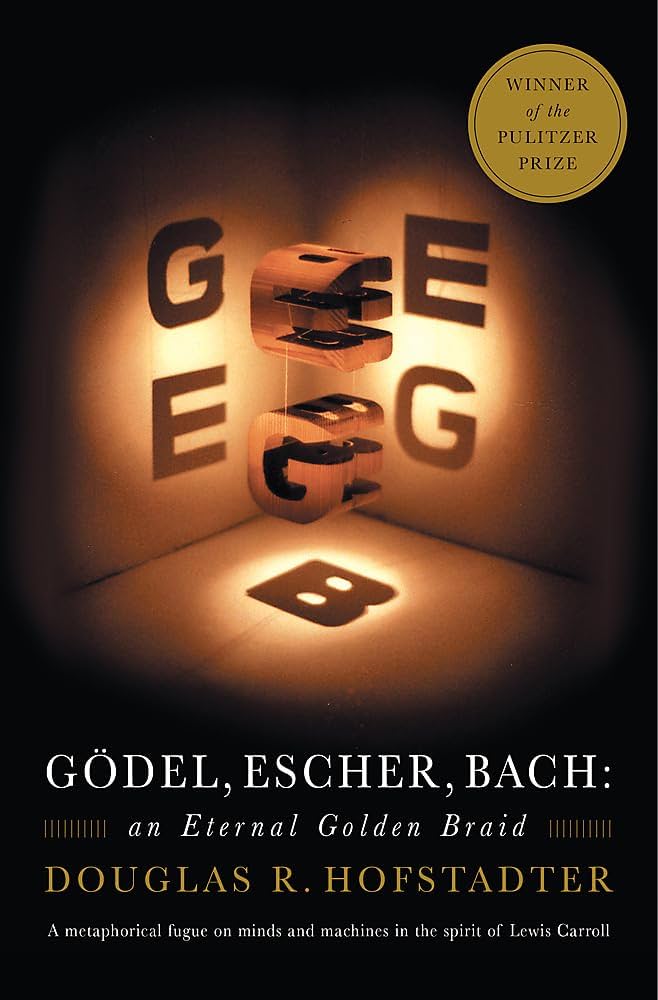
Douglas Hofstadter’s Pulitzer Prize winner, innovative in its day, has now been hollowed out and reappropriated for use as a mold. To cast a new work, simply select (1) a renowned mathematician; (2) an artist overtly inspired by mathematics, and (3) an artist bearing no more than a loose relationship to mathematics. Then, weave back and forth between the three figures, combining exegesis and biography, drawing strained analogies, until the dizzied reader begins to believe (accurately or not) the text is a fresh work of synthesis rather than one of stale juxtaposition.
None of this is to indict Hofstadter’s formal ingenuity. (Indeed, at least one of these authors seems not to have read the book he purports to imitate.) It is only that originality recruits mimics, who may mimic every trait of the original except, by definition, its originality.
Now, let us survey this blighted landscape.
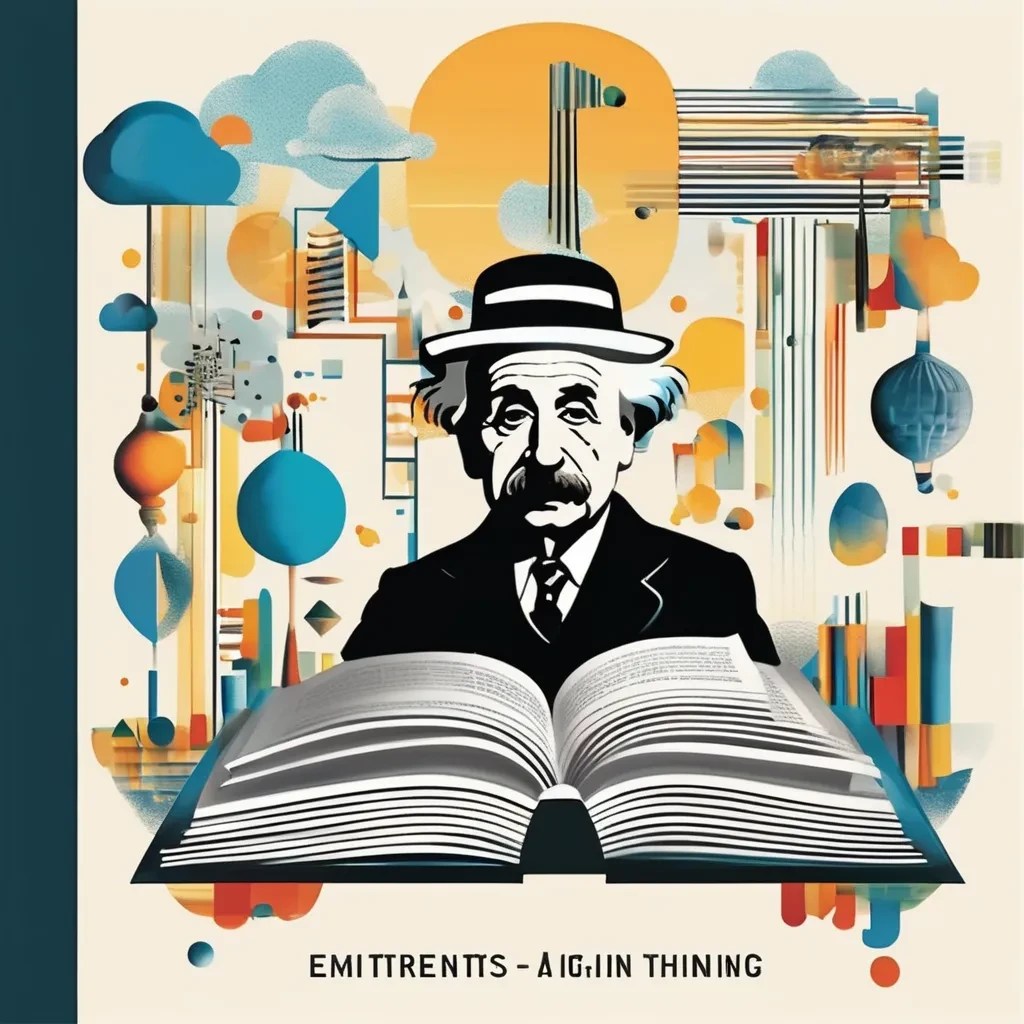
Ben Orlin’s EINSTEIN, BORGES, MAGRITTE: Experiments in Thinking (Running Press, $30) is the newest and most desperate of these imitations.
Orlin spells out his plaintive thesis on the opening page: “All three—scientist, writer, and painter—practiced the art of the thought experiment. Einstein’s imagination was a well-cut lens, bringing the world into sharper focus. Borges’s was a kaleidoscope, throwing up mirrored alternatives. Magritte’s was a reflecting pool, a watery, dreamlike surface. But for each, thought experiments served the same purpose: to marshal the messy realm of matter into the simple structures of the mind.”
Sadly overmatched, the writer approaches Einstein in the manner of a dog (sloppy affection and dim comprehension), Magritte in the manner of a foreign tourist (cheerful, spectacular ignorance), and Borges in the manner of a fearful worshipper. Sadly, it is Borges who thwarts Orlin’s celebration of pure, detached thought by systematically refusing to indulge in it. His stories are fueled not by unbridled imagination, but by dogged years of study.
Some of Orlin’s misconstruals feel almost willful. He treats Pierre Menard as a tale about “text separated from context, like a chemical precipitating out of a solution.” It is a story about the impossibility of such a precipitation.
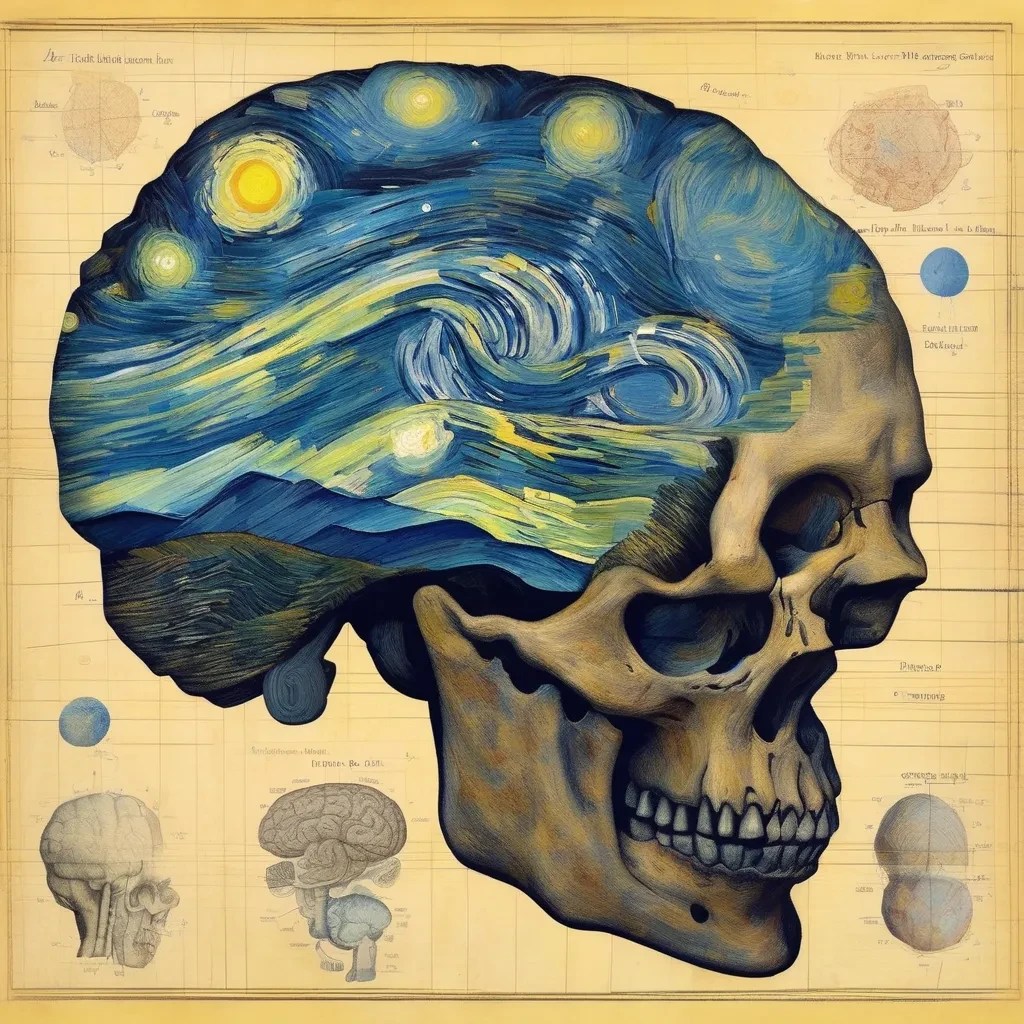
Lovelier and more ludicrous is the posthumous David Foster Wallace essay, newly published as a thin standalone volume, DICKINSON, CANTOR, VAN GOGH: Brains, Skies, and Their Relative Widths (Back Bay Books, $19.95).
In Wallace’s sketch, the trio lived a single life, recapitulated across the 19th century. A shy and tortured visionary, teetering on the edge of one madness or another, glimpses that impossible dream: infinity. Then, in a private project of tremendous consequence, s/he wrangles the infinite into art. Old formalisms splinter. New ones emerge in a breathless, divine hurry. The results transform us: we living today cannot conceive of the infinite except through the windows they built us, smudged with their fingerprints and gleaming with their genius.
One wishes that Wallace left a polished manuscript, rather than this cursory and schematic draft. Then again, had he investigated further, he might have discovered the cracks in his thesis, which rests on a selective reading of Van Gogh (who, in Wallace’s telling, painted Starry Night and little else) and an anachronistic one of Cantor (who has somehow disclosed to Wallace his intimate thoughts on mathematics developed long after his death).
Where the essay succeeds is on the strength of its images: the clods of paint piled in Van Gogh’s sky, Dickinson’s dashes like lightning against the thunder of her thoughts, Cantor’s infinite vistas bracketed by the curtains of his calligraphy.
Wallace’s admiration for his three protagonists is, if not infinite, then at least infectious.

Unusual in this valedictory genre is the icy, levelheaded cynicism of ERDOS, ASIMOV, DALI: Geniuses Before Their Time (University of Chicago Press, $35). First-time author Michael Pershan finds in each man the same contemptuous figure: a self-promoting “futurist” and a prolific creator, not only of “content,” but of a commodified “personal brand.” He markets himself through a “social network” of friends and admirers, casting his output (surrealism, science fiction, mathematical conjecture) as the work of a genius peering into the future, and papering over his abusive and problematic relationships in the present.
In short, these are men of Substack/Twitter/#MeToo, decades before Substack/Twitter/#MeToo, whom we can blame (as scapegoats if nothing else) for the malaise induced in us by Substack/Twitter/#MeToo.
The argument is bracing, pointed, and wholly unnecessary. Why these men? Pershan scoffs at Foundation, shrugs at The Persistence of Memory, and grudgingly tips his cap to Erdos while questioning the whole enterprise of pure mathematical research. One wonders why an author would devote such attention to three dead braggarts of such limited usefulness.
The ray of light comes when Pershan acknowledges that these men lived up to their boasts. For all their flaws, and through all their flaws, they presaged the future, precisely as they promised.
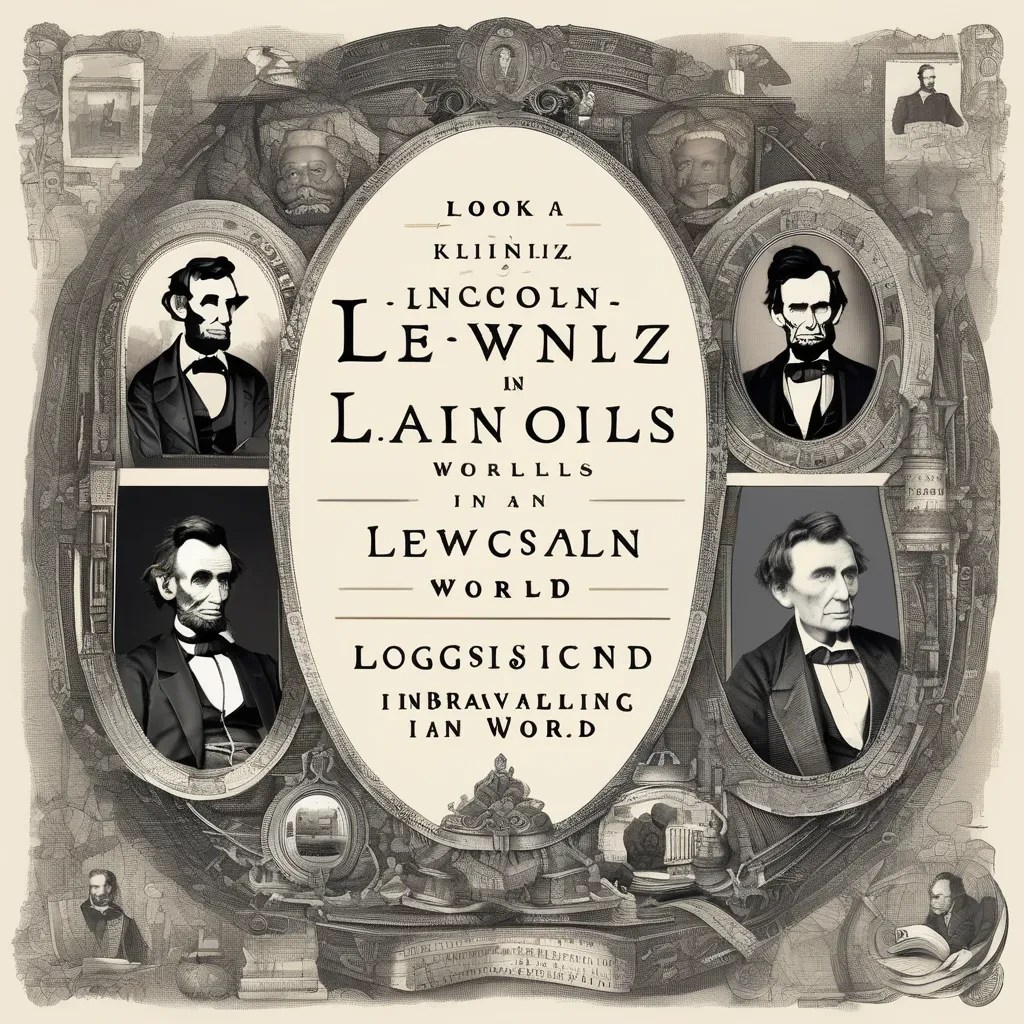
Finally, the worthiest successor to Hofstadter is Jordan Ellenberg’s yearning LINCOLN, LEIBNIZ, AND LEWIS CARROLL: Logicians in Worlds Unraveling (Penguin Press, $27.95).
As usual, the three biographies move in parallel. Each man practiced a love of mathematics and a gift for logical invention. Each man cherished the ironclad certainties of the ancients: Euclid, Thales, Pythagoras. Yet each glimpsed the shifting sands of modernity—competing world-models, negotiable axioms, formal systems empty of meaning.
In short, each saw a fog of perpetual uncertainty, and into that fog, he brought forth a paradoxical masterwork of logic.
Leibniz, living in the 17th century, envisioned the 20th in uncanny detail. Dodgson, donning the pseudonym Carroll, contrived the most absurd and definitive fantasy of English literature. And Lincoln, custodian of a crumbling nation, rebuilt its foundations on the fly, altering its written Constitution and recasting a rhetorical flourish from an enslaver (“that all men are created equal”) as a national axiom (for “a nation dedicated to the proposition”).
Each of the three was a tragic figure, who even as he rebuilt a new logic, longed for the certainty he had irretrievably lost.
Ellenberg deftly harmonizes three tones. He writes of Leibniz with courtesy and praise, as a mathematician speaks of a senior colleague. He writes of Carroll with clinical detachment, as a writer speaks of a formidable yet overrated rival whom he wishes neither to offend nor to flatter. (One wonders if Carroll’s inclusion came at an editor’s insistence.)
And he writes of Lincoln with fierce admiration, as a man writes of a boyhood hero. In Ellenberg’s tale, Lincoln is a figure of myth, singlehandedly hefting the stones of a ruined castle and rearranging them to make a new castle, a kind of civic mathematics in which we all still reside.
***
Retracing the compass-marks these men (always men) have left in the literature, I am almost tempted to venture an angle trisection of my own. I could call the book HOFSTADTER, ELLENBERG, WALLACE: Thought as Combinatorics. My three protagonists—failed novelist turned mathematician, failed mathematician turned novelist, and science writer who split the difference—all wrote works of inventive mathematical juxtaposition.
But the project defeats itself. To establish the lineage, I’d need Borges, too (for Llull, Pascal, the infinite library). Also, having assembled a triptych of triptychs, a recombination of recombinations, I would be compelled to invoke Mandelbrot’s fractals. At that point, with so many names crowding my title, the discrete would blur into the continuous, the sharp and distinct influences smearing into a dull and novel shade of gray. Having too many antecedents sometimes feels like having none at all.
 Math with Bad Drawings
Is this TRUE? Or supposed to be horrifyingly satiric? I read all of Hofstadter’s book the summer (44 years ago) when I was on maternity leave for my first child. I wrote him a fan letter and got a response!
I have been a proud member of the Lewis Carroll Society of North America since I was in COLLEGE (I joined because Martin Gardner was in it).
Please tell me that these depressingly titled books are a joke.
It’s a play on some of Jorge Luis Borges’s short stories that are about books. E.g. https://en.wikipedia.org/wiki/An_Examination_of_the_Work_of_Herbert_Quain . As the quote at the top, rather than write the actual book he’d write piece a about a fictional book.
🙂 torn between wanting to read them and being annoyed at them ripping off GEB.
Anyway, I’m starting on my manuscript now:
HOFSTADTER, ORLIN, SAM: Recurring, Recursive Recursion
Thanks. Very fun
I MUST have all four!! especially as I am just now finishing up “Moe, Larry, Curley: when the laughs stopped”…
STOOGES, BLIND MICE, AND THE BRANCHES OF GOVERNMENT: Why Pratfalls Come in Threes
Were these covers generated by AI? Felt like I was having a stroke reading the text on them…
Oh yes. I suspect Ellenberg would be wise enough to veto a cover consisting of four variously misshapen Lincolns.
You had me actually scouring every source I cood looking for Ellenberg’s book.
This whole topic reminds me of “A Perfect Vacuum” by Stanislaw Lem, also reviews of imaginary books.
Ha ha, sorry about that!
I enjoyed Lem’s “One Human Minute,” which is very much in the same Borgesian vein. Will have to check out “A Perfect Vacuum” too.