Since 2019, I have lived in Minnesota’s “twin” cities.
(Well, I live in one of them. Silly to have a house in both.)
Twinhood is a special relationship, for cities as much as for people. Sure, we may tease each other, grow rivalrous, or jockey for statewide supremacy by falsifying the results of the 1890 census. But in the end, our bond is strong.
So what, exactly, earns Minneapolis and St. Paul the title of “Twin Cities”? Well, obviously twinhood is about more than numbers, but in mathematical terms:
- They’re big (each more than 300,000 people).
- They’re close together (the downtowns are only 7 miles apart).
- They’re similar in population (Minneapolis is about 38% larger).
The result is a special kind of balance. Each city is big enough to dominate a metropolitan area—yet neither is big enough to dominate the other.
Still, I can’t resist a blasphemous thought. Are we really the twins? Or merely a pair of twins? To qualify as twins, let’s say that two cities must meet these three criteria (slightly relaxed versions of the Minnesota relationship):
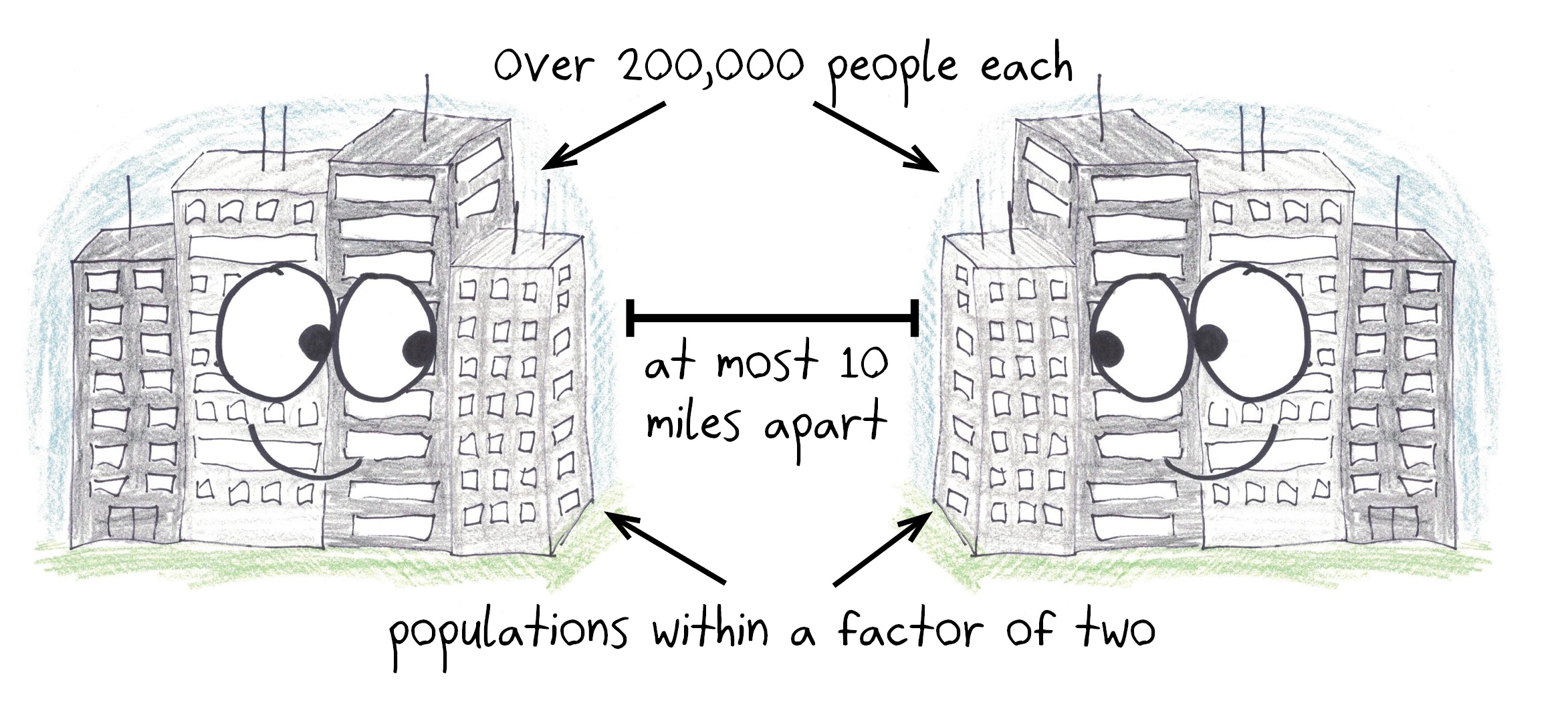
Now, here comes the puzzle. It’s a two-part challenge:
- Find a complete list of all pairs of U.S. cities that meet this definition (at most 10 miles apart, with at least 200,000 people each, and populations within a factor of two).
- From this list of twin cities, make a cogent and persuasive case for which pair deserves to be called THE twin cities.
I will hand-choose a winner (or randomly choose, if there are a bunch of good entries) and send them a free copy of my book Math with Bad Drawings, with a personalized signature.
Oh, wait, more fitting: I’ll hand-choose two winners. (They need not be twins.)
EDIT 12/20/2023: Thanks for the entries, everyone! I’ll announce winners in the new year.
(NOTE: Answers to #1 will differ slightly depending on what data sets you use. Answers to #2 may differ dramatically depending on your personal criteria.)
 Math with Bad Drawings
Great Article
What about those of us who already have Math With Bad Drawings?
Ha, good question! I’ve got a few copies of my Games book around if you’d prefer that.
And actually I have a spare copy of James Thurber’s classic children’s book “Many Moons.” Not signed by Thurber, but still beautifully written!
Aurora and Denver (where I am currently)
Bellevue and Seattle
Dallas and Fort Worth
Are you going to announce the winners?
St.Orlin, a city constructed on 2345 being a town of mathematicians, and St.Ortin, a parallel universe version of St.Orlin.
This is an interesting challenge! Makes me think about how cities, like Pokemon in a Pokerogue Dex, have unique attributes. Using data science to find “twin” cities reminds me of building the perfect Pokerogue team – balancing size, proximity, and similarities to achieve a special synergy. Almost like optimizing a strategy within Pokerogue for the ultimate win.
The fascinating concept of twin cities extends beyond geography; it’s about shared culture, rivalry, and a unique bond. Reading about Minneapolis and St. Paul being labeled true twins reminded me of the time I faced a dilemma choosing between two similar job offers — both had pros and cons, but I had to commit to one. Much like the Twin Cities, each option had its own unique appeal. Monkey Mart often highlights such intriguing comparisons in everyday life.
Exploring patterns between cities reveals surprising connections that often go unnoticed. The idea of twin cities extends beyond geography into culture, economy, and data trends. Once, while analyzing urban data sets for a project, I struggled to identify meaningful correlations until I discovered clustering techniques that unveiled hidden links. This reminds me of an Omegle conversation where diverse perspectives helped refine my approach to data interpretation.
That’s a fun breakdown of the Twin Cities! I’ve always loved the friendly rivalry between Minneapolis and St. Paul. Speaking of quick comparisons, sometimes I feel like I need to test my reflexes against others to see where I stand. There are some surprisingly addictive online tests that can do just that! If you’re curious about your click speed, there are some tools out there, and it’s a fun way to kill a few minutes. Cps Test