SURGEON GENERAL’S WARNING: BEWARE THESE PUZZLES. SIDE EFFECTS CAN INCLUDE LOST AFTERNOONS, HAIR PULLED OUT IN CLUMPS, AND EXCLAMATIONS OF “OHHHHHHH, THAT’S HOW YOU DO IT” SO LOUD THEY CAN DAMAGE WINDOWS.
I came across Catriona Shearer‘s math puzzles on Twitter a few months ago. I was immediately drawn in: they’re so tactile, so handcrafted, so ripe for solving. Each of her gorgeously tricksy problems can swallow an hour in a single bite.
She agreed to let me brainfish you folks by sharing 20 of her favorites. She even indulged my curiosity and admiration with an interview (see the bottom of the post).
Enjoy. And don’t say the Surgeon General didn’t warn you.
1.
The Garden of Clocks
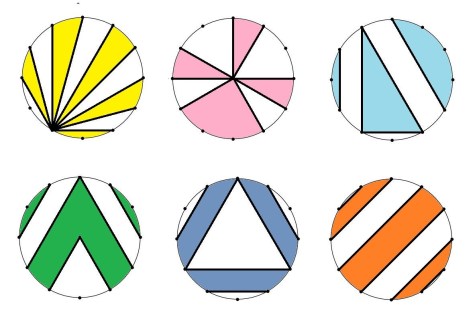
“Unfortunately, my favourite one of the six is the only one I didn’t come up with myself,” says Catriona, “the dark blue one.”
2.
The Toppled Square

(This one feels like an instant classic to me.)
3.
It’s a Trap
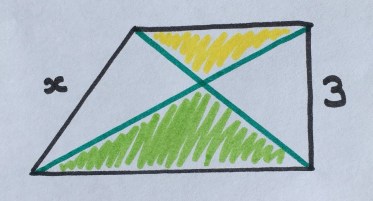
“A ‘second attempt’ puzzle that was nicer than the first one I came up with.”
4.
Three Square Meals
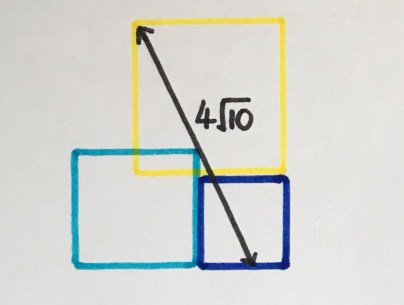
“I quite like this one – I drew lots of pretty patterns based on it.”
5.
Shear Beauty
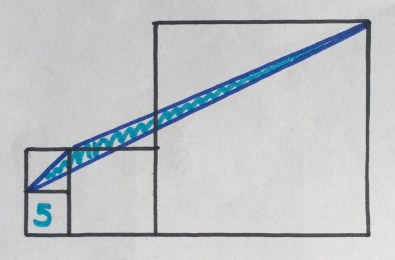
“Probably my all-time favourite. It just looks impossible! Apparently the solution method used here is called shearing (unfortunately, not in my honour).”
6.
All Men are Created Equilateral

“Another corollary that I much prefer to the original.”
7.
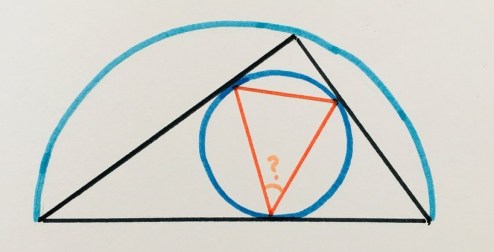
Semicircle Turducken
Power Chords
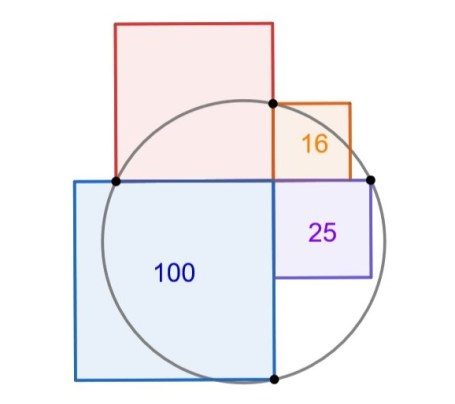
9.
Tale of Two Circles
“This was a corollary to a different puzzle, but I like it more than the original!”
Doc Oct
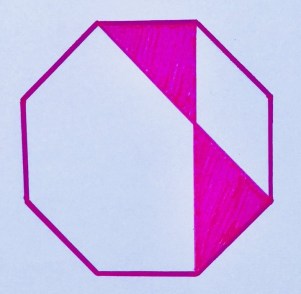
“I think this one’s quite neat, although it looks like a massive rip-off of Ed Southall’s puzzles.”
11.
All in the Square
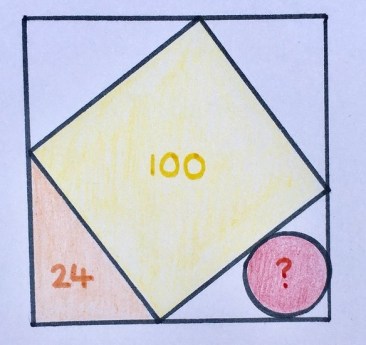
“I like the fact that although you can work out all the dimensions of the orange triangle from the information here (and I did when I solved it), you don’t actually need to – using the area and the hypotenuse is enough.”
12.
Spike in the Hive
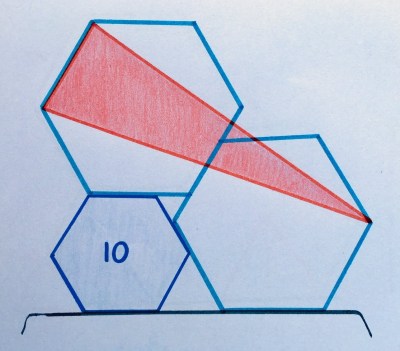
“This one’s quite neat – I like the fact that you don’t need to work out any of the actual side lengths, which are almost certainly horrible.”
13.
Isosceles I Saw
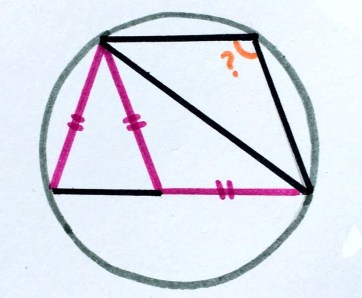
“I think the wording of this one is my favourite. Lots of people missed the important information and concluded there were infintely many solutions!
14.
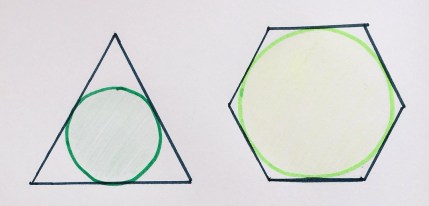
Green vs. Blue
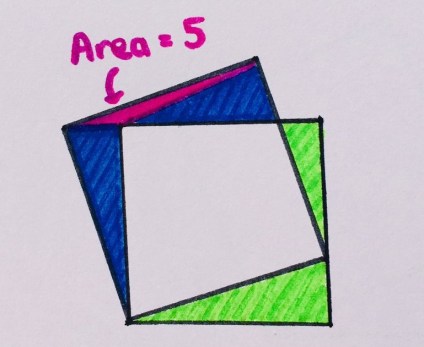
“Another one of my favourites.”
15.
Jewel Cutters
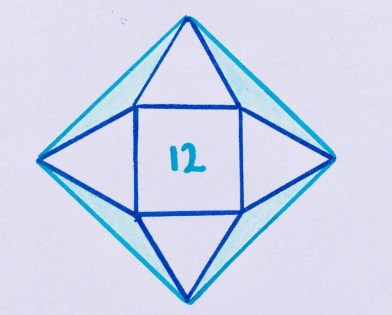
“The best thing about this one: the really nice dissection solutions that were posted.”
16.
Going, Going, ‘gon
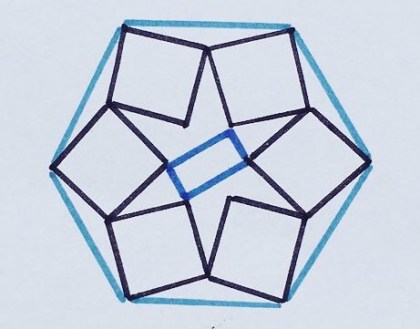
“This one isn’t so neat, but the answer really surprised me. I think because it’s harder it didn’t get so much traction on twitter!
17.
Just One Fact
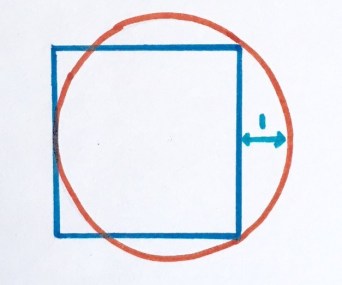
“This is one of my favourites, as it just doesn’t look like there’s enough information.”
18.
The Tumble Dryer
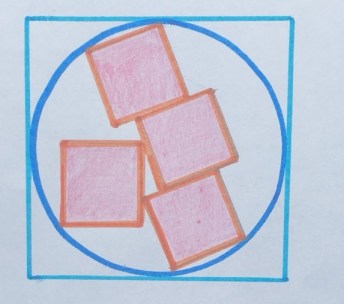
“I like the higgledy-piggledy squares here, like they’re rattling around in a tumble dryer. And the answer is surprisingly neat too.”
19.
Fly the Flags
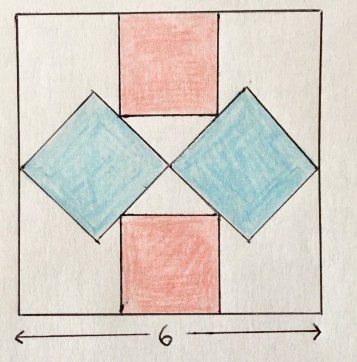
“This one’s quite simple, once you see it – but I didn’t straight away so the simplicity of the answer surprised me.”
20.
The Tiger-gon
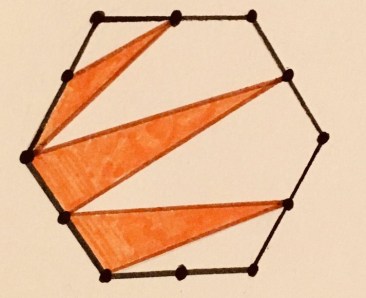
“This one I nearly didn’t post. But the picture reminded me of Tony the Tiger.”
BONUS:
Sunset Over Square City
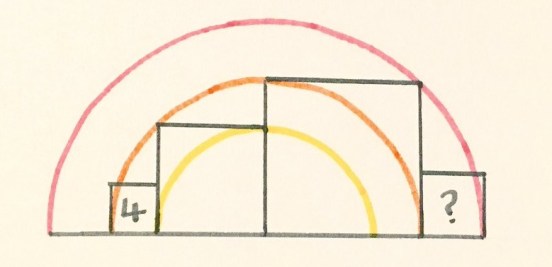
“I like this one because it reminds me of a sunrise over a city of squares.”
In case you’ve made it this far down the post – in which case, it’s probably 6 months after you started, and your desk is surrounded by crumpled papers and empty Chinese food containers – then here are some questions I had for Catriona.
How did you get into designing these puzzles?
I went on holiday to the Scottish Highlands, but forgot to take a coat with me, so I ended up spending more time inside than my friends did! I kept doodling along the lines of “I wonder if I could work out…”
I wasn’t expecting it to turn into a hobby, but it gets a bit addictive – especially when people reply with their solutions, which I love. There’s almost always a neat shortcut that I’ve missed.
What’s your creative process like?
It just starts with doodling. I’ll end up with a whole page of overlapping squares at different angles, or regular(ish) pentagons with different parts shaded in, and then see if there’s any nice Maths hiding there – relationships between lengths or areas or angles.
Lots of your images are marker on paper. Why the low-tech approach?
I did try using Desmos and Geogebra, but I’m not very good. I found it way quicker to draw an inscribed circle by getting my compass out and doing a bit of trial and error than by constructing it nicely in geometry software.
Also, with felt tips you can fudge things because the lines are so thick. It’s a nice compromise between it looking ‘right’ but also knowing you can’t just get your ruler out and measure it.
One of the nice things about geometry is it’s very forgiving – I can show you a hopeless picture of a square or a circle, but it’s enough to communicate the concept because they’re so well defined.
Several of your puzzles provide just enough information. How do you find that boundary, where a diagram is just barely determined?
Sometimes giving the bare minimum is actually a giveaway, because it only leaves one avenue. My preference is for giving slightly too much information, so there are a couple of decoy routes. This also means I get to see more variety when people reply with their solutions!
I’ve posted a couple of puzzles that were impossible – luckily someone usually points it out quite quickly!
I’ve also posted puzzles that I’ve massively over-specified, because I didn’t see a nice shortcut that would only use half the information.
Advice for would-be puzzle makers?
Ok, my imposter syndrome has fully kicked in here. I’m definitely still a novice – I’ve only been doing this since August! On the other hand, I’ve discovered I enjoy making puzzles and reading solutions even more than I like solving them myself.
A puzzle’s primary purpose should be amusement – that’s what marks it out from a standard Maths problem. So you need at least two of:
- A neat set up. Perhaps just enough information, so that the reader is wondering how on earth this is possible. Or several tantalising pieces of information that each feel like they offer a way in. Regular polygons and circles are a fantastic two-birds-one-stone here, because they disguise a wealth of information, without the specifically useful bits being marked on the diagram.
- A neat method. A trick, or a shortcut, or an insight that simplifies the whole thing. This might not be the most obvious method – I can think of lots of puzzles I’ve solved with lines of algebra, or surds, or horrible expressions with pi, only for it all to cancel out at the end and I realise there must have been an easier way.
- A neat answer. It’s a bit unsatisfying to work through a puzzle to get to a messy answer.
Basically, get drawing – find a puzzle you enjoyed solving and see what happens if you extend it, or change some elements of it. If you find a relationship that surprises you, chances are it will also surprise the rest of us, so put it out there. Twitter’s a great platform as people can post their own diagrams in reply.
Also, while you’re here: check out Math with Bad Drawings: The Book of All New and Wildly Enjoyable Stuff!
 Math with Bad Drawings
Very good article.
Anybody have some hints for #3?
Looks like there’s no certain answer.
x can reach any value over 3.
I do not agree with Alex’s statement. For each value of x > 3 there is only one way to draw the trapezium. For each of these you can compute the difference in area between green and yellow and you will see that in most cases it will not equal 6.
Nope, there is a definite answer. x can be found as the hypotenuse of a right triangle. How can you use the areas to find the leg you don’t already know?
The yellow triangle and the green triangle are similar triangles.
The height of each is proportional to their bases.
What you know about the relative areas is enough information to find the difference in the lengths of the bases.
hint: areas of white triangles are equal.
The side with length x is related to two other segments in a right triangle: a segment of length 3 and a segment whose length is the difference of the lengths of the parallel sides of the trapezium.
I think more than this might spoil the fun for you. Enjoy!
x = 5. Try and show that the difference between the parallel sides of the trapezoid = 4 units.
x = 5
For #2, are those areas or side lengths?
Good question – areas!
Are they all squares?
You can assume so, in order to solve the problem, so yes
Refer to the link to see the elegant solution to this problem.
Zakładając, że wszystkie figury są kwadratami, a liczby wewnątrz kwadratów to ich pola to szukane pole wynosi 135
I solved problem 3 in a somewhat unsatisfying way (giving names to relevant lengths, translating everything I knew from the geometry into algebraic relations between these quantities and then manipulating the algebra until I got what I wanted) but in the process I discovered something much more interesting:
If we shift the segment marked ‘x’ horizontally to the left or right without changing its length or inclination, then the green and yellow triangles change both their shape and their area, but the given ‘the green area is 6 more than the yellow area’ stays true!
Now if I could have seen that directly, it would drastically simplify the rest of the proof: I could just compute x in a hand picked nice example (e.g. the case where the intersection point of the diagonals has distance 1 to the top horizontal line and distance 2 to the bottom horizontal line, or the limit case where the trapezium has become a triangle and the yellow area is zero).
So my question is: IS there an easy way to see that the give ‘green area is six more than the yellow area’ is preserved under horizontal extension and shrinking?
Ok, after reading Question 5 I figured an answer to my own question about question 3 above (although I still would be interested in hearing other people’s thoughts). The key is shearing.
Call the corners of the trapezium A, B, C, D counter clockwise starting at the bottom left (A). Moreover, let D’ be the orthogonal projection of D on AB.
Now the difference between green and yellow is the same as the difference between the bigger bi-colored triangles ABC and DBC. By shearing, the latter triangle has the same are as D’BC, wich lies entirely inside ABC so that the difference between ABC and D’BC (and hence between green and yellow) equals the area of the slightly off-balanced triangle AD’C. By shearing again, AD’C has the same area as the right angled triangle AD’D.
In other words we know that the difference between green and yellow equals the area of the triangle AD’D, which stays unaffected if we lengthen or shorten segments D’B and CD. It follows that the difference between green and yellow stays unaffected as well, as predicted in the previous comment.
(On the other hand, once we know the area of AD’D we can simply compute x without bothering with the rest of the proof strategy of my previous comment, so there is that…)
Hi.From your comment I understood, that you calculate the area difference between green and yellow triangles while moving ‘x’ segment left or right, and found the difference in area stays constant.
However, what must stay constant, it is the area RATIO, and be equal to 6.
When moving ‘x’ segment left or right, without changing its length or inclination, area ratio of green and yellow triangles will change.
I’m pretty sure that ‘6 more’ means that the difference is 6; if the ratio were 6 she would have written ‘green area is six times the yellow area’ or similar. But on the other hand: exchanging difference for ratio in the puzzle (or the other way around) gives us two puzzles for the prize of one, so instead of arguing this further I will try and solve this new puzzle as well.
You’re right, I misunderstood the task.
In response to the question in your last paragraph, note that your observation of the invariance in the ratio of the areas of those triangles is equivalent to the fact that the triangles are always similar under your transformation, for the diagonals are still constrained by the parallel sides. Indeed, this remains true even if the lengths and orientation of the nonparallel sides are arbitrarily varied — although of course in this case the (arithmetic) ratio between the areas would now be different from 6, so you have the theorem that in a trapezium, the triangles on the parallel sides and determined by the diagonals are related to each other so that the difference between their areas is invariant under any transformation of the nonparallel sides that does not alter the altitude of the trapezium. The same result follows if we alter the altitude instead but do so in a linear fashion.
I don’t think I can solve even one of these without looking up solutions. Man these are amazing
Where are the Solutions?
Refer to ‘Mew Maths channel on YouTube to find out elegant solution to this problem.
The #2 puzzle caught my attention. Surely, there is a nice trick somewhere, I’d thought. I eventually had to follow the routine — Pythagoras and all that. Came out with a nice little integer (being 135) as the area of the toppled square. This seems to confirm my original suspicion that there is a cooler, less humdrum way.
Did someone do it differently?
that’s what I got, too!!! 135, for question number 2. I used pythagoras theorem. I assumed that the 12 and the 27 are aligned back to back so that there is no space (which there is between the 3-square and the 12-square). Then i summed up the widths of the 3 equally-shaped triangles. I didn’t have to do a lot of calculations at all, after I realized that sq(27)=3*sq(3) and sq(12)=2*sq(3)…
Easier if you notice that the right triangle between the righthand 27 box, the 12 box, and the ? box is twice as high as it is wide (base = sqr(27)-sqr(12) = sqr(3); height = sqr(12) = 2sqr(3)). Every related right triangle in the diagram is similar to this, and since the height of the 27-12-3 boxes is 6sqr(3), the related base must be 3sqr(3). The pythagorean theorem gives you the square of the side of the ? box serving as the hypoteneuse = 108+27=135; this is also the area of the ? square.
135. I assumed the left ? square was even with the left 12 square. Then, the height of the 3 stacked squares is equal to the distance from left 12 to bottom ? square corner. With that, you can get your small theta.
Refer to channel ‘Mew Maths’ on YouTube to see the elegant solution to this problem.
Elegant Solution to this question
Is there a key?
Dbsda vHN Dscx
I saw one of my friends trying it in the morning. It is night now. He is DONE with ALL 21 of them. No crampled paper, no chinese food container. It took him 5 pages of his copy and a single day. 😘
wow, can you please ask mail me the solutions
Cant figure a simple solution for number 19? Killing me. Can someone help or post solution? Thanks
please share the answers to all these i am preparing this for my comoetetive exams please help some one
Elegant Solution to Question Number 2.
For question #8, My Math geek friend got 51.25 pi. Anyone else arrived to this answer?