a.k.a. “Movement in Its Exact Truth”
a.k.a. “Math with Good Drawings”
When I lived in England, the little university museum across the road boasted a painting by Edgar Degas. It was nice: two horses cantering before a race, blue-green grass below, pink sky above… and, inexplicably, a pole blocking your view.
Not in the museum; the pole was in the painting itself.
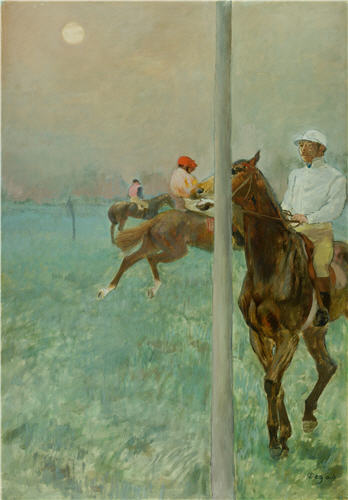
Oh, how I resented that pole: it was like Degas had opted to save a little cash by placing us in the discount obstructed-view seats. When the tour guide mentioned that the painting was the most valuable in the museum, worth perhaps fifty million pounds, I coughed in outrage.
Did no one else notice the pole?!
Two years later I returned, saw the painting again, and thought: It’s perfect. The pole gives a sense of motion, of a scene of unfolding—a snapshot feel achieved in an age before snapshots.
According to art historians, few painters have equaled Edgar Degas at capturing the little movements of everyday life. He drew the puffing cheeks of oboists, curls of smoke in bustling cafés, ballerinas stretching before the performance.
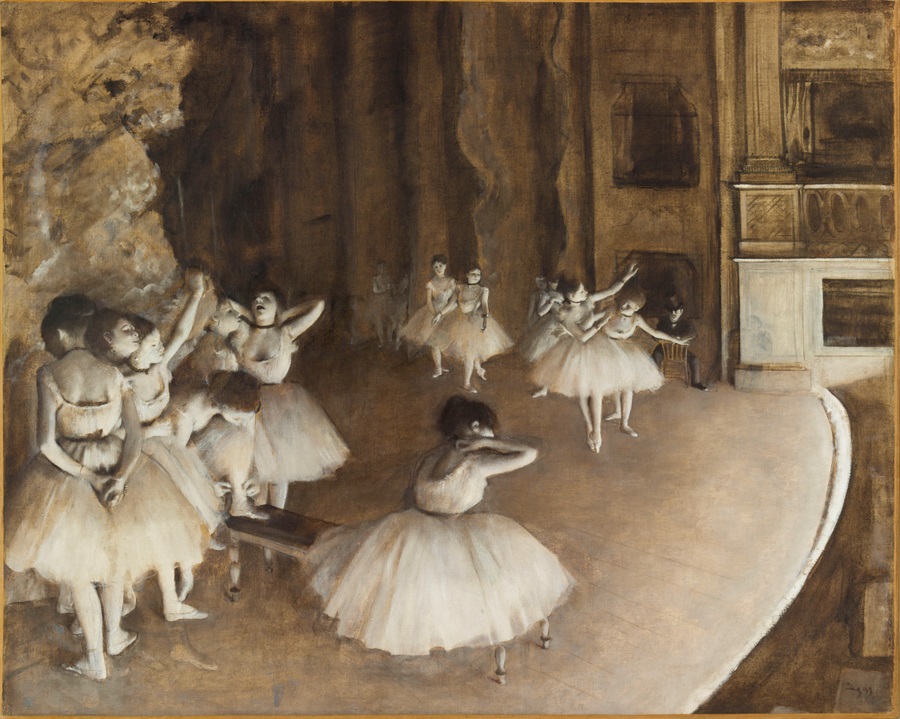
Still, if his subjects were spontaneous, his style was not:
No art could be less spontaneous than mine…. One has to do the same subject ten times, even a hundred times. In art, nothing should look like chance, not even movement.
Whatever the stereotype of painters, Degas was not the least bit dreamy or vague in his thinking. He brought to his art a focus and precision that we associate less with painting than with engineering. He obsessed over questions of technique—mixing his own fixatives, deploying tools in novel ways.
If his Impressionist comrades were like teenagers passing around a joint and gazing up at the clouds, Degas was the buzzkill insisting he’d better to get home to finish his geometry homework.
For Degas, exactitude and technique didn’t block the path to artistic truth. They led the way.
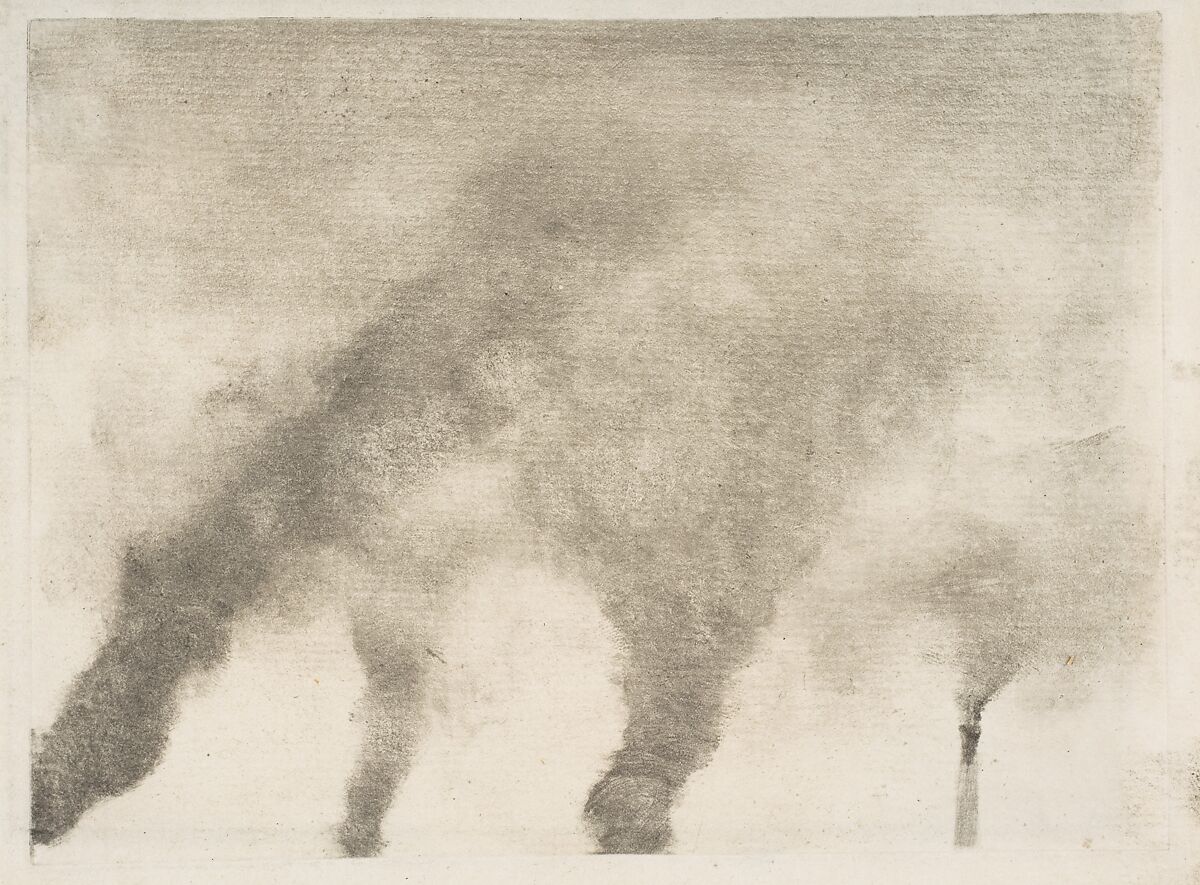
We all know divisive pot-stirrers who would pit mathematics against the arts, opposing the technical and the creative. Mathematics, they say, is unsentimental and flavorless. Art is free-flowing, intuitive, receptive to life’s dynamism.
Nonsense. The technical and the creative go hand in hand. I know it, you know it, and Edgar Degas sure as heck knew it.
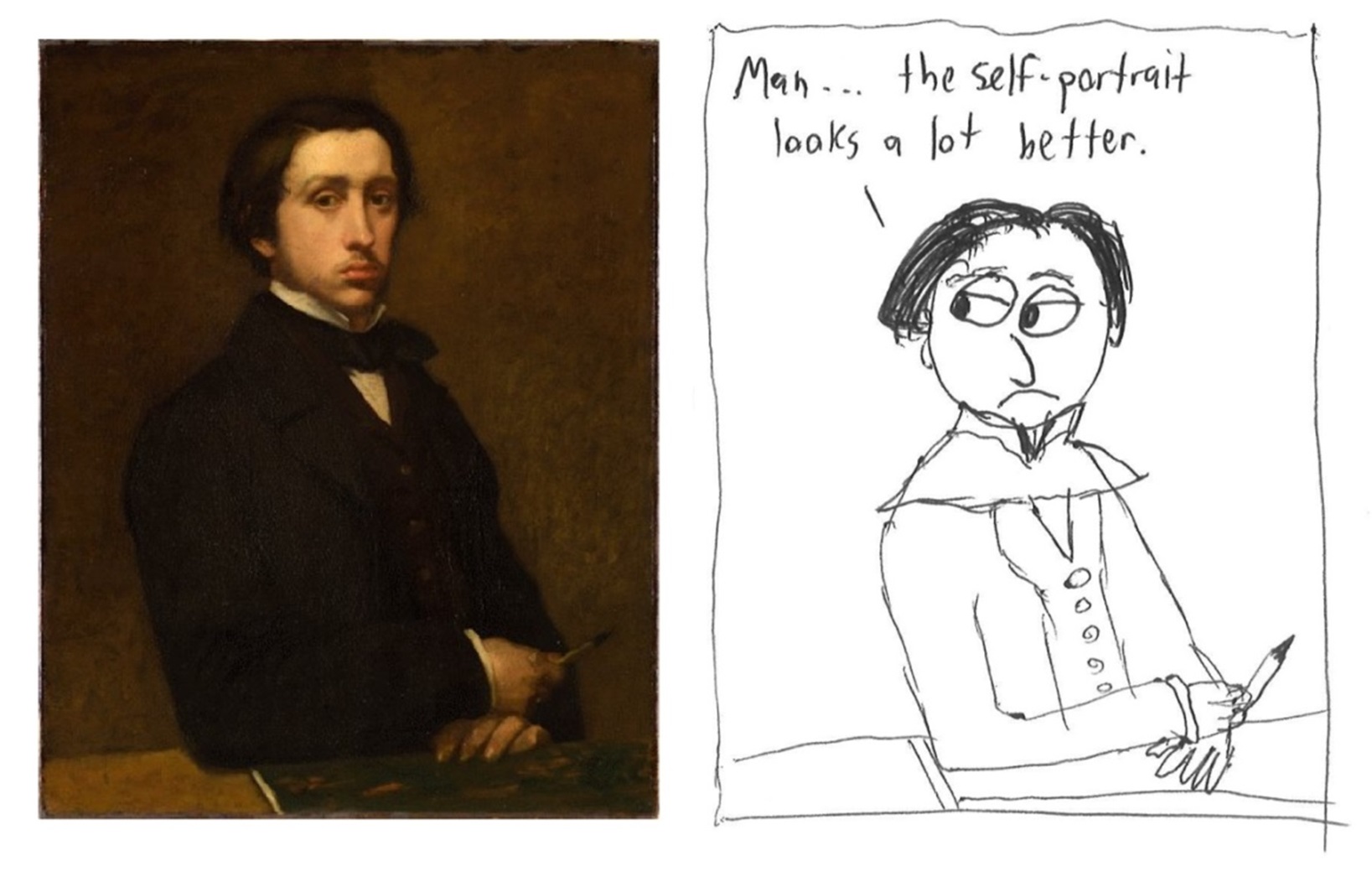
We want a full and flourishing language to describe motion, not just a crude pidgin. In that, every physicist follows in Degas’s footsteps. “What matters to me,” he wrote, “is to express nature in all of its aspects, movement in its exact truth.”
I find it unfortunate that “technical” carries connotations of “boring.” It brings to mind that dull, discouraging caricature of school mathematics: dimming the lights behind our eyes, becoming cold and reliable robots who execute predetermined steps.
Degas lived his own version of this. While his Impressionist buddies abandoned studio painting to improvise out in the fresh air, Degas himself spent years in the stuffy halls of the Louvre, copying more than 700 paintings. He scoured the works for anything he could employ for himself; he even filled notebook pages mimicking the styles of the old masters’ signatures. He described motion so beautifully not by fleeing technical challenges, but by honing his toolkit and his painterly idiom over long years of directed study.
“My pictures are the product of a number of calculations,” Degas once wrote, “and an infinite series of studies.”
For Degas, authenticity didn’t mean slavishness to reality. To paint a cloud, for example, he might study a bit of cotton instead. When he began experimenting with photography, he would command his subjects into posed positions. The key thing is to look natural, not be natural. One fellow painter said, “Degas is a master of creating compositions that do not look composed.”
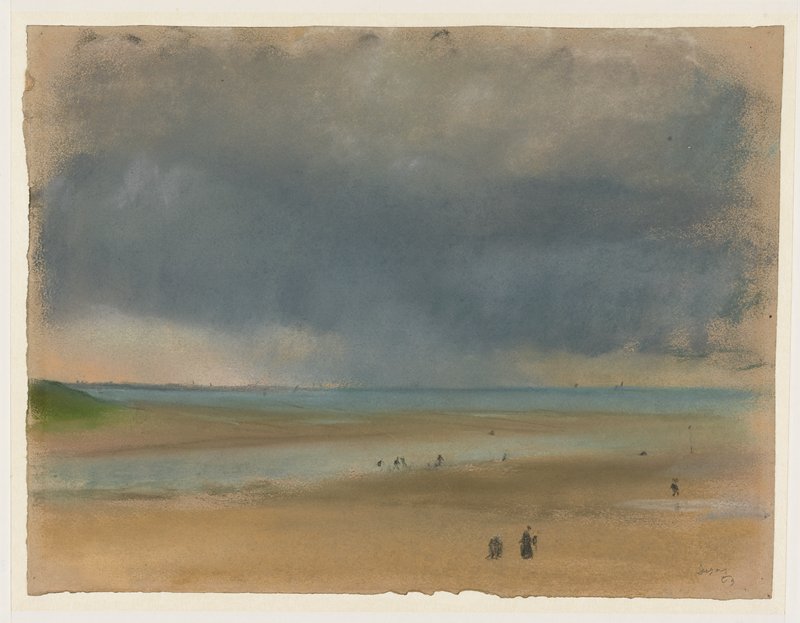
When he painted ballerinas, jockeys, or laundresses, he wasn’t aiming to expose any deep psychic truth about his subjects. “The dancer is merely a pretext for a picture,” he liked to say. Fundamentally, Degas was seeking manifestations of motion. His pictures are precise fictions, crafted to house broader truths.
“Art, for him,” a friend of Degas’s wrote, “was simply a series of problems in a more subtle kind of mathematics than the real one, a kind that no one has ever been able to expound, and whose existence is known to very few.”
Degas himself put it even more simply: “Drawing is a way of thinking.”
 Math with Bad Drawings
Wonderful!
All right now Ben, you’ve gone to far with this one. Much too far. You’ve stepped up to the plate and cracked one out of the park and now we’re never going to get the ball back.
Phew! That was an amazing piece of thoughtful writing about some amazing paintings by an amazing artist. I’m taking a course on composition at a local art colllege and I am absolutely gobsmacked by the pole and the horses. I’m bringing it in and have the class talk about it. Magic!
And by the way, your drawings are as charming and creative as can be. And mathematics IS a type of creativity we non-mathematicians can only imagine and admire, like we do these mysteriously perfect paintings. Cheers!
This one was different. You drawings are truly charming, expressive and thought provoking. I am a non mathematician and can only appreciate once again after I started reading your blog. Now I am hooked. I wish I had more patience to learn math as a youth. I have compensated nicely as my girlfriend is a math teacher and we both love this blog. I have to explain it the best I can and wish there were a spanish version to share. I appreciated the art lesson today, I love art but can’t draw and I love math but can’t math very well. Sorry, my point is I’m a big fan and am looking for ways to translate this but the cartoons do not translate. Anyway, thank you very much!
Love this Ben! I’ve been studying art and math for a long time, and am a huge fan of Degas and many others who, through their representations utilized concepts of perspective, illusion, and design to embrace a feeling of wonder and emotion in their art — just as math does with describing order out of numbers and concepts. Truly, math observed as an art form (and vice versa) makes more meaningful connections to life than most people realize! 🙂 Jeanne Lazzarini
Thanks all for the kind thoughts.
Sidebar: I farmed all these quotes from a stack of Degas books in the big central library in Birmingham, UK… and then failed to track my sources. Let this be a lesson to sloppy researchers like me: shape up, or you will have great quotes that you can’t reliably source!