I hope you are enjoying summer, and if you are not, please console yourself that your body is working as intended, and is able to accurately recognize the sweltering misery of humid air.
You wish to know what I have been up to. Good, thank you: I feel suitably watched and judged, and unable to pull a fast one on you.
So, a round-up of my digital activities:
1. Pi Day for Grinches
A happy belated Pi Approximation Day to those who celebrate (i.e., those for whom Pi Day is somehow insufficiently nerdy).
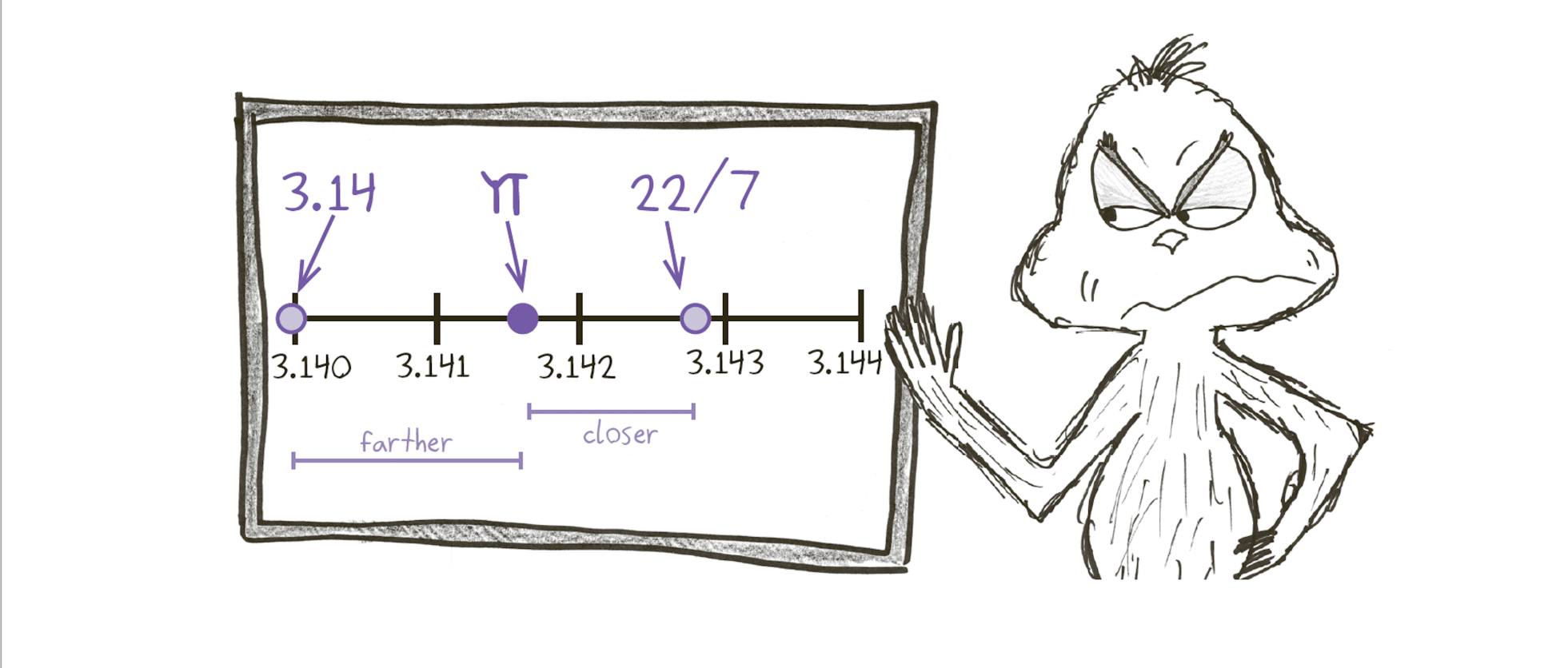
I touch on the case for 7/22 (or 22/7, as it’s known outside the U.S.) in my new book Math for English Majors. To mark this year’s holiday, Popular Science published the chapter in question, and Inverse‘s Elena Spivack generously took the time to interview me on the culture of pi.
The headlines hint otherwise, but the truth is that I wouldn’t trade our 3/14 Pi Day for anything. It remains the greatest math PR coup of my lifetime: a de facto international math appreciation holiday and a brand association with dessert pastries. What’s not to love? A little staged controversy is great (pi vs. tau, who will win???) but please, let’s not mess this up for ourselves.
Anyway, not too late to preorder a signed copy of the book!
2. A Wintry Interlude
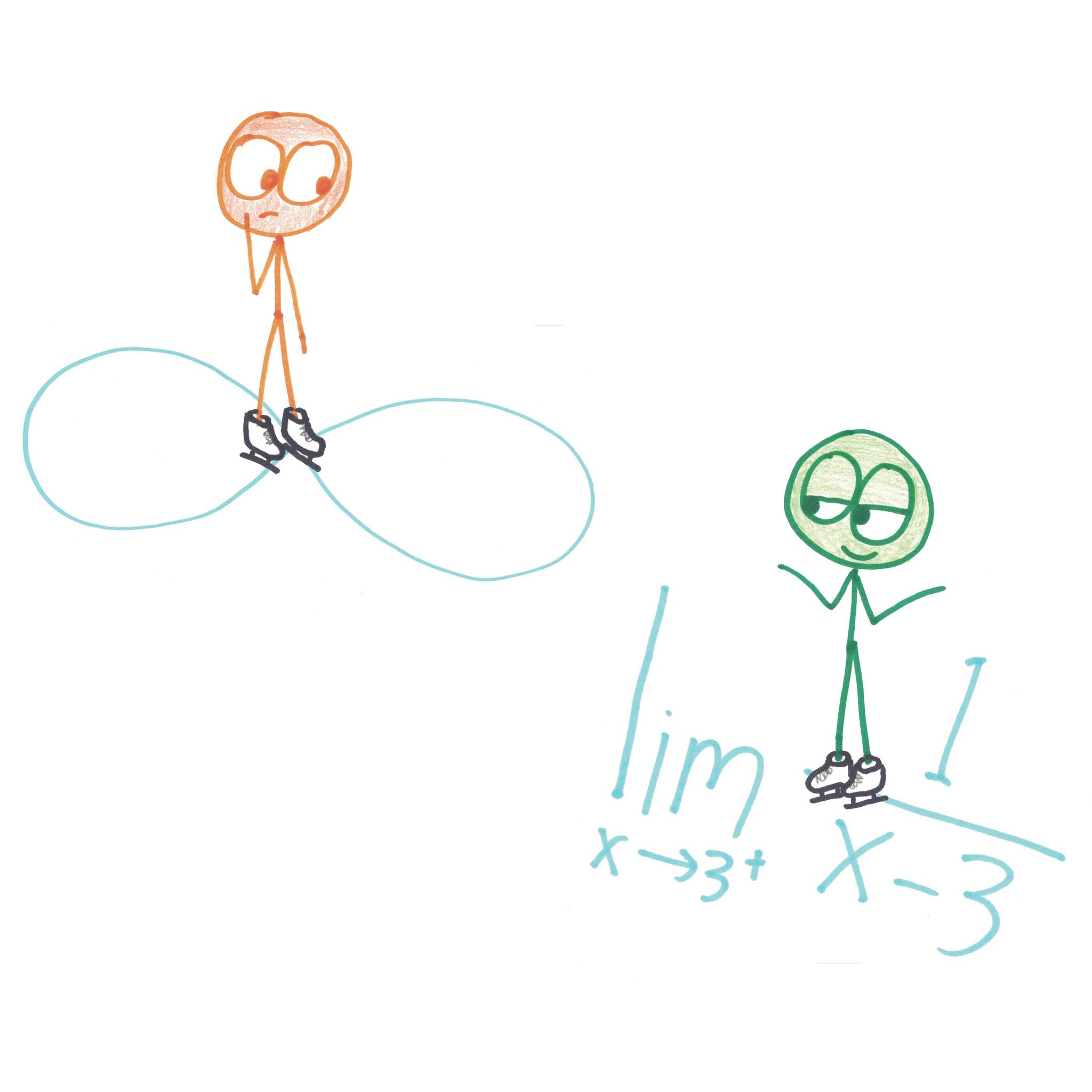
I’ve been sharing old cartoons on Facebook and Instagram, and I’m starting to sprinkle in a few new ones, like the totally-seasonally-appropriate gag above.
On Facebook, Steven Stowers asked if I’d chosen this particular limit for any special reason. Steven, my dear man, my actions never have reasons, and even when they do, they’re not particularly reasonable.
3. Negatively Polarized
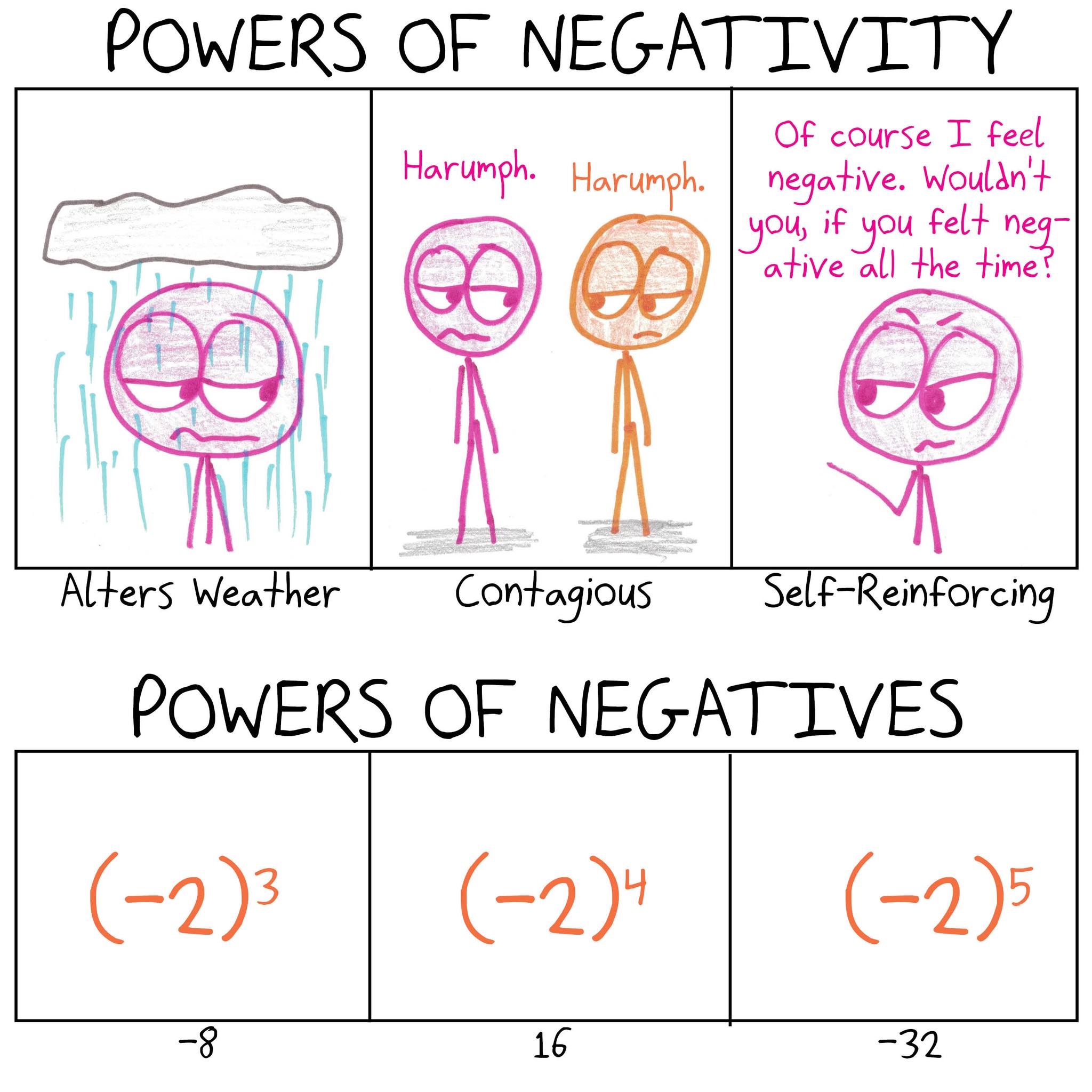
But more vexing than either of these powers, as someone pointed out on Facebook, are negative powers like 5-2, simply named yet subtly conceived. Math for English Majors deals with those, too, elaborating on thoughts that first appeared here on the blog.
4. The Logic (and Illogic) of Love
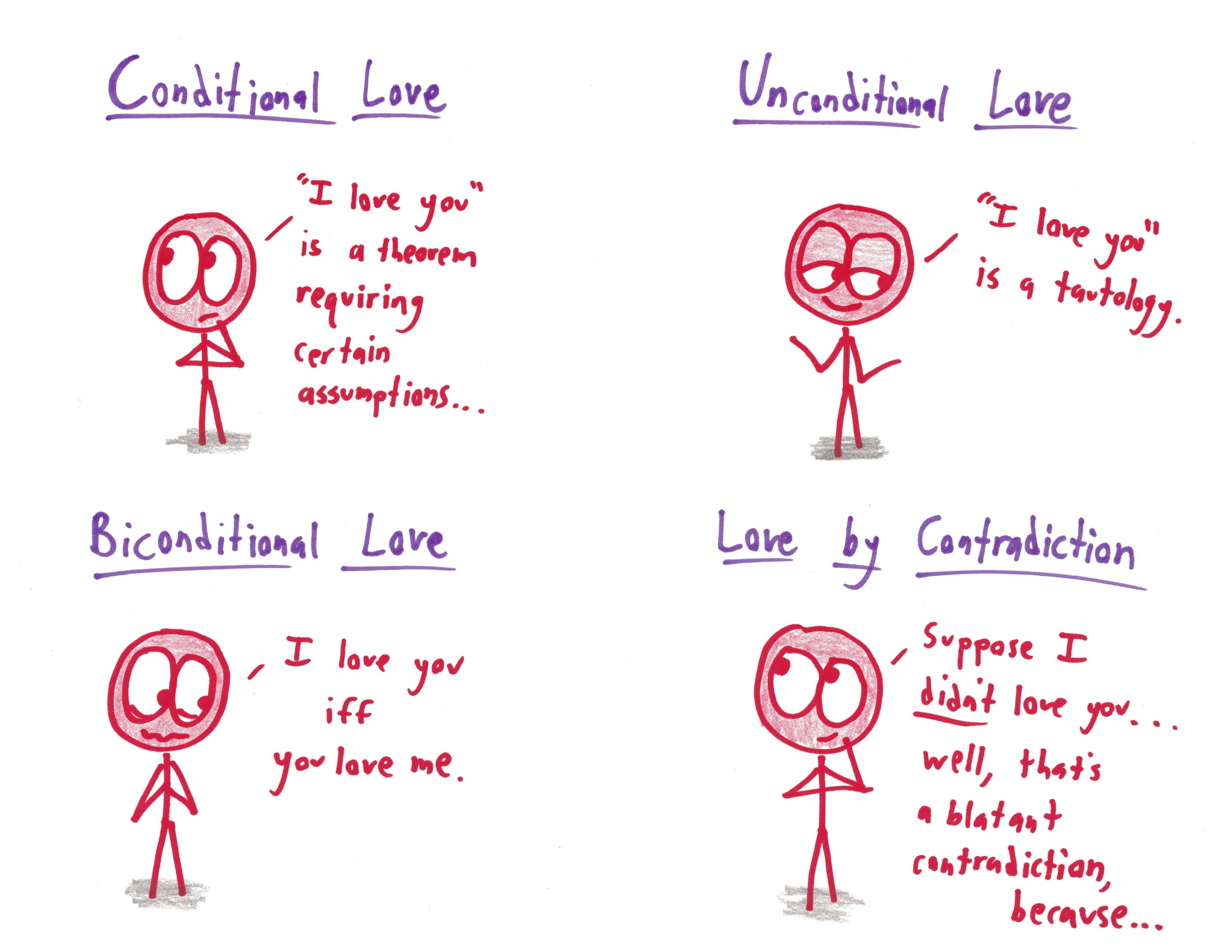
This one feels like it could be from one of my old Valentine’s posts, but as far as I know I hadn’t posted it anywhere until this month. Love deferred, yet fulfilled.
5. Recordings of Me Talking
Thanks to Dustin D. for hosting me on the Kook Jester Show. I especially appreciated his getting vulnerable about his own struggles in calculus.
Also, it’s been a couple years, but I never posted this fun conversation with Peter Rowlett and Katie Steckles about the most vital and complicated objects in mathematics: human fingers.
6. A Model of How to Compile Quotes
I love Andrew Krause’s page of quotes about mathematical modeling. Tired of hearing ad infinitum about George Box’s “all models are wrong but some are useful” (an idea that’s wrong, but useful)? Overfamiliar with Eugene Wigner’s “unreasonable effectiveness of math in the natural sciences” (a view of the natural sciences that’s been unreasonably effective in pure math). Want to go like seven levels deeper? Then Krause’s page is for you.
7. Smiling at Smullyan
I enjoyed working through Raymond Smullyan’s Alice in Puzzle-Land. The puzzles (in classic knights and knaves style) are fun. But I especially like the moments between puzzles when he does his best Carroll imitation:
“Well, Humpty Dumpty is one of the keenest arguers I know… he almost had me convinced that I had no valid reason to be sure that I was awake… It took me about three hours, but I finally convinced him that I must be awake, and so he conceded that I had won the argument. And then–.”
The King did not finish his sentence and stood lost in thought.
“And then what?” asked Alice.
“And then I woke up!” said the King, a bit sheepishly.
8. A Shocking Diagnosis
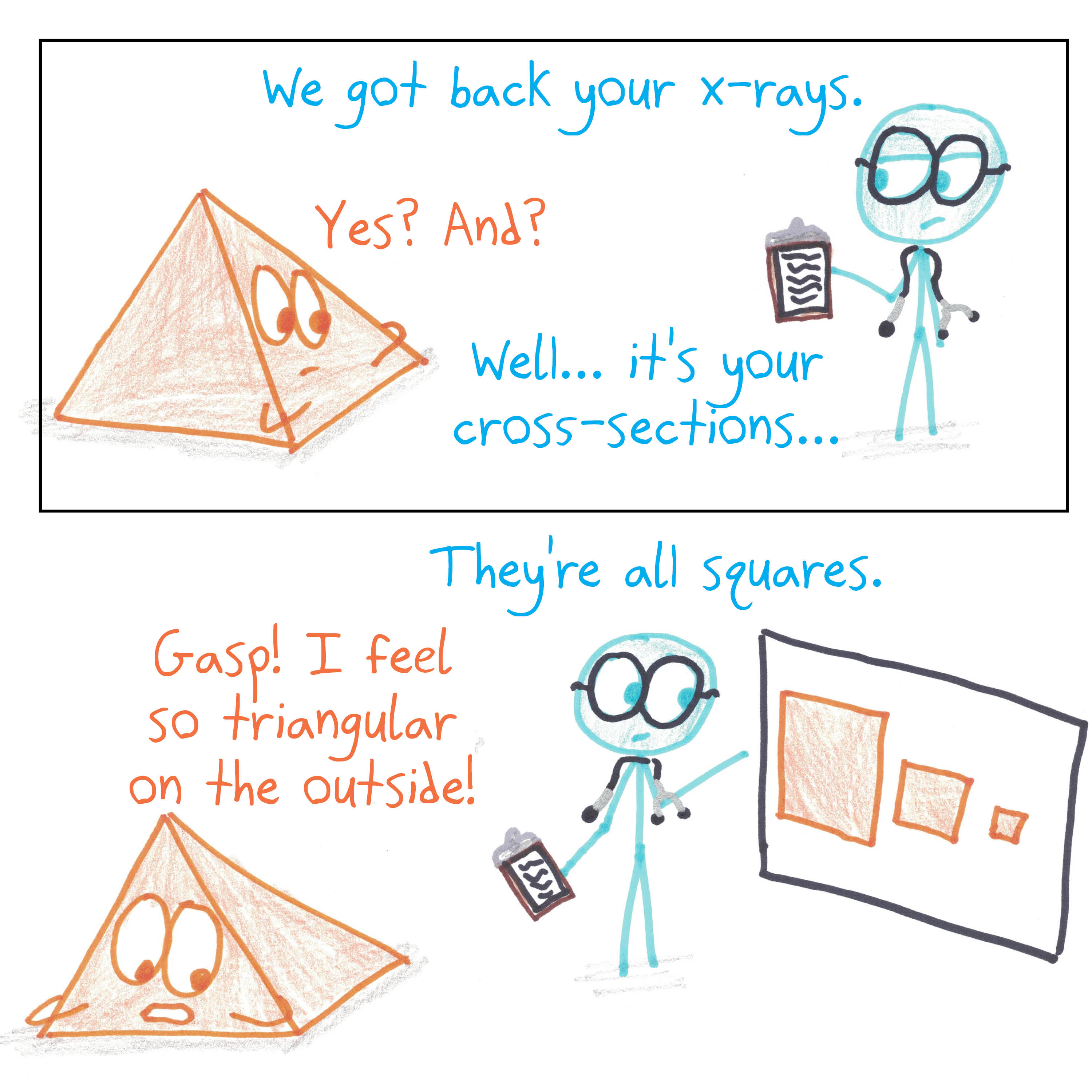
This one tickles me. Not sure why. I’m pretty sure none of my cross-sections are squares, but I do wonder what kinds of cross-sections you can get if you x-ray me from various angles…
9. Shout-out to Kayla, A Deeper Thinker Than I Am
I was honored that my book Math Games with Bad Drawings inspired a puzzle in Zach Wissner-Gross’s “Fiddler” (spiritual successor to 538’s “The Riddler”):
From 11-year-old (!) Kayla Schubmehl comes a question inspired by the book “Math Games with Bad Drawings,” by Ben Orlin:
Suppose you (player A) and a friend (player B) are playing a game in which you alternate rolling a die. So the order of play is AB|AB|AB, and so on. (The vertical bars here are just for organizational purposes, and do not signify anything special that happens.) The first player to roll a five wins the game. As it turns out, whoever goes first has a distinct advantage!
Kayla wondered about other ways you and your friend could take turns, ways that might result in a fairer game. For example, consider the “snake” method, in which the order is reversed after each time you both roll: AB|BA|AB|BA, and so on.
Assuming you are the first to roll, what is the probability you will win the game?
What a great puzzle! I wish I’d thought of it, and I’m honored that Kayla saw fit to convert my book into such a rich question, like a tree converting stale CO2 into delicious sugar.
I’ve been poking at Kayla’s bonus question, which asks about the probability of victory if you trade turns according to the Thue-Morse sequence. I’ve got a messy way of writing the computation, and a strong hunch (nay, a total conviction) of what it *should* converge to. But connecting those dots is another matter…
10. Dumb Joke, Clever Puzzle
I posted this nonsense old cartoon on Facebook:
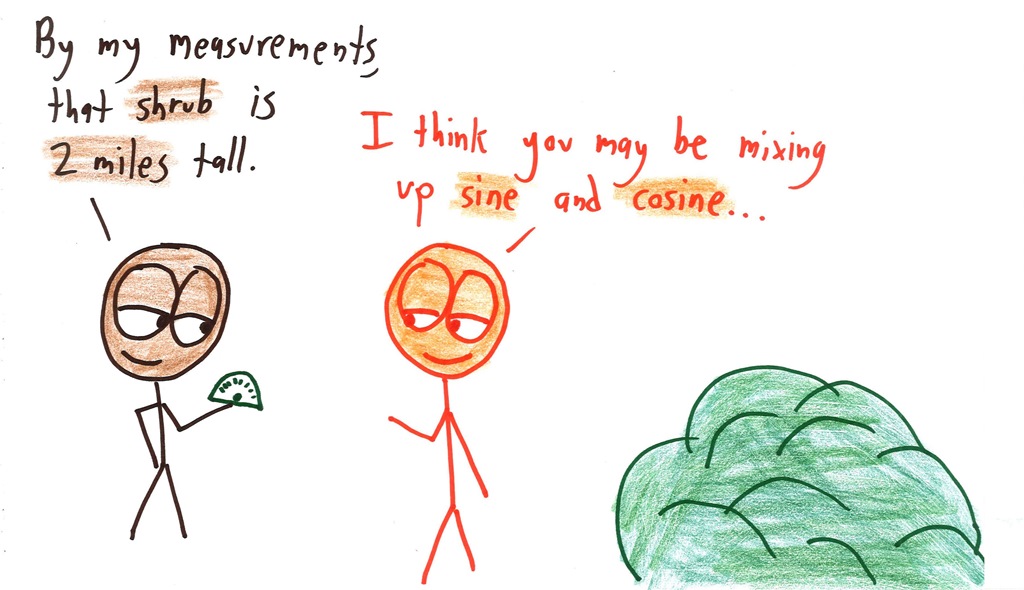
To which Casey Warmbrand replied with a lovely and elevating suggestion:
This would actually make a great task launch. Ask students to find (reasonable?) numbers that make this work. Sketch a diagram, model with a right triangle, and show the erroneous calculation that leads to the comic.
 Math with Bad Drawings
Enjoyed your Kook Jester Interview. I can relate to the concept of Mentorship. In college, there was very little mentorship. (I was in Mechanical Engineering, and none 0 !!! hod ever worked as an engineer. I wound up dropping out, and entirely by accident wound up working in Finance, and my boss was my mentor, and it was a Godsend !!! I used much of my math in Finance.
A word on Calculus, I didn’t get how differentiation, and integration were linked. I knew they were inverses of each other, but I didn’t understand how. I knew I was missing something but I couldn’t put my finger on it. By reading various books, including yours, I realized: Newton had a matched set of function and area, and that by taking the derivative of area, he got the original function back. By then reversing the differentiation process he could generate an area function.
Calc books often don’t show the sequence of Newton’s thinking, and so some of this is lost.
My family celebrate pi approximation day by eating foods which are almost pies (e.g. crumbles, tarts, quiches). We’re British, by the way, so I think you might call what we call crumble something different. We also celebrate pi day by eating pie, and tau day by eating even more pie.
I love how the post blends humor and math in such a clever way! The bad drawings make everything more relatable and fun, while still sneaking in some thoughtful insights. Always enjoy visiting this blog for a good laugh and some brain food @fall guys online