There are two kinds of people in this world, and no, I don’t mean “kind” and “nice.”
I mean “people who use the words ‘kind’ and ‘nice’ interchangeably” and “people who care passionately about the difference.”
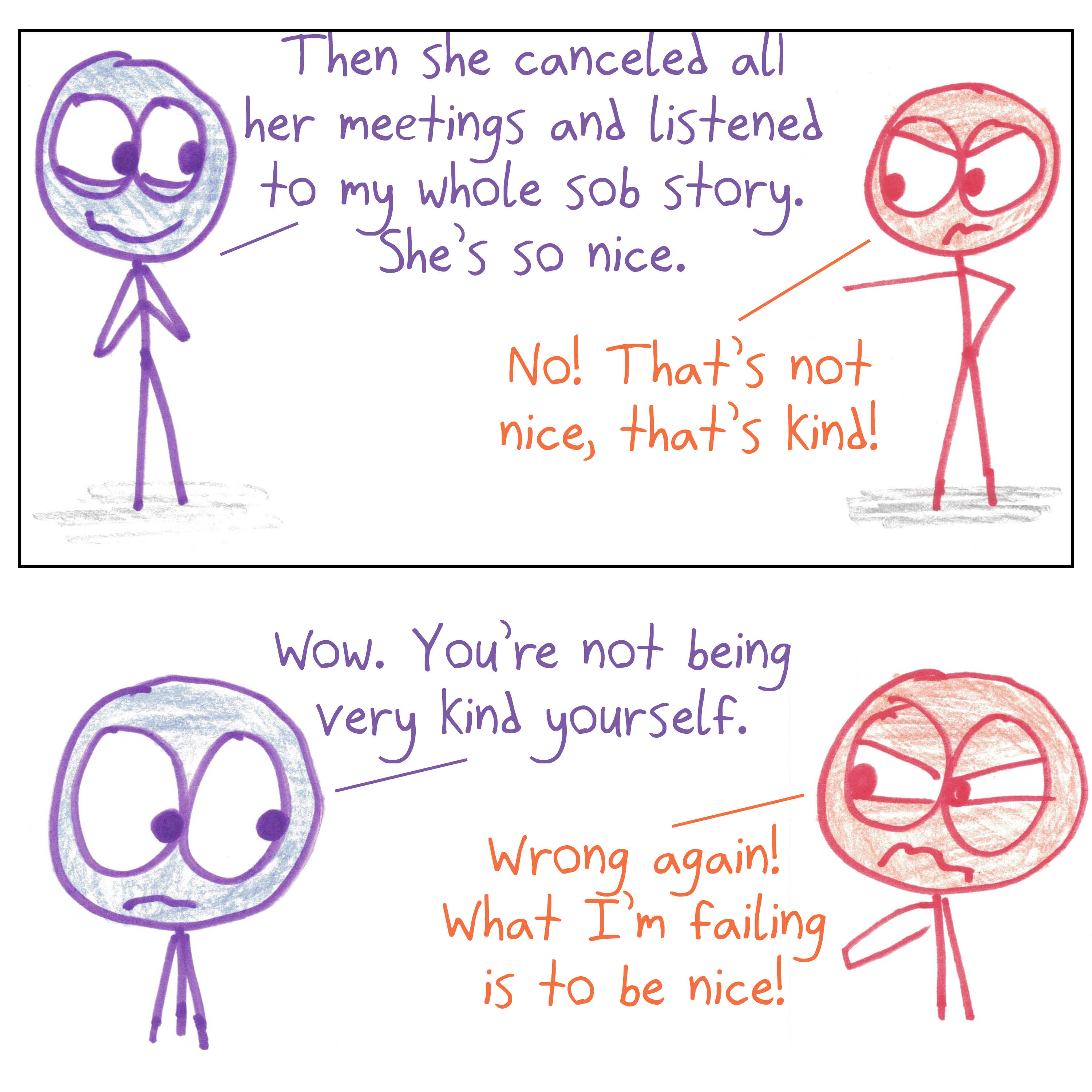
Those who draw the distinction all seem to agree: “kindness” is better. To be “kind” is to share deep and genuine connections, to help others, to sacrifice oneself. To be “nice” is to be superficial, artificial, cheap, and calculating.
I want to speak in partial defense of niceness. To me, “nice” and “kind” are two distinct virtues, each with its own purposes—and its own limitations.
Niceness tries to avoid bad feelings; kindness tries to heal them.
Niceness is about a pleasant interaction; kindness is about an enduring connection.
Niceness builds networks of loose pals and friendly acquaintances; kindness builds close bonds of friendship and support.
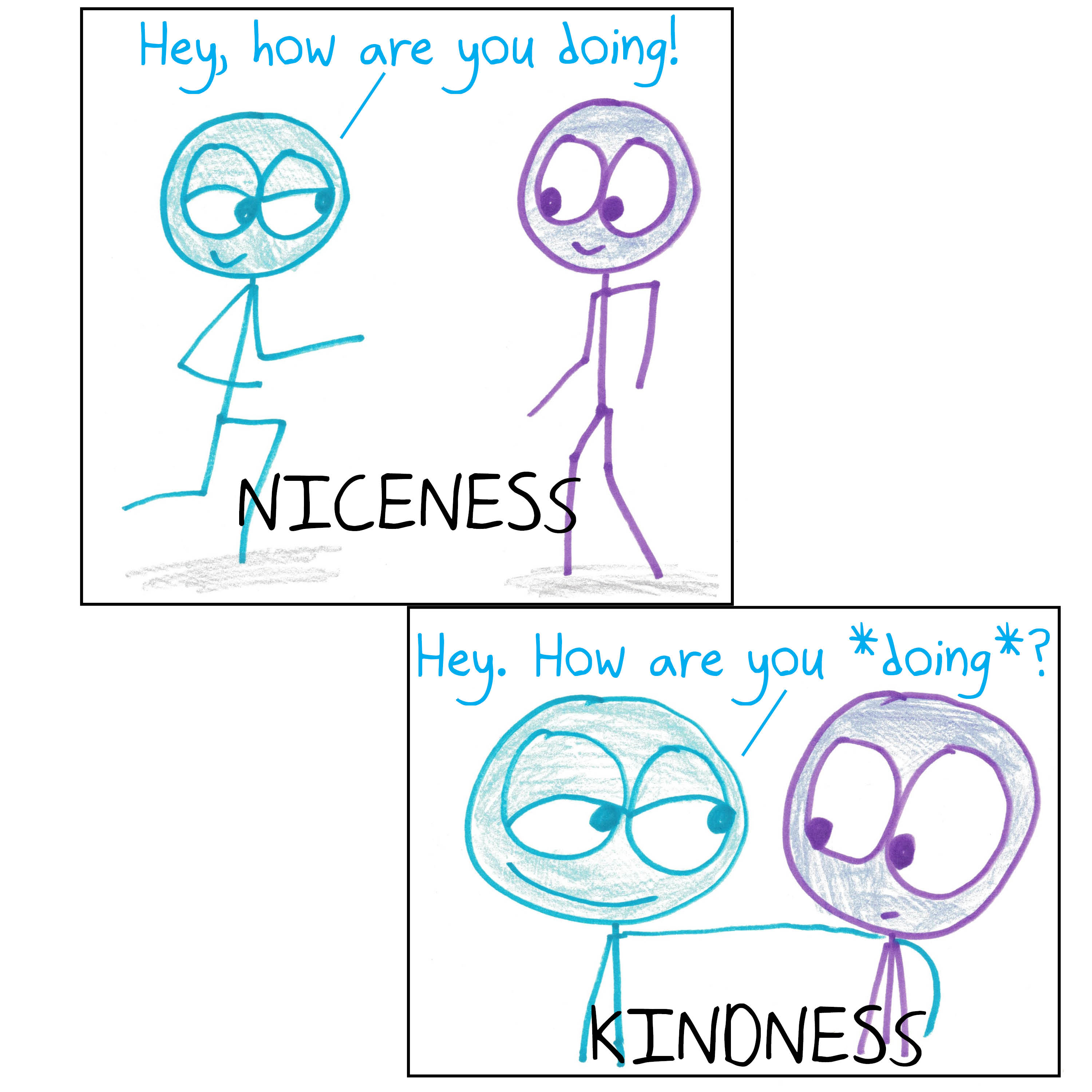
The intimacy of kindness is beautiful, but not always attainable—or even desirable.
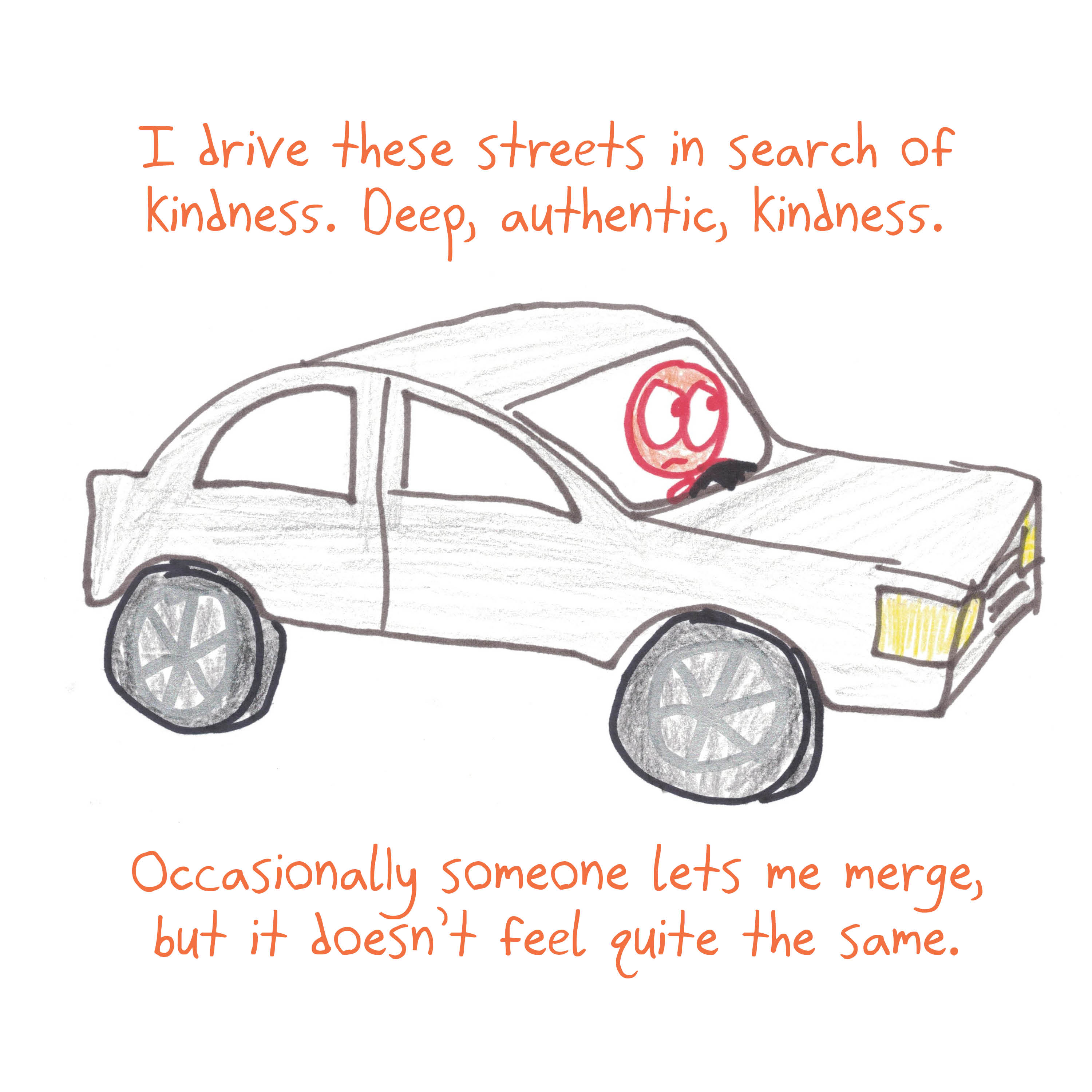
For example, a city is safer and more pleasant when the drivers are nice. A nice driver brakes for yellow lights, lets other cars merge, and gives bicyclists a wide berth.
What would it even mean for a driver to be kind? There is no opportunity or need for a deep bond with a fellow driver. We’re just sharing public spaces in isolated encounters. Niceness is the virtue we need.
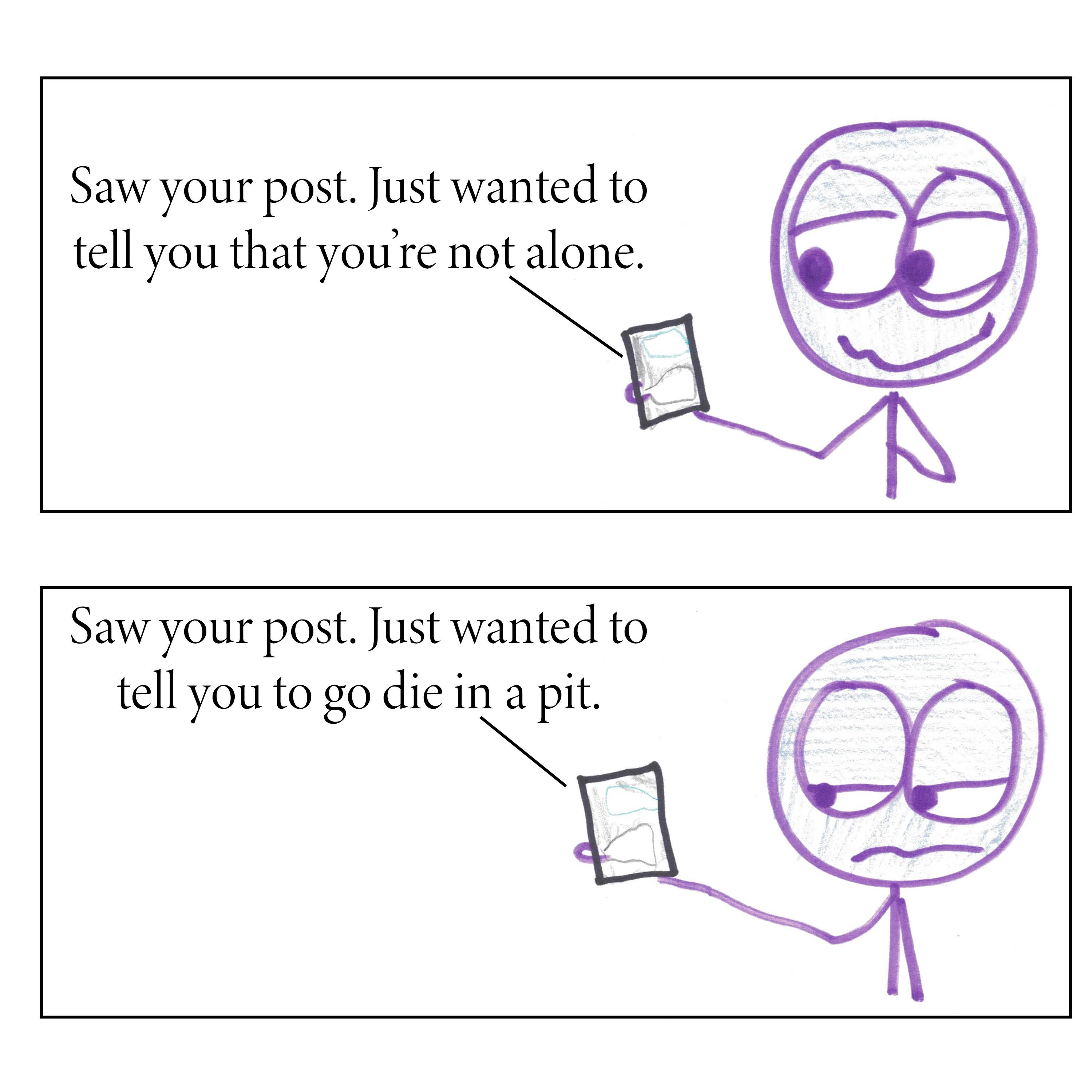
Or, for a digital example, I find that the internet has surprising reservoirs of kindness. Many people find deep community and forge real bonds. What the internet tends to lack is niceness. Where communities collide, we often treat each other shabbily (or worse than shabbily).
To go on Twitter and urge greater kindness would be a fool’s errand, a kiss blown into a hurricane. To go on Twitter and urge greater niceness — well, that’s also a fool’s errand, but at least it correctly identifies the virtue that’s missing.
Kindness, because of its depth, asks a lot of us. It’s demanding; you must improvise to meet a person’s particular needs in the moment. Niceness is easier; you can follow a generic script (“What about this weather, huh?”).
Being a matter of surfaces, niceness is possible even when you’re hurting. It doesn’t much sting to have it rejected; you can just turn the other cheek and keep smiling. But kindness requires more of your inner self; it’s vulnerable. To have kindness rejected can be quite painful.
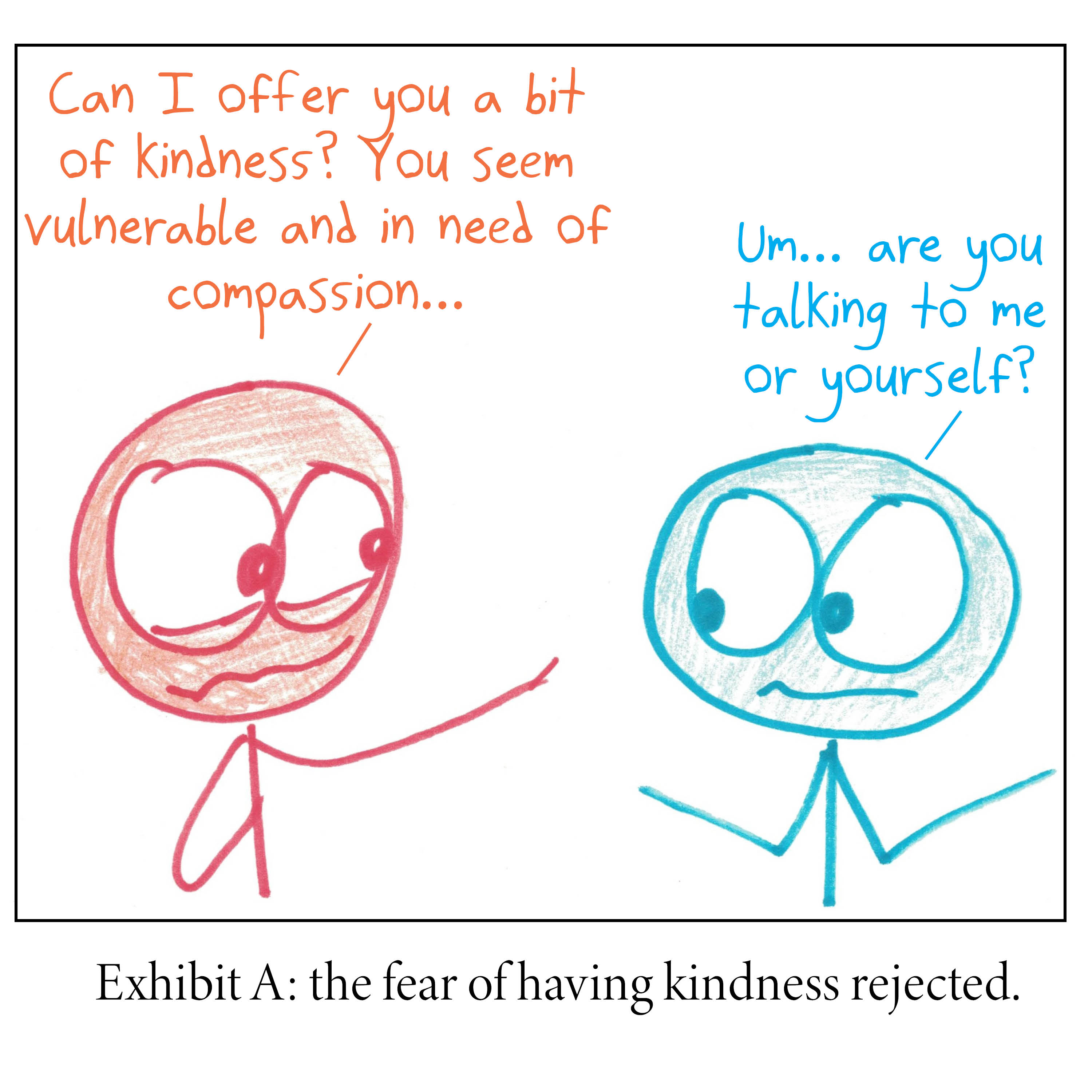
Of course, the misuses of niceness are familiar. To offer niceness when someone needs kindness is cold, and can even verge into the cruel. (I know I’ve been guilty of this: every few months, with a little spike of shame, I think back on an eerily chipper email I once sent to someone who had recently lost a parent.)
Certainly, kindness is the deeper virtue. A world without niceness would be a bit of a grind; a world without kindness would be unendurably lonely. If the internet were full of writers blithely conflating the two, or insisting that niceness is the key to life, then I would of course speak up in defense of kindness.
But we find ourselves in the opposite world, where many are inclined to round niceness down to zero (or even treat it as a vice!). I thus offer the most banal conclusion any writer has ever uttered: being nice is Good, Actually.
 Math with Bad Drawings
Someone asked me why I was so kind a week ago. I immediately wondered if they meant nice. I was going to take offense. One (bad) definition of niceness is doing and saying things to get other people to like you. I agree niceness is not bad, but kindness > niceness. It’s also hard to imagine someone who is kind and not nice. It’s easier to imagine someone who is nice but not kind.
Yeah, when I picture “kind and not nice” my only image is the TV archetype of the gruff/standoffish/demanding mentor figure with a secret heart of gold. Mr. Miyagi, Yoda, Ed Asner on the Mary Tyler Moore show, that doctor on Scrubs who’s always ridiculing Braff… But I suspect this personality type is much more common in fiction than reality!
There are so many people invested in nice that don’t ever get to kind. But those who aren’t into pleasantries, but show up to help you clean when you need to – they’re gold worth finding.
Oh yes, cleaning up unasked at the end of an event is the golden virtue! The vector sum of niceness and kindness.
I was recently talking about this phenomenon with a friend, actually, because I know a few people who are very insistent on being kind-but-not-nice, and who are often very tiresome to be around as a result. In my experience these sorts of people flip between constant razzing and weirdly intimate emotional conversations, and it just feels kind of forced.
I know some people just like shittalking their friends, (and I’ll admit I’ve never really had the highest tolerance for that) but for some reason the people who do it with this “kind but not nice” framework in mind always seem to be especially cruel about it.
That all sounds exhausting!
No idea how widespread the “I’m gonna be kind but not nice” phenomenon is, but I speculate that it stems from the (true) observation that, from time to time, kindness demands telling people hard truths they may not want to hear. In those moments, kindness and niceness really are at odds, and it takes courage to brave an unpleasant interaction for the sake of a deeper loyalty.
But how common are those scenarios? Maybe a few times a year? Silly to build your whole worldview around them. In the more ordinary 99.9% of our lives, kindness and niceness are perfectly easy to align, and cultivating a “not nice” attitude makes it (for obvious reasons) much harder to be kind!
I don’t think “kind but not nice” exists in reality. Those people describe themselves as “honest” and “saying what I feel”. However, I think those people are sadistic. Someone who is truly kind will speak hard truth in a way that minimizes pain.
You can say “Wow, you are getting fat”. Or you can say “Hey do you want to come to my workout group?” I don’t think the first response is kind or nice.
Ben, what a meaningful post. You have addressed kind and nice beautifully. Marcie
It’s a tough world – we need more kind people.
The meaning of ‘nice’ has evolved somewhat over history I’m immediately reminded of C.S. Lewis’ use of the N.I.C.E. in his book ‘That Hideous Strength, where it was anything but kind.
In Middle English, nice meant stupid or ignorant More recently, nice has often conveyed an impersonal sense — nice weather, nice tree, etc.
I don’t feel that our world is suffering a deficit of niceness. However, we’re lacking in what were once common social currencies — courtesy and decency. And kindness.
Mmm, yeah, I think “courtesy” and “decency” have a lot of overlap with the version of “niceness” I’m characterizing here — especially if you prefix your word “common,” as in “common courtesy” or “common decency.” Not an especially profound cluster of virtues, but as you say, a useful form of social currency.
I needed this in my email box today, Ben. Thank you. (Looking forward to your new book, by the way!)
Thanks, Ricky!
This was excellent Ben. I want to be both! Maybe not always simultaneously (as some of the commenters pointed out), but definitely want to strive for each quality. Thanks for writing this (and I loved the illustration in the car!).