Not long ago, in an email relayed by his father, a fourth-grade reader took issue with one of my calculations in Math with Bad Drawings.
Here’s the passage in question:
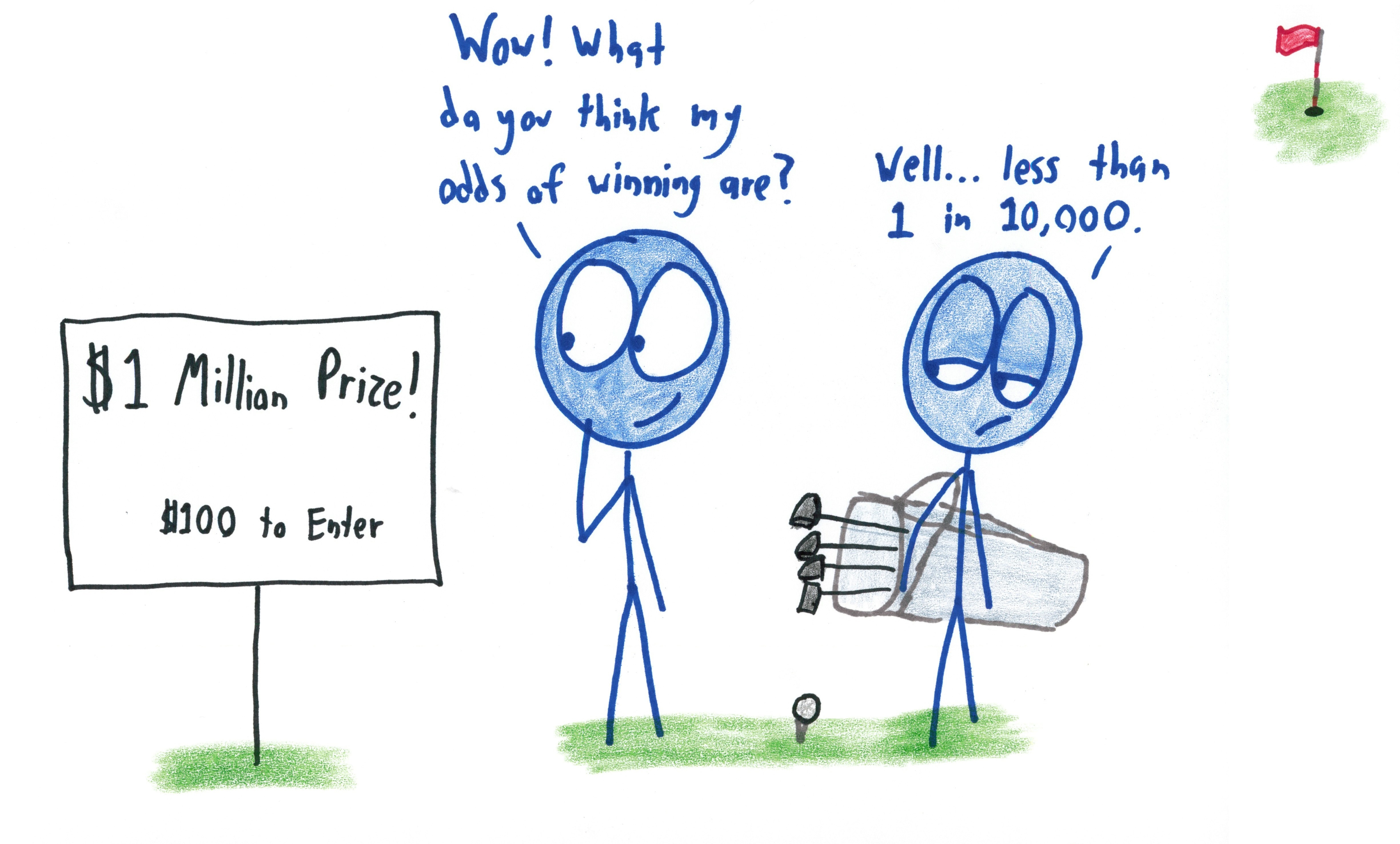
There’s nothing more American than a gaudy competition. The $10,000 half-court shot. The $30,000 dice roll. The $1 million hole-in-one. When rolling out such promotional gimmicks, there’s just a teeny, tiny risk.
Someone might win.
As it turns out, this market is a dream for insurance companies. As merchants of probability, their solvency depends on accurate computation. 50-to-1 payouts on a 100-to-1 event will keep you in the black; 100-to-1 payouts on a 50-to-1 event will bankrupt you. The actuarial intricacies of home, life, and health insurance make it easy for an insurer to miscalculate.
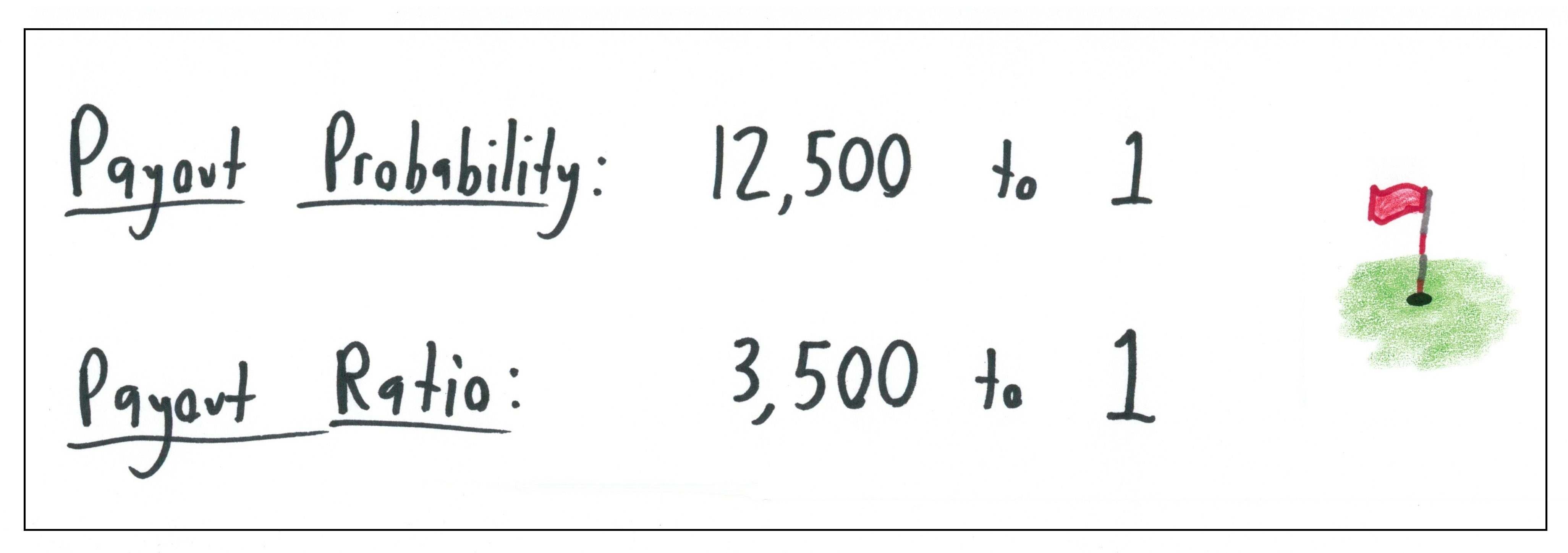
But prize giveaways? No problem! Take the hole-in-one. Amateur golfers succeed roughly once in every 12,500 attempts. So, for a $10,000 prize, the average golfer costs $0.80. Charge $2.81 per golfer (one company’s advertised premium) and you’ll turn a tidy profit. The same company insured a $1 million hole-in-one prize for just $300. It’s a fine deal on both ends: the charity offloads risk, and the expected-value cost to the insurer is just $80.
And here’s the young reader’s reply:
12,500 to 1 payout probability and 3,500 payout ratio is written. But when I calculate the payout ratio by doing 10,000/2.81 I got approximately 3,558.7188 and when I round to the nearest hundred I got 3,600 not 3,500. So, how did you get 3,500?
Please write back to explain your thinking.
His forthright inquiry demanded a forthright answer. I wrote back:
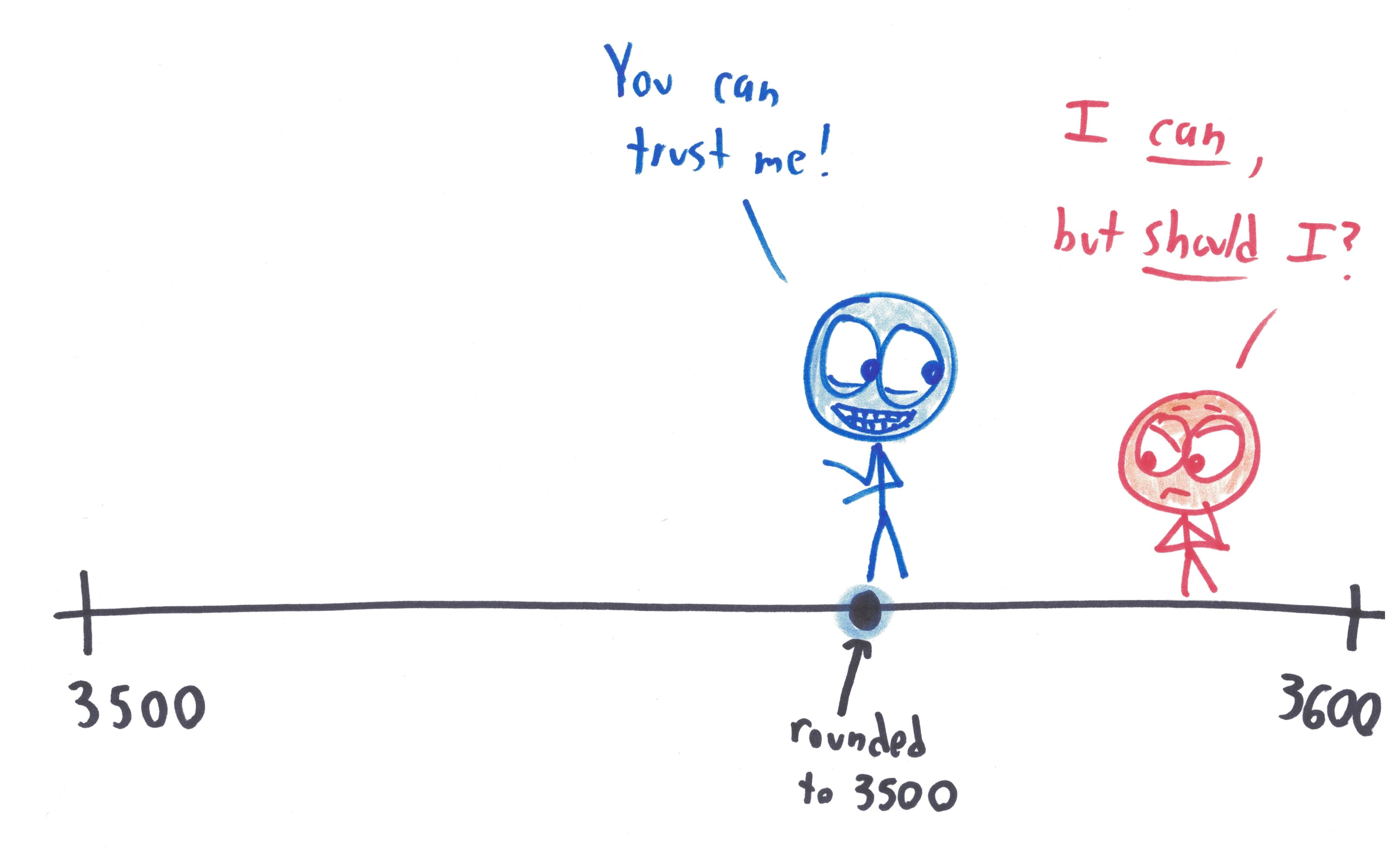
What a fabulous question! Your calculations are correct, and indeed, the result is closer to 3600 than 3500. So why did I write 3500?
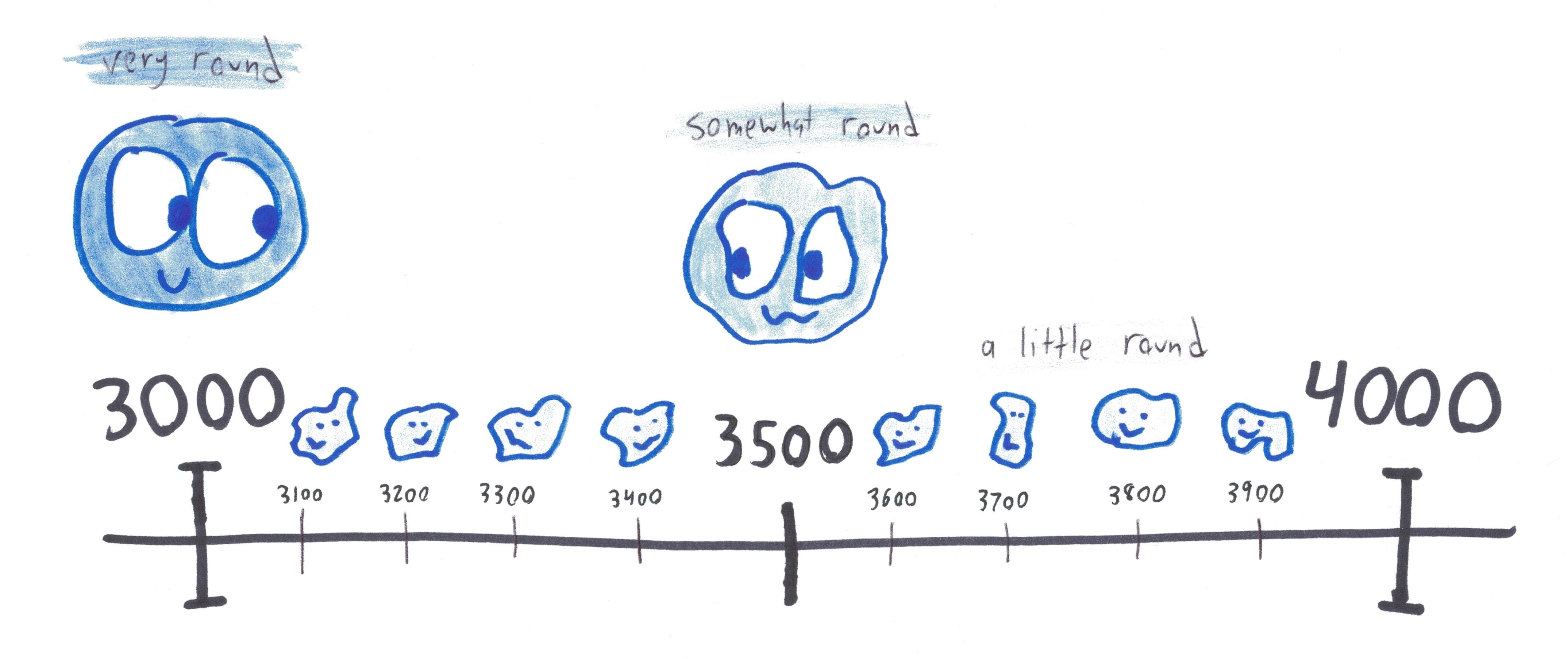
My thinking is that 3500 sounds like a “rougher” number than 3600.
To be sure, 3500 and 3600 both appear to have been rounded to the nearest hundred. But in everyday communication, we tend to treat 500 (being half of a thousand) as a rounder, coarser number. If someone tells me a TV costs $3600, I expect it to be within $50 of that value. But if someone tells me a TV costs $3500, I wouldn’t be surprised if the precise value is, say, $3400, or $3675.
In everyday use, $3600 means “rounded to the nearest hundred,” while $3500 means something like “roughly halfway between $3000 and $4000.”
So why did I pick the “rougher” number here? Because the whole chapter is written with imprecise, rough-and-ready numbers. In particular, the 12,500-to-1 probability is a crude estimate I grabbed from an online source. I didn’t want to put a very rough number (12,500) in juxtaposition with a more precise number (3600). I wanted the reader to be focusing on the gist of the argument, rather than the precise figures. Aggressive rounding moves the focus away from the details.
Except, of course, for very diligent and perceptive readers such as yourself, whose focus on the details cannot be budged!
 Math with Bad Drawings
Well, I learned something today. Good to understand how you think as well.
Is there a formal name for this kind of rounding? In spreadsheets (Excel, Google) this is done with the MROUND(number, factor) function. So, MROUND(3560, 500)=3500.
It is rounding to the nearest multiple of 500, or rounding to the nearest 500. In general, you can round to the nearest multiple of any particular number you like—for example, I have a ruler with markings every 16th of an inch, hence the measurements given by that ruler are rounded to the nearest 16th of an inch (i.e. rounded to the nearest multiple of 1/16 of an inch).
Instead, the payout ratio is determined by dividing the prize amount by the average cost per golfer, which is $0.80 according to the passage. Therefore, $10,000 divided by $0.80 equals 12,500, as mentioned in the passage.
In general, when rounding numbers, there are different rounding methods such as rounding to the nearest integer, rounding up, rounding down, or rounding to a specific decimal place.
The article gave me a very interesting perspective on how people think about rounding numbers. I had never thought of it before.