Each month I do a roundup of news and nonsense. (NOTE TO SELF: news + nonsense = “nuisance”? Investigate further.) I also include a monthly “parting puzzle.”
Here are those puzzles, collected together, solved, and shorn of all distracting nuisances.
To see questions without spoilers, click the links in the puzzle titles before reading on.
To see spoilers, just do your thing.
September 2024: Strange Currencies

Puzzle: In a land whose currency has strange denominations, you are capable of paying each of the following amounts: 20, 30, 40, 50, 60, 70, or just one other number, this being the highest of all. What is this amount?
Solution: It’s 90.
What’s our smallest coin worth? Well, the smallest amount we can pay is 20, so we must have a coin worth 20.
Also, we do not have a coin worth 10, or we’d be able to pay 10.
Then, since we can pay 30, we must also have a coin worth 30.
This also takes care of 50 (which we can pay as 20+30).
Now, we can also pay 40. How do we do it?
One possibility is that we have a coin worth 40. If so, then we’re done adding coins, because we can pay 60 (as 20+40) and 70 (as 30+40) with the coins already in hand. So the only missing amount is the sum of all three coins: 20+30+40 = 90.
When I posted this problem, I thought that was the only possibility. But there is another!
Instead of a coin worth 40, maybe we have a second coin worth 20. But in this case, how do we pay 60? The puzzle states that we can only pay seven amounts, so we can’t add in a coin worth 30 (to do 30+30) or 40 (to do 20+40) or 60 (to pay as one coin). Each would give us too many possible amounts.
The coin we’re missing must be a third coin worth 20, allowing us to pay 60 as 20+20+20. Then, we can pay 70 as 20+20+30, and so the only remaining amount is the sum of all of our coins: 20+20+20+30=90.
Thus, while we don’t know whether you have three coins (20+30+40) or four coins (20+20+20+30), we know that their total value (and the missing item on the list) must necessarily be 90.
Thanks to my dad Jim Orlin for helping formulate this problem originally, and to Simon K. and an anonymous commenter for pointing out the second solution!
October 2024: How transitive is correlation?
Puzzle: We don’t know anything about the relationship between the variables A and C, but we know that each one has a 0.7 correlation with B. What are the strongest and weakest correlations that might exist between A and C?
Solution: The strongest possible correlation, as many readers guessed, is 1. After all, it’s possible that A and C are the same number!
But the weakest possible correlation is weaker than you might expect. For example, let A and C be independent random variables, uniformly distributed from 0 to 1. Their correlation, unsurprisingly, is zero.
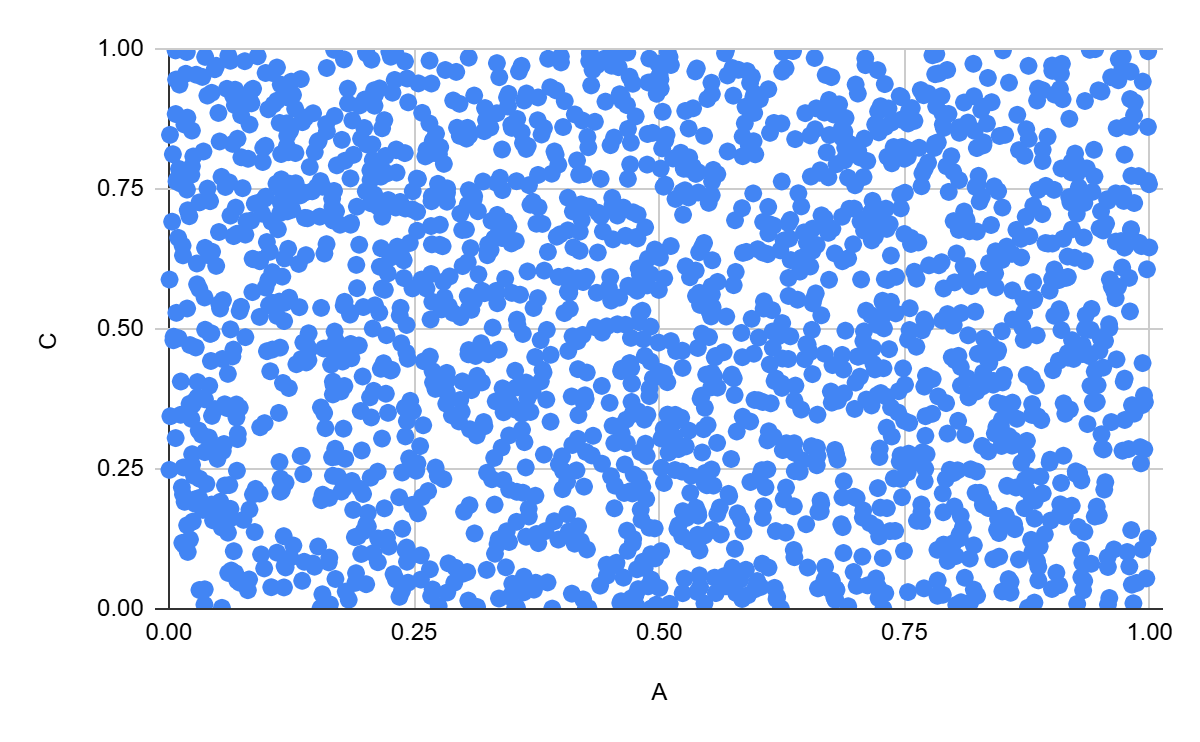
Then, let B = A + C. Now, B is correlated with each of those variables at 1/RT(2), or roughly 0.71.
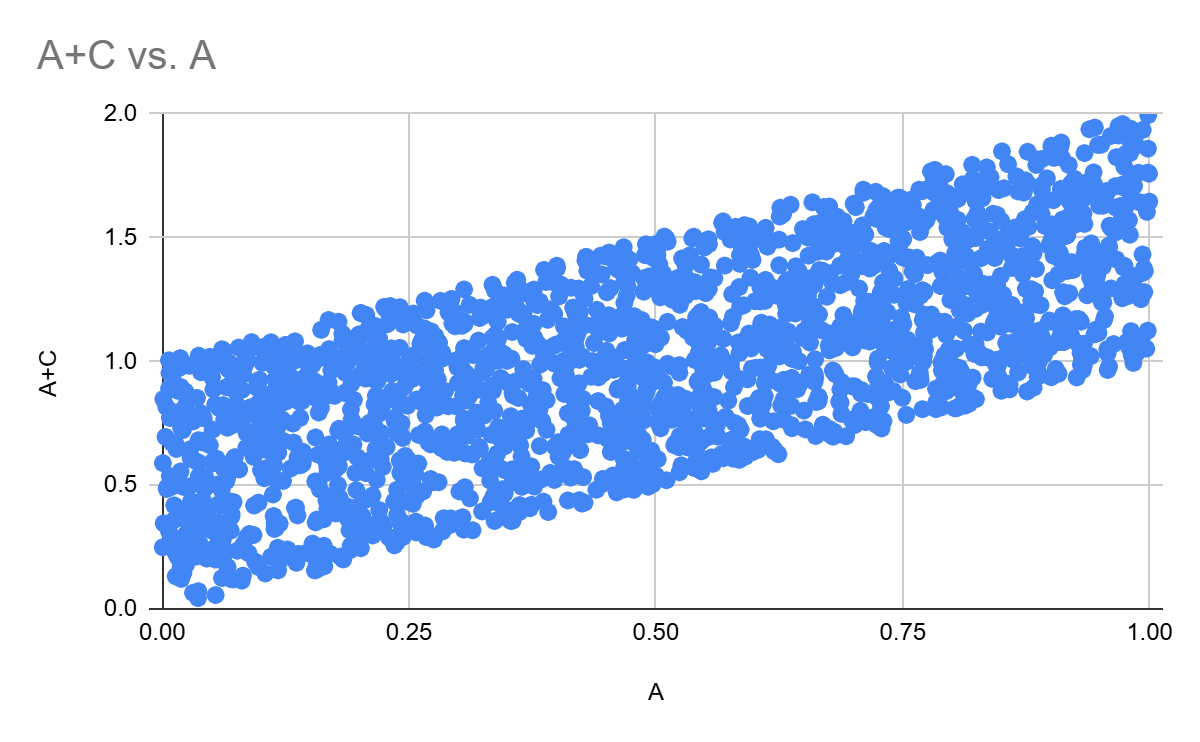
You can even choose a small value x, and then define new variables (1+x)A – xC as well as (1+x)C – xA. These variables are now negatively correlated, but for small enough x, still each have a correlation of at least 0.7 with B.
So, in short: it’s possible that two variables are each correlated at 0.7 with B, and yet negatively correlated with each other!
November 2024: The Woefully Unfair Casino
Puzzle (from Alex Bellos’s Puzzle Me Twice): At the Woefully Unfair Casino, there are two games.
In Game A, you simply lose $1 each time you play.
In Game B, you count the dollars in your possession. If it’s an even number, you win $3; if it’s an odd number, you lose $5.
That’s all there is to do at this casino. Just those two terribly unfair games. Is there any way you can make money playing them?
Solution: Indeed, there is! Just alternate between them: if you have an odd number (say 11), play game A; now you have 10. Then, with your even number, play game B; now you have 13. Continuing this alternation, you’ll have 12, then 15, then 14, then 17… and so you can stutter-step your way as high as you wish. As Bellos explains in his excellent book:
This puzzle is an example of Parrondo’s paradox, a counterintuitive result from game theory named after the Spanish physicist Juan Parrondo, who formulated it in 1996. According to the paradox, it’s possible to create two games with a higher probability of losing, and then develop a winning strategy by playing them alternately.
December 2024: The Divided States of Economerica
Puzzle: It’s a fact that the U.S. has the world’s largest economy (as measured by GDP). But let’s break the U.S. into smaller economies, and see how much of the world’s Top 10 it can thereby dominate.
(1) Warm-up: Treating the U.S. as 51 separate economies, one for each state (plus DC), how many rank among the world’s ten largest?
(2) Challenge: Now, consider all the ways to decompose the U.S. into new, smaller economies, each consisting of one or more contiguous states. Let’s do this to maximize the number of economies that rank in the world’s ten largest. What’s the best you can do?
Here’s a csv to get you started:
Hints: Just sort the spreadsheet, and you’ll find the answer to #1. For #2, you’ll need a handy map of the U.S. (and/or an adjacency matrix of state borders).
Also, for #2, note that the GDP of the whole U.S. is about $28 trillion. So, if you break it into ten little economies, the smallest will be at most $2.8 trillion — which is less than China, Germany, Japan, India, the UK, France, and the nine other little economies you just created. In other words: the U.S. definitely can’t dominate the whole top ten. But how much can it dominate?
 Math with Bad Drawings