I spent months scraping half-dry markers against the shiny surface, too stubborn to admit I was writing in invisible ink. Students in the third row squinted at my writing like it was a high-stakes eye exam.
Category: Reflections
The Teacher-Centric Universe (or, Galileo Would Be Ashamed)
I’ve had moments—awful moments—when I realize I’ve lost them. The whole class. I’m like a general who’s been marching ahead with his nose in the air, and then looks up to realize that his army is nowhere in sight.
Learning to rock-climb is changing how I’ll teach math.
Back in the classroom, I was the one holding the ropes, with two feet planted on flat, sturdy ground. Now, I’m the one clinging to the wall, hoping like heck that the ropes don’t break.
Two-Column Proofs that Two-Column Proofs are Terrible
Theorem #1: “Justifying steps” ought to be an opaque, frustrating process.
The Mental Machinery of the Chess Master
A strong player has spent years exploring the intricacies of chess. She studies her prior matches the way a football coach studies game tape.
Black Boxes (or: Just Say No to Voodoo Formulas)
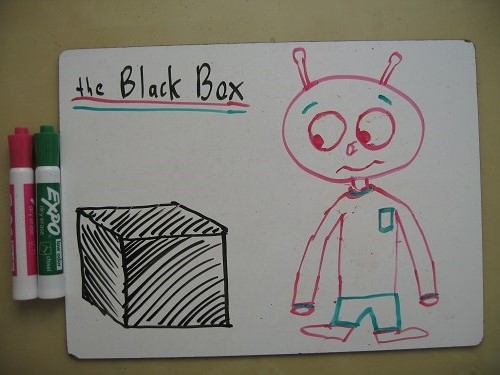
We’ve all got black boxes in our lives. A black box is a little mystery that you take for granted. It’s something you use without thinking, without skepticism, without once opening the lid to peek at the workings inside. For all you know, it might be powered by wind, water, cold fusion, hamster wheels—or even … Continue reading Black Boxes (or: Just Say No to Voodoo Formulas)
Is Memorization Necessary, Evil, or Both?
At The Atlantic today, I have an essay weighing in on the decades-long debate over memorization, trying to cut a middle path between two extremes: 1. "Memorization is the enemy. It's the antithesis of critical thinking and conceptual learning. Memorization's defenders are wilfully blind soldiers marching for an outdated tradition." 2. "Memorization is an essential tool for students. It's … Continue reading Is Memorization Necessary, Evil, or Both?
A Ray of Light
There are moments of teaching I like to remember - episodes of cleverness, compassion, success. And then there are the other moments, the ones that my thoughts tend to flee, the ones I prefer not to think about. This is a story about both.
What It Feels Like to Be Bad at Math
Instead, failure is born from a messy combination of bad circumstances: high anxiety, low motivation, gaps in background knowledge. Most of all, we fail because, when the moment comes to confront our shortcomings and open ourselves up to teachers and peers, we panic and deploy our defenses instead. For the same reason that I pushed away Topology, struggling students push me away now.
Fistfuls of Sand (or, Why It Pays to Be a Stubborn Teacher)
This is a story about one small compromise that I refused to make, a stubborn act that paid off, though I didn’t expect it to. The setting is a Calculus classroom, but I hope the story will resonate with anyone who spies something dubious in the rigid and widespread assumption that learning can be endlessly itemized, carefully quantized, and instantaneously measured.
 Math with Bad Drawings