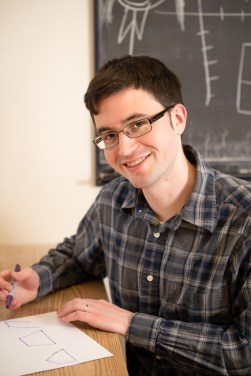
 My name is Ben Orlin.
I like math, jokes, and teaching.
I can’t draw.
I live in Saint Paul, Minnesota, my pronouns are he/him, and I am very excited about my two books: Math with Bad Drawings (2018) and Change is the Only Constant (2019).
I have taught every level of mathematics from ages 12 to 18, with occasional spells teaching Psychology, Biology, English, Theory of Knowledge, and even Earth Science (the latter to no one’s benefit, least of all the Earth’s).
To email me, just use the name of the blog at gmail. Or follow me on Twitter or Facebook. I love to hear from readers, whether you stumbled here accidentally or are my college roommate Michael Wayne. (Hey, Michael Wayne!)
Here’s some coverage of CHANGE IS THE ONLY CONSTANT:
- The New Scientist called it “a cartoon triumph.”
- Math Frolic named it the Best Math Book of 2019.
- The chapter “1994, the Year Calculus Was Invented” will appear in Princeton University Press’s 2020 edition of The Best Writing on Mathematics.
- Ars Technica featured an interview with me and a personality quiz I wrote to decide whether you are a Newton or a Leibniz.
- The podcasts Talk Nerdy, My Favorite Theorem, Breaking Math and Culture Cafe interviewed me.
- BBC Science Focus published an excerpt titled Archimedes: Inventor of war machines and calculus (almost).
- I wrote a piece for CM, my high school’s alumni magazine, on the connection between mathematics and inside jokes.
- Leading educator Jo Boaler adapted the chapter “Sherlock Holmes and the Bicycle of Misdirection” into a lesson plan.
- The Mathematical Association of America reviewer called it a “thoroughly enjoyable read, even to the point of giggles.”
- Award-winning math teacher Patrick Honner described it as “simultaneously high brow and goofy, deep and easy going, important and self-deprecating, but always fun and enlightening. In other words, it’s uniquely Ben Orlin.”
Here’s some coverage of MATH WITH BAD DRAWINGS:
- Excerpts: What does math look like to mathematicians? (Popular Science); The Ten Types of People Who Buy Lottery Tickets (Vox)
- Reviews: Ars Technica; Hampshire Daily Gazette; 3 Quarks Daily; Math Frolic; American Scientist
- Interviews: Freakonomics Radio; Google Talks; Yale Alumni Magazine; Whad’Ya Know; The John and Heidi Show; Gonit Sora; Breaking Math; Read Science!; Inside the Black Box; WAMC Roundtable; Intelligence Unshackled
Here’s some of my stuff as it’s appeared at other web sites and publications:
- The Atlantic: When Memorization Gets in the Way of Learning; Why Do Private School Teachers Make Less Money?; How I Became an Unfair Teacher; I Lie About My Teaching
- Los Angeles Times: Why I Won’t Reenlist as a Yale Alumni Interviewer
- Slate: You’re Not Stupid. You’re Slow; How to Fix the SAT: Give Out Fewer Scores; We’re Giving the Wrong Dr. Seuss Book for Graduation
- Vox: What journalists, weather forecasters, and Han Solo get wrong about probability
- Journal of Humanistic Mathematics: Nine Mathematical Ways of Watching a Baseball Game
And here are other interviews with me, in case you want to hear people ask the tough questions like “what’s wrong with your drawings” and “why Ben why”:
- WordPress Discover (wherein the gracious Ben Huberman somehow manages to suggest that I have an “acumen” of any kind)
- Math Frolic and Math Frolic again (wherein the wonderful Shecky calls me “Math Blogging’s Bill Watterson” – a horrible slander against the great Bill Watterson)
- Challenging Opinions Podcast (wherein the eminently fair William Campbell proposes that maybe I hire four-year-olds to do my drawings for me)
- Top Craft Bloggers Share Their Tips for Online Success (wherein I give a few quotes, despite the words “top” and “craft” being quite ill-suited to me)
- I’m quoted briefly in this story on the struggles of the Canadian lottery to attract players during the coronavirus pandemic.
 Math with Bad Drawings
Your books look intriguing. I have a son who loves math but chose to get his bachelor’s degree in chemistry and his Master’s in physics. He was three years into the doctor program in physics when he was arrested. I would like to send him your books in prison but I can only find hardcover in their expensive. Do you know where I can find them used? Thank you.
There should be used copies on Amazon, for maybe 2/3 the price of new. Does the prison have a library? I could try seeing if there’s a way to have a copy donated.
Hi Ben Just bought MwbD.
Great book and excellent drawings
Hi Ben Just bought MwbD.
Great book and excellent drawings
What percentage of high school students fail to graduate, because they could not do the two-column proof?
Excellent read. I’ve re-established my love and confusion (isn’t love always confusing) with mathematics and your book (C) is helping me back in. Gotta admit I stopped enjoying mathematics around the time of double and line integrals…
Medium just published a very good view of the applications of calculus to “everyday” life:
View at Medium.com
URL getting dropped. Maybe this will work – (prepend your own https : )
medium.com/however-mathematics/the-emergence-of-calculus-a-mathematical-journey-of-human-thought-303dd0839b0a
I just read “What it feels like to be bad at math” and burst into tears when I read this: “I tell my story to illustrate that failure isn’t about a lack of “natural intelligence,” whatever that is. Instead, failure is born from a messy combination of bad circumstances: high anxiety, low motivation, gaps in background knowledge.”
Thank you for such honest, truthful and hilarious words! The child I used to be really appreciated reading them, knowing she was never stupid for not “getting” math, she was just very scared.
Hi, I’m unschooling a 12 year old. She does not enjoy being taught math in most forms but absolutely loves solving math challenges that nobody ever taught her how to do. We enjoyed reading your book together. Do you know of any resources where I could find some cool challenges to give her?
Great question! Some thoughts:
Brilliant.org has great problems.
For geometry, the books Area Mazes and Geometry Snacks are fun, and I love Catriona Shearer’s work (@cshearer41 on Twitter).
Alex Bellos has several good books of problems.
YouTube channels like Numberphile and Cracking the Cryptic offer various pleasures.
Teacher resources like Dan Meyer’s 3 Act Tasks, Fawn Nguyen’s Visual Patterns, Robert Kaplinksy’s Open Middles, and Jenna Laib’s Slow Reveal Graphs could be delivered by a parent pretty smoothly.
Oh, I should also mention math game sites like those of Denise Gaskins, John Golden, Marilyn Burns, and Dan Finkel (all easily Googled).
Do you sell posters of your work anywhere? Some of these would be fun to hang in my office. Especially “Why Not to Trust Statistics.”
Ah, it’s a good idea! I’ve never yet gotten my act together to put these up for sale – feel free to print out copies in the meantime.
It would be fun to imagine how you might think Neanderthals got ’round to coming up with a notion of number.
How did neandertals learn to count:
https://www.nature.com/articles/d41586-021-01429-6?utm_source=Nature+Briefing&utm_campaign=f6bf0abbed-briefing-dy-20210602&utm_medium=email&utm_term=0_c9dfd39373-f6bf0abbed-44937229
Greatt reading your blog post
I am hoping to receive the cards from my Kickstarter pledge. I think my messages through Kickstarter must not be reaching you. The book was an excellent gift for my math teacher sister, and I would like for her to have the cards as well. Thanks.
MWBD. First – a fantastic book, now my second favourite behind Wells “Curious and Interesting Numbers” – the calculus book is up next on my reading list.. The Last .400 Hitter. The baseball box score was likely derived, conceptually, from the cricket scoring template which tells the story of a cricket match ball by ball. You mention that cricketer Brian Lara’s 400 runs without being out is a record. That’s true in international cricket, but at the comparative level of MLB, the same Brian Lara holds the record too – 501 not out in 1994. At the high school equivalent level, AEJ Collins’s 628 not out stood as the record until 2016 when Pranav Dhanawade scored 1009. Perhaps Lara’s 501 should be mentioned in the next edition? Bracketology. In 1974-75 (page 311 for reference) the top UK income taxa rate hit 98%. And for many years the Surtax in the UK was assessed in such a way that the bracketeology demon DID apply – but was relived by a mechanism called Marginal Tax Relief which could only have come from the desk of a professional sadist in a dark room at Inland Revenue HQ. I am pretty sure, also, that in the early 60s, the income tax rate, including surtax and special charge, actually exceeded 100% on certain types of revenue – mainly investment income. Have been unable to prove this, but might try again sometime. Annoying Nitpickers Club – I guess I must be a member, and if this is the 477th trime you have heard all the above, sincere apologies.
Thanks so much for this! To be on any shelf with “Curious and Interesting Numbers” is a great honor.
Much appreciated on the cricket corrections. I speak wobbly conversational cricket at best, and should clearly have run that chapter by a fluent expert such as yourself.
Hi, first of all, thank you so much for your work! I especially love your book “Math Games with bad drawings”, the games have saved many train rides with my kids. Since in one post, you mentioned that there is a demanding populace, I thought I could contribute to that because I have been having an idea for quite a while: When I am in the train, I have a hard time remembering the game that I wanted to play. How about you (or someone else?) would create an app from the book in which you can enter maybe the number of players, their minimum age, and maybe the topic and the app selects all the appropriate games? It should not be too complicated, should it? Anyhow, also without the app, I recommend the book to everyone I know and would like to thank you again!
Best wishes from Switzerland
Lilla
Hi,
We want to clarify some math on pages 169 to 170. We’d like to send you a detailed write up on our understanding and how it differs from yours. Please send us your email address so we can send you our write up.
Ooh, I’m happy to hear! I’m just mathwithbaddrawings (i.e., the name of the blog) @gmail.com
Hi! I have, and love, MWBD and MGWBD and use the latter in teaching maths (upper primary age, extension classes). Two of my students have come up with variations on the Amazons game, one who felt it wasn’t aggressive enough and invented a version where you can attack pieces, and the other a game where arrows fire in blocks, to practise areas and fractions. I just thought you might like to know, since so much of the books is about creating variations on games!
Aww, that’s fun! And those sound like cool variations. If you or they want to email me further details (just the name of my blog at gmail), I’d love to hear more!
Hi Ben! I am huge fan of your books and I love to read them. I remember a Dandelion Game you have mentioned the Math Games with bad drawings, I have created a python code to mimic this! If you want it, I can email it to you!
My Email: runbo01pd2029@saschina.org
I just read Math with Bad Drawings, and absolutely loved it. I’m an associate professor of chemistry, have a PhD in STEM, and I learned so much from this book. And laughed quite often. Thank you so much!
Sir, if you make a book of word problems, I will buy it. I desperately need word problems that aren’t COMPLETELY divorced from reality.
Wonderful post. Thanks for sharing it with us.
Hi Ben,
Just came across your wonderful Grinch poem advocating 22/7 (22nd of July to most of the world) as a more sensible date for Pi Day than 14th of March.
Sorry, I’m probably not the only person who’s come up with this response, but I couldn’t resist the temptation.
“Twenty-two over seven’s a more sensible action.
Why use a decimal and not just a fraction?”
Ha, thanks for this — yours is the first rhyming response, and I like it!
Thank you Ben 🙂
Personally, as an engineer (English) I hate decimals. I was brought up using an Armstrong scale – halves, quarter, eighths, sixteenths . .
Even for cooking, decimalisation was a retrograde step. Dividing a 4oz or 8 oz block of butter into ounces using diagonals, easy, dividing a 250gm block into 50gm pieces . . yeuch.
My personal opinion (as a non-mathematician) is that we got stuck with base 10 because the Romans could only count on their fingers, where base 12 or base 16 would have been much more useful.
Hi Ben,
This is Iris, We are a coaching college in Australia. we are very interested in your books. I would like to have your distributor contact in Australia.
Kind Regards
Iris
Hi Iris, thanks for the message! Can you send me an email (just the name of my blog at gmail) and I can put you in touch with my publisher?
Thank you so much for the details. Liked it!
The book contains a lot of practical calculus. Do you, as the author, also apply calculus to your daily life?
Hello, I’m Korean student Kim Hakyum. Our school starts a project that read a math book. I choose your book to read, So can I ask some question about your book or you?
Hello, I’m Korean student Kim Hakyum. Our school starts a project that read a math book. I choose your book to read, So can I ask some question about your book or you?
First question-The book contains a lot of practical calculus. Do you, as the author, also apply calculus to your daily life?
second question-Why do you draw pictures in your math books?
Third question-Is there an easy way to do calculus?
Thank you for made this funny book.
Hey Mr.Orlin! This is Francisco from OCHS Class of 2013. I’m now a 7th grade Math teacher and saw your drawings in our curriculum as we intro new topics. I knew the drawings looked familiar and came across your work. I was so excited to share you were my high school math teacher to my kids although they didn’t believe me or really care. Thanks for always making math fun, enjoyable, sparking curiosity and for all the aha moments in class. Hope you are doing well.
Francisco!!! It’s so good to hear from you, I was just today wondering whether teaching you guys AP calculus, after four years together in the trenches, was my favorite teaching experience ever (it probably was). I’m honored that you chose to join our profession — we’re lucky to have you. Where are you teaching? (And feel free to send me an email — just the name of the blog at gmail!)
Great website! Ben Orlin, your approach to mathematics and your ability to convey it in such an accessible way are truly inspiring. Congratulations on your four books and the passion you share with others. Math with “Bad Drawings” is a brilliant idea – it shows that it’s the ideas that matter, not perfect form. Well done!
I am keen on the topological game with very few and very simple rules of Hex (of which Einstein had a gameboard on his desk in Princeton, contemporary computing did not exist in his time). I dream of the demonstration of the following conjecture of mine. “Artificial intelligence discovers the winning strategy of Hex on an arbitrary-sized board after working out the winning strategies on boards of several sizes.” If you have not got hardware powerful enough to demonstrate the conjecture do you at least use a supercomputer to completely walk through the game tree part (simple theory of games concept) related to a cell on the board with the 4 sides 9 hexagons long depicted at http://webdocs.cs.ualberta.ca/~hayward/hex/?
Does anyone enter my conjecture in the Langlands program citing me?
I dream of all university culture being explained in a nonacademic way (so with figures, examples and without skipping steps) incentivizing humans to be creative and leaving the drudgery to artificial intelligence.
I need to be informed of any costs being a well-off Italian.
Hi There,
I hope this message finds you well!
I’m smith blogger outreach specialist at contentlinko, and I wanted to reach out with an exciting opportunity for collaboration.
We specialize in LinksBuilding campaigns and want to outrach your websites for our clients and are really impressed with your content. We believe that a partnership between us could create something truly impactful and potential benefits or outcomes for us.
Here are a few key points of our article:
I would love to discuss this further and explore how we can work together.
Are you available for a quick chat this week? Please let us know your pricing structure.
Looking forward to hearing from you!
Best regards,
smith Blogger Outreach
Orlin takes a slight offense at the nature of ‘eighteen’ in English: it’s
“lopsided” and doesn’t have the “symmetry” of ‘two nines’ in Welsh, which is ‘deunaw’ (4).
Orlin even has a stick figure smiling at the two groups of nine and looking askance at the
groupings of eight and ten. Orlin goes on to claim that “there is nothing inherently special about
ten” (6).
But I can offer a highly speculative answer by the way of the Hebrew language; Orlin’s
illustration helps me to see that instead of being imbalanced, ‘eighteen’ in English actually
employs the Hebrew concept of the number, which invokes numerology with the combination of
the letters ‘chet’ (eight) and ‘yod’ (ten). Combining these letters forms the Hebrew word for
‘life’ or ‘chai’ חי. Ask any pagan what the nature of life is and they will claim it peaks and dies.
But that’s not the Biblical concept, for Jesus said that: “[He is] come that [we] might have life,
and that [we] might have it more abundantly” (Joh. 10:10). Hebrew is read and written from the
right to the left and Orlin’s illustration actually has the group of eight to the right. The number of
circles that Orlin has grows from right to left, just like the Hebrew concept of growing from eight
to ten. So we can see that life in a sense grows from the ‘beginning’ to the ‘end’ because it does
not end–it just keeps growing. Life is not a series of ‘the same’, like two nines in a row but a
vibrant process that imparts and even protects growth.
“John 10 (KJV) – Verily, verily, I say unto.” Blue Letter Bible. Web. 24 Aug, 2025.
Orlin, Ben. Math for English Majors: A Human Take on the Universal Language. Black Dog &
Leventhal Publishers, Hachette Book Group, 2024.
Yup, that’s numerology alright.
Tell me: has any actual math been facilitated by such numerology or metaphor? Give us examples of 3 theorems numerology or these Hebrew metaphors have helped to prove, by providing key steps
Hi! I was just reading “Math Games With Bad Drawings”, and came across the Prophecies section where you show the self-describing chart. Is this a possible answer?
Digit I 1 (to the power of 1)
Appearances I 3 (to the power of 1)
Love your books!
Hi Orlin,
My son is reading you book ‘Change Is the Only Constant’ (Chinese Version). He likes it very much. He found a small mistake when he was reading it. There is a small mistake in Chapter 16, page 166. An equilateral triangle is inscribed in a slice of pickle. The ratio of the triangle’s side length to the circle’s diameter should be √3/2 instead of 2/√3.
I cannot paste the photo of this page here.
Love your books!