Many authors will tell you how to write mathematics clearly and correctly.
But few will tell you how to write it with style and panache, so as to attract the oohs, aahs, and swiveling heads of passers-by.
In that spirit, allow me to channel the men’s fashion guy on Twitter. (Note to the men’s fashion guy on Twitter: please never look at me or my clothes.) Here are a few side-by-side case studies in how to make your mathematics look good:
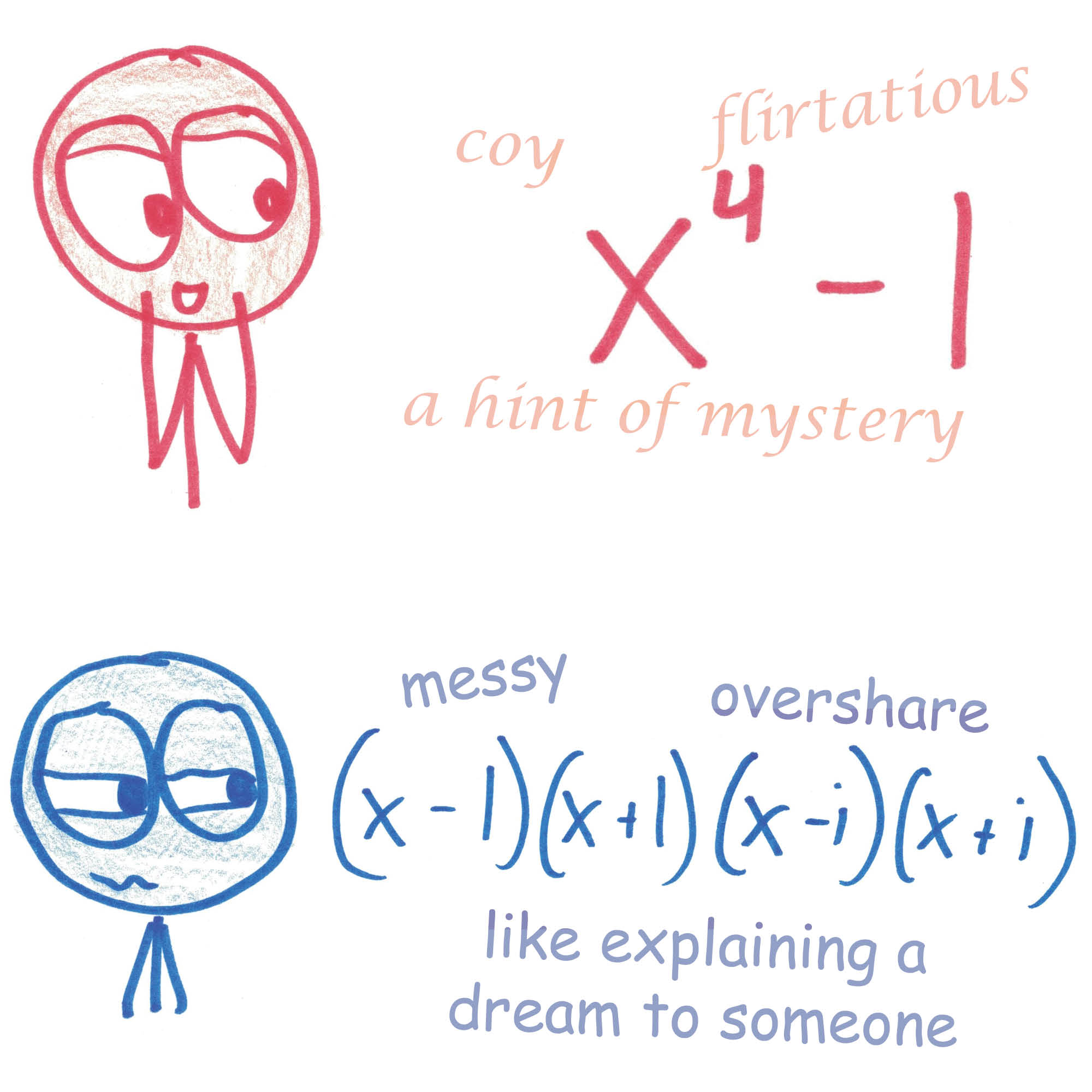
Sure, some polynomials look fabulous when factored. Also, some athletic 23-year-olds look good in midriff-baring tops. This doesn’t mean we should all try it.
Better to leave something to the imagination; it’s a sign of maturity.
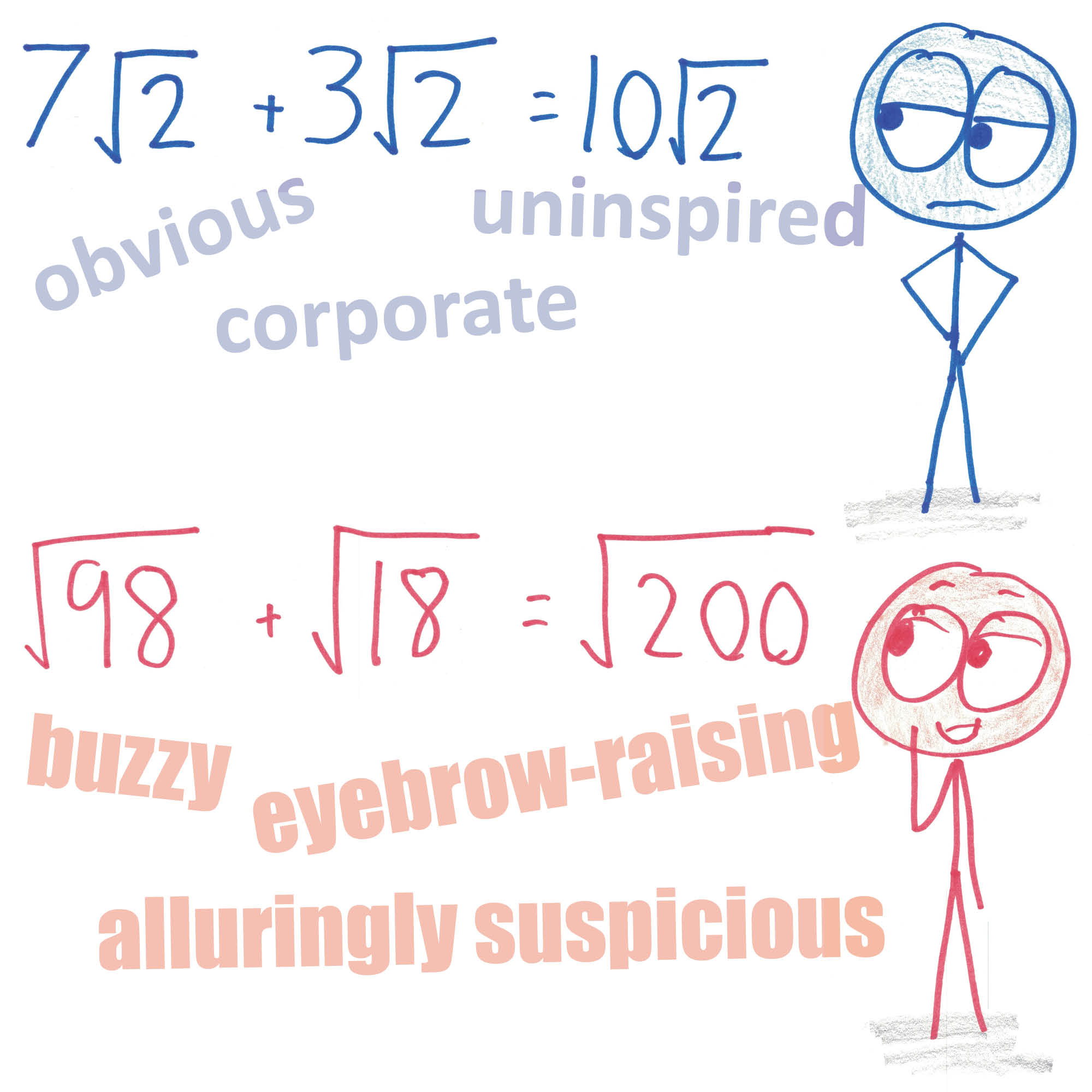
They’re called radicals for a reason, folks. Don’t conform to algebraic conventions. Give the people something to talk about.
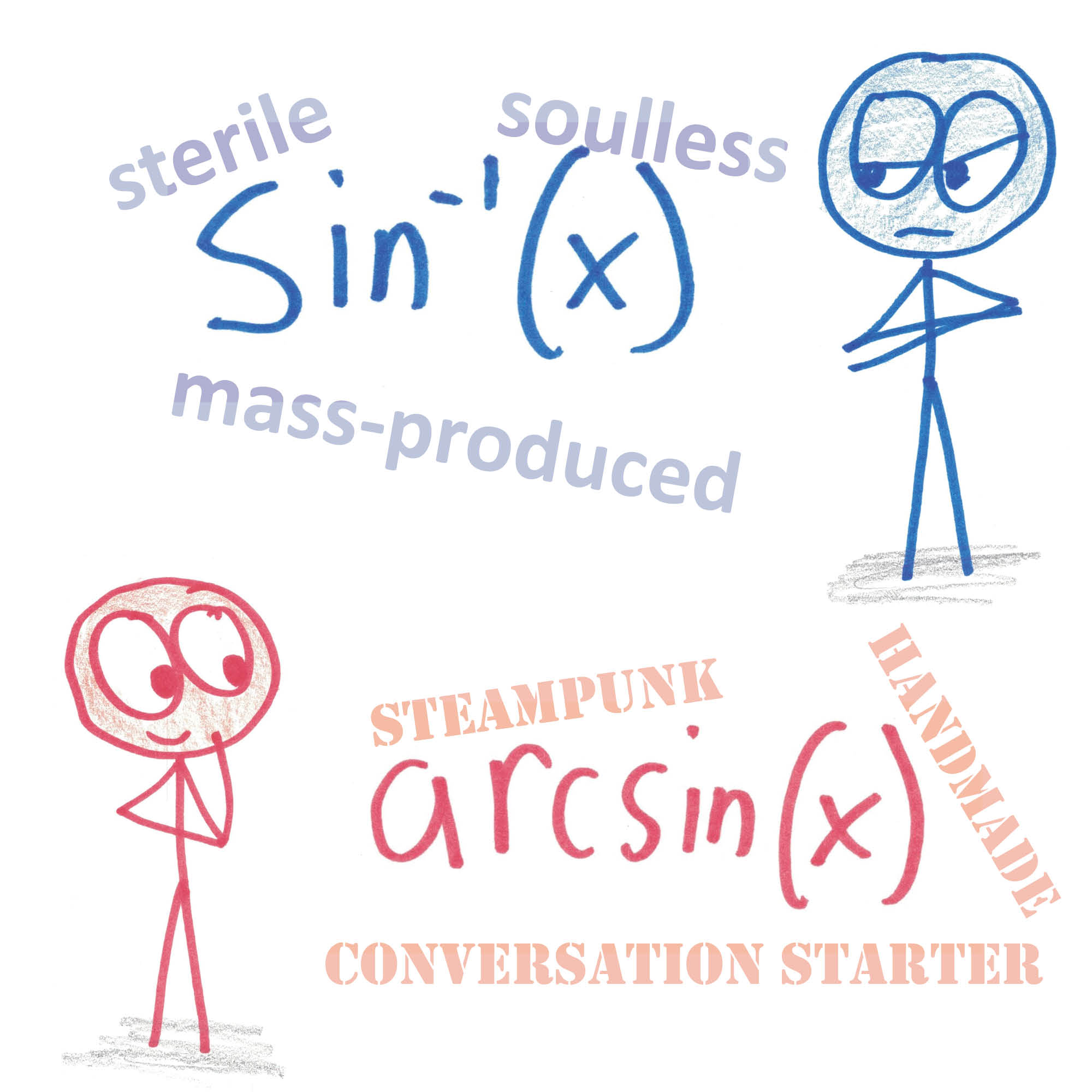
I’m not against f-1 notation in general. That would be like opposing casual wear at the office; no point shaking one’s fist at a ship that long ago sailed. (And anyway, why should x-1 be reserved for reciprocals? Isn’t that just a clever and illuminating convention? Any use of negative exponents is already a high-fashion abstraction.)
Anyway, in this particular case, it’s madness to use the dainty superscript when there’s a robust and appealing alternative.
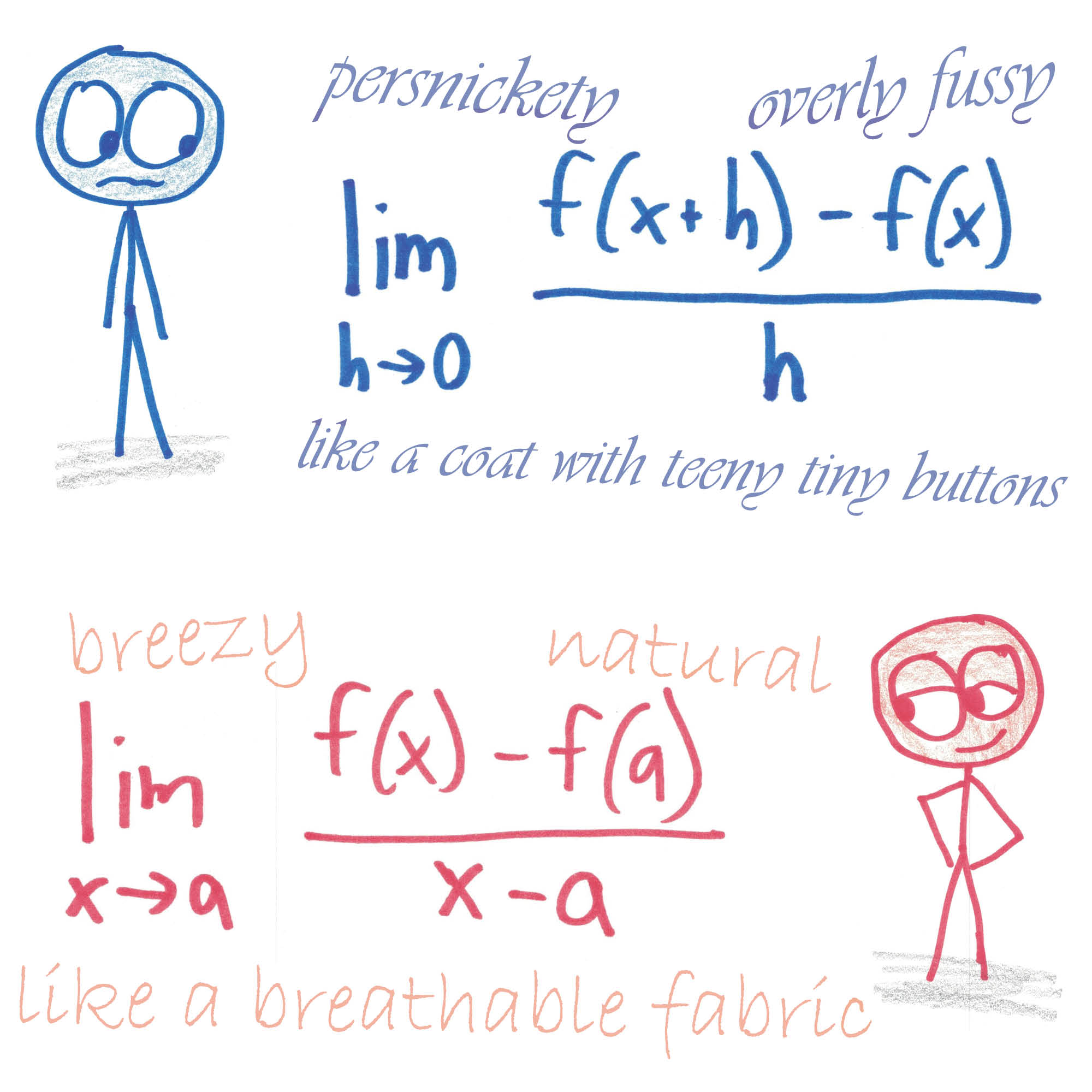
Okay, yes, if you’re actually calculating anything from the limit definition of a derivative, you should go with the more familiar h going to 0 definition.
But be honest. Are you working with the definition of a derivative? Is this the 19th century? Are you a yeoman farmer and/or a Cauchy-era analyst?
No?
Well, then, you’re not bringing this definition to work. You’re using it to make a point: namely, that the derivative is what happens to a slope as the two points draw closer together. And that point is best made with this stylish latter version.

I hesitate to wade into the long-simmering /phi vs. /varphi debates.
But c’mon, folks.
If we can’t agree on such an obvious matter of aesthetics, then I fear we may be approaching the end of our existence as a coherent civilization. Perhaps, in a few decades, the /phi advocates can be resettled on the surface of the moon, where they can build their own sorry little society, beyond the intimidating shadow of our superior fashion sense.
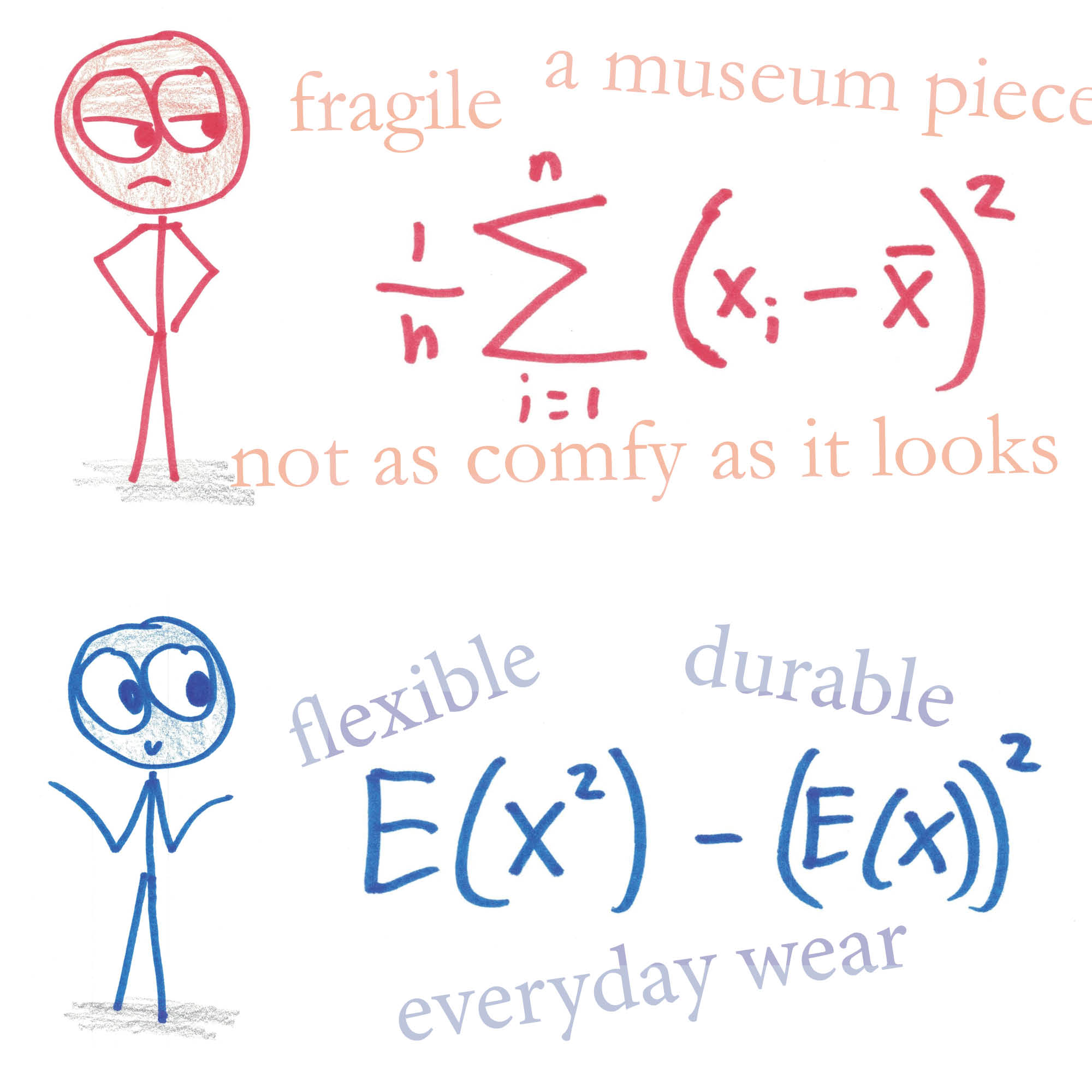
Ah, variance, you minxy concept.
I almost went the other way on this one. After all, is this not the opposite of my advice on the definition of a derivative? Here, am I not promoting easy manipulation over conceptual illumination?
Indeed I am. And that’s because we’re perpetually manipulating variance. The only thing you want to do with that first definition is change speedily into the second one.
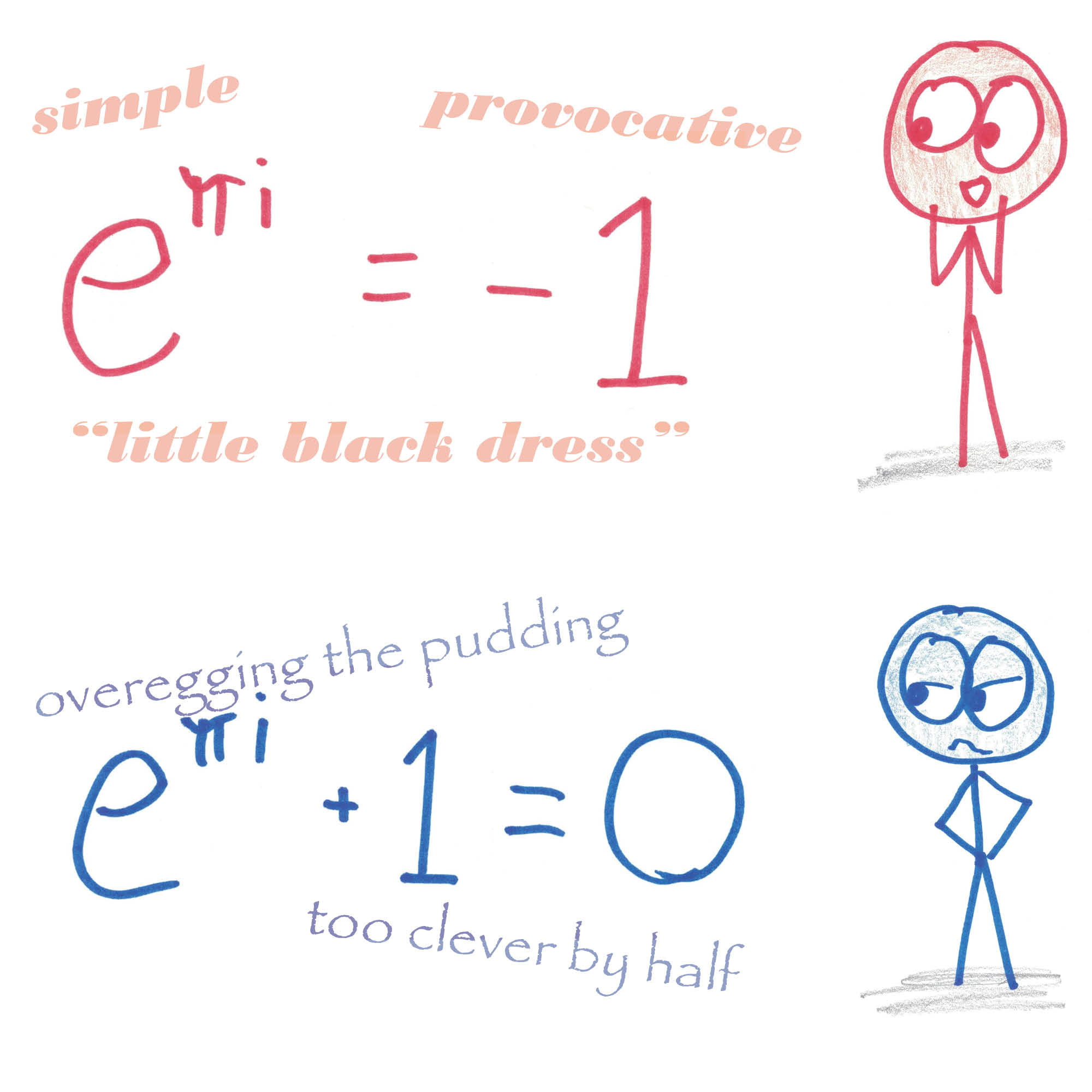
I know I’ll ruffle some feathers with this one. Good. Those feathers look silly. They need ruffling.
Now, have I disrupted the beauty of an equation that “unites the five fundamental constants of mathematics”?
Or, have I just revealed that “-1 + 1 = 0” is not as profound a sentiment as some folks think?
 Math with Bad Drawings
Didn’t understand a word (or number) of it, but enjoyed it nevertheless. Innumeracy is not a bar to appreciating the good things in life.
It’s even better when you understand the math concepts! 🙂
Brilliant.
I loved this SO much! It felt great to smile and laugh first thing in the morning.
“A coat with teeny tiny buttons” eh? 😉
Love this and all you write! So fun and yet so pertinent! Great job Ben! 🙂 Jeanne Lazzarini
Here’s the problem with sin^-1. “sin^2(x)” means sin(x) * sin(x), NOT sin(sin(x)), even though “f^2(x)” means f(f(x)). That obviously means that trig functions are an exception to how exponents apply to function notation. But then “sin^-1(x)” is supposed to be an exception TO the exception?! Ridiculous. We have a NAME for that function, and it’s “arcsine”. It’s so much more clear to just use that!
Haven’t you been showing your preferred form in blue in almost all examples? Did you reverse your convention for the last one?
Oh wow, good catch!
Actually, preferred form is always in orange; it’s the second-to-last one that I switched up at the last moment, while assembling illustrations.
I did so because I realized that (1) my case for the orange definition of variance was going to be too similar to my case for the x –> a definition of the limit, i.e., that I like it when notation clearly conveys a sense of the concept, even at the expense of ease of calculation, and (2) this argument is actually much weaker here than in the limit definition case, because in my experience as an amateur statistician, I’m perpetually using the E(X^2) – E(X)^2 shortcut.
Hence the switch, which seemed to improve both entertainment value and accuracy.
You describe that as orange?! The floating epithets around the formula might be orange, but the formula itself is RED! Let’s start a holy war!
Also, Re: five fundamental constants of mathematics. The best wording for Euler’s identity that I’ve heard is “if you go around something, you’ll end up on the opposite side of it“. If THAT doesn’t take the bombastic rhetoric a few notches down, then I don’t know what does.
Hey everyone! Just wanted to share how I found a great way to unwind after a long day. I saw a small banner while reading news and decided to see what the fuss was about. The variety of online casino bets at betty spin kept me engaged for hours. I was particularly interested in the slots online because of the high-quality graphics. It turned out to be a very successful evening as I walked away with more than I started with, which was a pleasant surprise.