I have long wrestled with exponents.
Not physically. And not really for myself.
I wrestle on behalf of my students.
We tell them that exponentiation is just repeated multiplication. Then, as if we cannot hear our own nonsensical self-contradiction, we tell them that 20.5 and 2-3 and 20 all make perfect sense. It’s a nasty bait-and-switch.
In August, giving an invited address at MathFest in Indianapolis, I mentioned one way to these strange exponents a bit more legible to learners.
Picture a bacterial blob, doubling in size every hour.
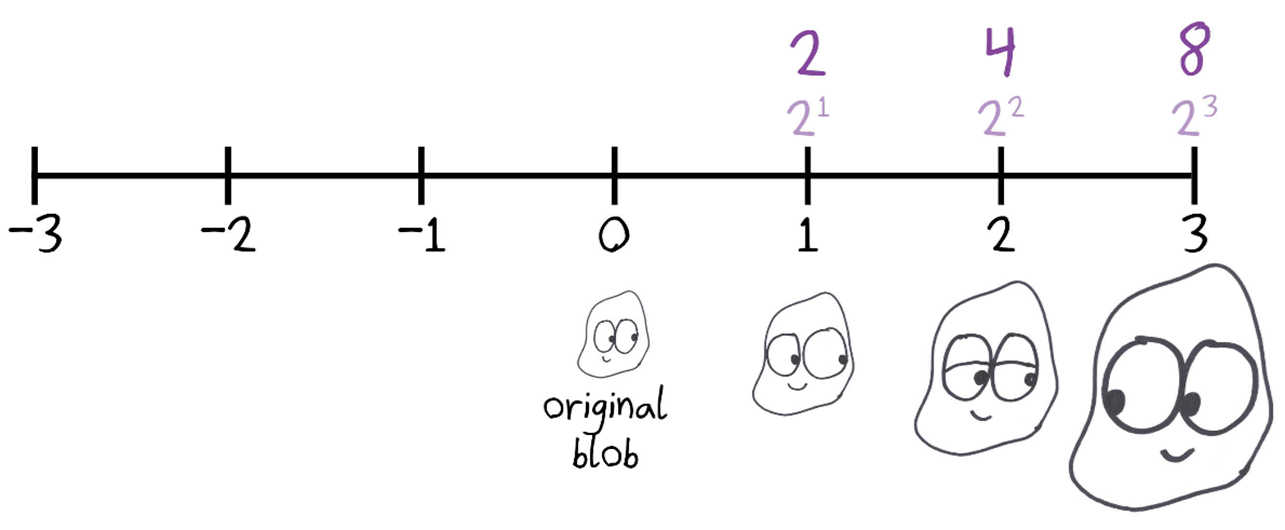
Now, how big is it after 0 hours (that is, at the starting time)? Its original size, of course. So if–and this is a big “if–but if we want the exponential notation to refer to any moment, not just whole hours, then we are left to conclude that 20 = 1.
Now, what about at -3 hours, i.e., three hours before we started the clock? It was 1/8 its original size. Thus, invoking that same “if,” we must say 2-3 = 1/23.
And so on.
Anyway, at that talk, I met the lovely John Chase. He emailed me later:
The fact that you use “blobs” rather than discrete bacteria is important, since the aggregate growth for a bacterial colony depends on the individual splitting time for bacteria in a non-obvious way.
“Non-obvious” is gentle language for a shocking fact. The harsh truth, in a paper that John wrote with collaborator Matthew Wright: average doubling time is faster than average dividing time.
How so? Well, the paper begins with “the classic problem”:
Suppose a bacterium has an average division time of 1 hour. Write a model that gives the population size after t hours if the initial population is 1 bacterium.
The traditional answer: Population = 2t.
But this, John and Matt compellingly argue, is wrong.
Think about it. Do you mean to say that the division time is always and precisely 1 hour? That’s no good. Then, the bacterial population becomes a step function, remaining constant for a whole hour, and then doubling in the final instant.
Obviously that’s not how a bacterial colony works. After 24 hours, it instantaneously leaps from 8 million to 16 million?
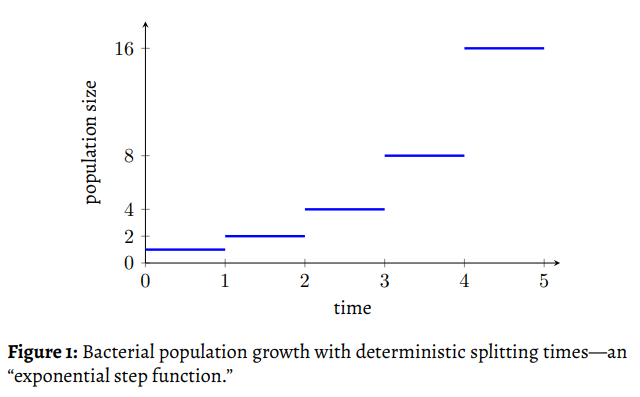
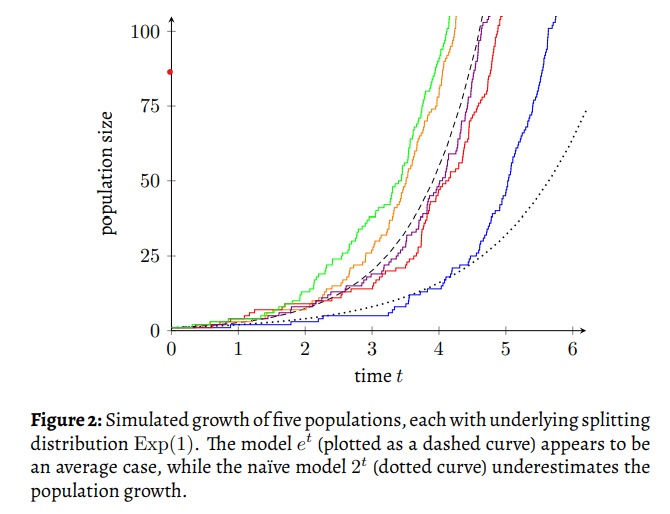
No. You must be picturing some kind of randomness in the doubling times. Some kind of distribution of times for a given bacterium to split, with 1 hour as an average. You’re relying on the randomness to smooth the ugly discrete jumps into something more plausible.
But watch out. If the average splitting time is 1 hour, then for a wide variety of possible distributions–including basically all the ones you’d naturally imagine–the population’s average doubling time will be less than 1 hour.
The growth is faster than it “should” be. You double faster than you divide.
Here’s an off-the-cuff question for further research: What if the splitting time does not have an arithmetic mean of 1 hour, but rather a geometric mean (natural in cases of multiplicative growth), or even a harmonic mean (natural in cases where we average rates)?
Does one of those means more nicely correspond to our intuition that an average splitting time should tell us the average doubling time?
Or is our intuition, as in all things exponential, simply garbage?
The details are in John and Matt’s paper, published last year in Mathematics Magazine.
 Math with Bad Drawings
Great post! On a mostly unrelated note, does anyone else have a multiple year backlog of Math Magazine journals that you’ll swear you’ll get to one day, but in the meanwhile, your giant stack of journals gets keeps growing (at a linear rate) and you don’t know what to do about your mounting guilt of not reading any of these journals and you’re suddenly reminded of this fact because of a citation of an article that you should have read a year ago?
Similarly to how we define average speed not as the arithmetic mean of speeds, but as total distance over total time (which would then work out to be the harmonic mean?), I think we should DEFINE “average” dividing time to be log2(size) over time. Maybe this would also work out to be some “well-known” mean…
A fascinating fact about Cardano is that his work on probability was published after his death in 1663 in “Games of Chance,” which primarily discusses gambling but contains several errors. So, I don’t believe it’s surprising that his ideas didn’t catch on given the errors, the posthumous publication, and the unfavorable gaming environment.
my view is this:
10^3 = 10x10x10 (of course)
10^2 = 10×10
then, 10^1 only has one 10, so there’s no ‘gaps’ between tens to put the multiplication symbols.
and, it only makes sense that 0, being 1 less than 1, would then feature negative multiplication, or division, so 10^0=10/10, and any number divided by itself = 0.
Leí un post muy detallado en un blog de ocio digital sobre opciones seguras en es y decidí darle una oportunidad tras una semana muy gris. Estaba muy desanimado con mis juegos habituales y buscaba algo distinto. Al final, en https://spinwinera.es/ encontré la variedad que buscaba en las slots online. Mis online casino bets empezaron a dar frutos justo cuando iba a cerrar. Gané lo suficiente para pagar lo perdido y quedarme con un saldo positivo muy gratificante para mí hoy.