A mathematician once sent me a draft of some writing he’d done for a general audience. I liked the ideas. I liked the storytelling. I liked being consulted as an expert (it’s very ego-soothing). But I gave one word of warning: don’t frame it as a “history.” Historians will object loudly, I said, for reasons X, Y, and Z.
Naturally, the author also ran his draft by a historian… who hated it, for reasons X, Y, and Z.
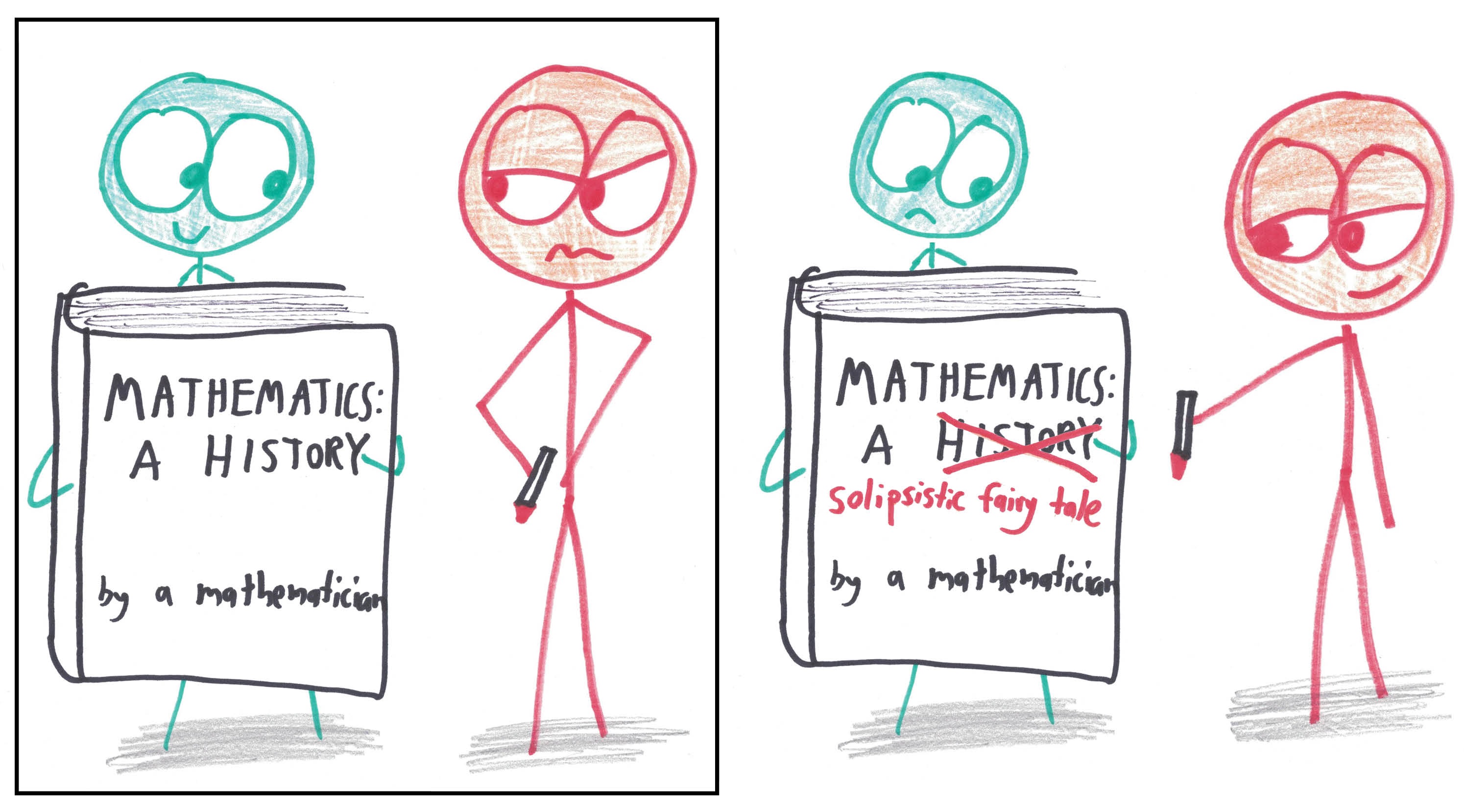
So what were X, Y, and Z?
X: History is not a tale of “progress.” Yes, new math depends and builds upon the mathematics of the past. But this does not mean past thinkers were benighted knaves. When mathematicians act as if humanity were a lone scholar perfecting her proofs, historians want to bang their heads against the wall (and by “their” I mean the mathematicians’).
Y: History is profoundly contextual. To know what is new and innovative in a document, you cannot rely on the document alone. When mathematicians attribute pivotal ideas to lone authors based on a single reading of a single document… well, again with the head-hanging.
And finally, Z: Historians get especially annoyed when mathematicians commit these errors, because they seem to do so with probability approaching 1.
“It’s almost impossible for mathematicians to tackle history,” I said to a friend recently. “History is the opposite of mathematics.”
My companion looked perplexed. “Explain.”
“Okay, not opposite. Dave Richeson and Jay Cummings can do it,” I clarified. (Totally changing my claim is my favorite kind of clarification.) “But in the high-dimensional space of academic subjects, the subject furthest from math—the one most different in methodology, nature of inquiry, and intellectual skills required—is history.”
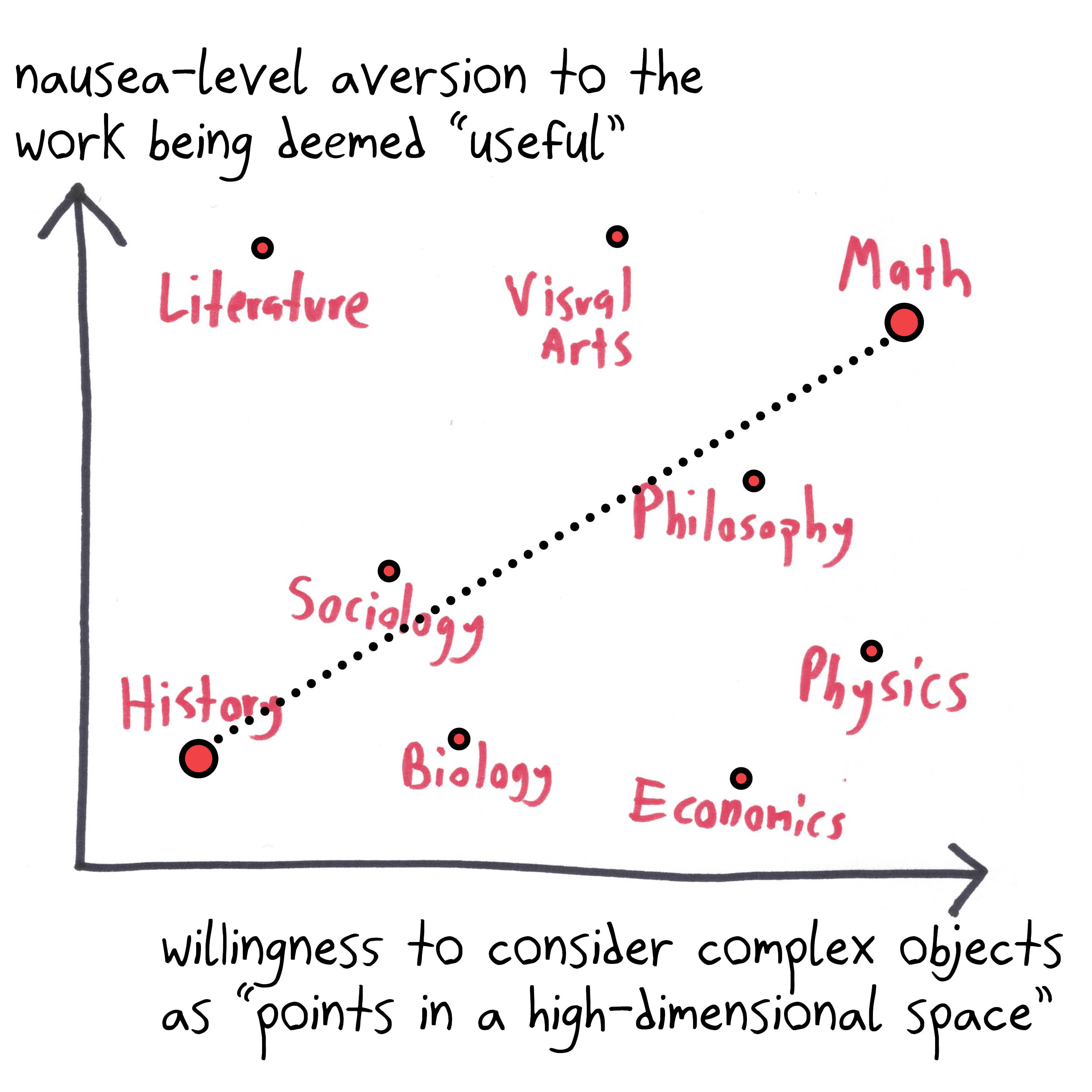
“Not English literature?”
“No,” I said. “See, math is 100% theory, 0% empirics. Everything follows from first principles; think hard enough about something, and you reach the truth. In math, new data can never refute a beautiful idea.”
“And how is that like literature?”
“In literature, everything depends on the text. It’s a self-contained cosmos. Later texts can never refute it, only enrich it. And just like reading a proof, you approach the text word by word, excavating all the nuances that were carefully encoded there by an author.”
“Hmm.”
“But history is 1% text, 99% context. To understand a document, you’ve got to read a thousand others. Nothing means anything in isolation, nothing follows from first principles, and the primary role of theory is to keep us from drowning in oceans of detail. Historical truth is irreducibly complex, and all our conclusions are only tentative ways of compressing it to fit in a human brain.”
“Bleak.”
“More to the point, it’s messy, messy in a way that mathematical thinking is totally ill-equipped to handle. Mathematics is self-contained. History is uncontainable.”
Of course, I didn’t say any of these things precisely. A historian might be able to recreate the conversation more faithfully, or present the memory with sufficient vagueness instead of open fabrications—but alas, I’m the opposite of a historian. I remember the big idea, and I simply trust the details to fill in themselves.
Which might sound lazy of me. But if you consider the totality of mathematics—our culture of abstraction, the nature of our language, math’s uneasy interdependence with more “practical” sciences—in short, if you consider mathematicians in the rich, contextual way that a historian would… well, then my failures as a historian make perfect sense.
 Math with Bad Drawings
Great post! And something I hadn’t quite thought about in that way (although I am well aware that we mathematicians think differently than most of the people I meet).
It’s an interesting idea to try and think about what discipline would be the opposite of mathematics, but I think to do so one needs a more accurate description of “mathematics.” I disagree with your characterization of math as “100% theory, 0% empirics.” What about applied mathematics? There’s an entire NSF-supported mathematical sciences research institute titled the “Institute for Computational and Experimental Research in Mathematics” (ICERM).
Mmm, this is a fair concern. Perhaps a better characterization than my glib “100% theory” phrase, which wrongly suggests that experimentation and inductive thinking have no role, would be that mathematics is “the maximally deductive discipline,” or “the discipline in which pure theory takes us the farthest.” (This is still true, I think, if we draw the disciplinary boundaries to encompass pure and applied math, as we should!)
History, meanwhile, I think of as “the maximally contingent discipline,” or “the discipline in which pure theory cannot take us very far at all.”
Marx (and Marxists) would disagree. Or, a bit less provocatively, consider a book like Generations, and its theses about, well, how the behaviour of generations has predictive power. Or the 1619 project. These are physics-style empirical theories, but theories nonetheless.
Ah, well said — I should admit (to myself, as much as the reader) that I’m making very particular historiographical commitments here!
Marx is a good touchstone: I do find classical Marxism more mathematical in flavor, involving the rigorous application of certain “theorems” about power. Or for another example, “Why Nations Fail” posits a physics-style empirical theory (even as it’s careful not to claim physics-level predictive accuracy).
In my own head — probably contra what these historians themselves mean — I tend to downgrade these from “mechanistic theories of human society” to “effective algorithms for data compression on the historical record,” ways of capturing a maximal amount of human experience using a minimum of equipment.
But I don’t know enough history to know if I’m espousing a weird fringe view, or something more conventional.
Well, Applied Mathematics isn’t actually Mathematics, is it? ; )
Seems to me that you are also implicitly making a case for the importance of general education in higher education, for who can appreciate your analysis without one? Thank public education for what little of it we have.
That was a must profound post. Thanks for sharing . I’m not a mathematician (I was a film history major in college) Recently I have been reading a lot of history of math books (the ones in the back of Barnes and noble that have no equations) for someone like myself who wants to learn more about mathematics is the current path am on the right one?
It depends. If you want to do mathematics, then knowing the history of math won’t help as much as practicing actual math.
If you just want to know how we got here, then a history of math book is ideal for that.
It sounds like a great way to explore!
Any particular goals you’re hoping to achieve in your mathematical journey?
Or, perhaps more relevant: which of those history of math books have you found most compelling or rewarding?
This post wins the internet today: an interesting contrast that I have never considered or run into before. I agree with some commenters that characterizing math as 100% theory and 0% empirical is extreme. An 85% and 15% split is more accurate; this leaves plenty of room for applied mathematics. As for some historians claiming that Marxism is a theory, it is a theory, just like phlogiston was a theory. If anyone is counting, most theories are wrong. Marxism’s saving grace is that it makes claims about reality that can, in principle, be tested but never are, as any time someone points out blatant contradictions or failed predictions (the state will wither away), some no-true Scotsman Marxist always pipes up with, “that’s not communism.” The other big difference between history and mathematics is that mathematical problems can be solved while historical ones never can.
Thanks for commenting! A perplexing recent read for me was Terry Eagleton’s “Why Marx Was Right,” in which he attributed to Marx such ideas as “the capitalistic industrial revolution was a hugely successful wealth-generating engine, without which society would have simply lacked the material resources for socialism to be imaginable.” It struck me as a defense of Marx at the expense of Marxism — which is just to say that Marxism is perhaps not a theory, but a diverse family of theories all somewhat uncomfortably sharing the same species name.
I think there are more historians who are willing to consider their work as “useful,” I suppose depending on how one establishes that. E.g., military history and a fair amount of 20th century history (political, social movement). But Historians, like many of us in non-STEM liberal arts subjects, resist the demand for immediate instrumentalization of knowledge in applications a young person can accomplish. And many of us resist the constant pressure for most college subjects to be tethered to a short term calculus of job markets for 22 year olds.
Thanks for commenting! What you say squares with my weakly-held outsider impressions of historians: that you folks are perfectly happy if your work informs present-day approaches to politics and social action, but you’re definitely not in the business of packaging up historical knowledge as directly applicable job preparation.
(My two-variable graph totally collapses this distinction, and many others, but at least each discipline’s cultural resistance to distinction-collapsing is roughly captured on the x-axis!)
For what it’s worth, the STEM liberal arts folks I know (who may or may not be representative of the larger crowd) espouse a pretty similar attitude; they seem to see some natural overlap between the skillsets for academic work and for industry, but by and large, they lament the pressures to turn the liberal arts B.A. into a form of fancy vocational training. That said, I’m not sure how successfully they’re resisting the pressure! (And they may not be sure themselves.)
Wow! Great 🙂 I was bad at maths😅