Updated 7/16/2013 – See Original Here
Once at a picnic, I saw mathematicians crowding around the last game I would have expected: Tic-tac-toe.
As you may have discovered yourself, tic-tac-toe is terminally dull. There’s no room for creativity or insight. Good players always tie. Games inevitably go something like this:

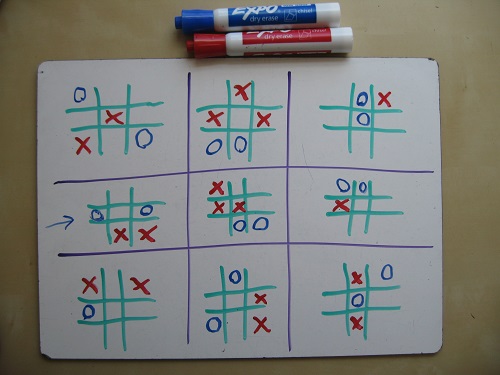
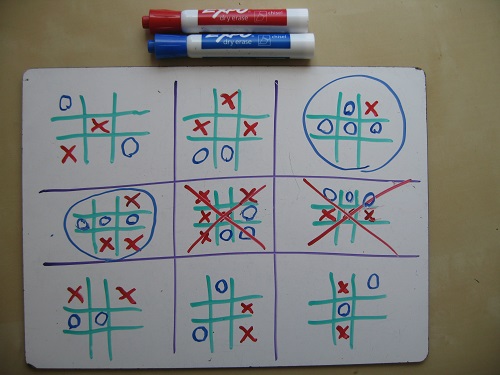
But the mathematicians at the picnic played a more sophisticated version. In each square of their tic-tac-toe board, they’d drawn a smaller board:
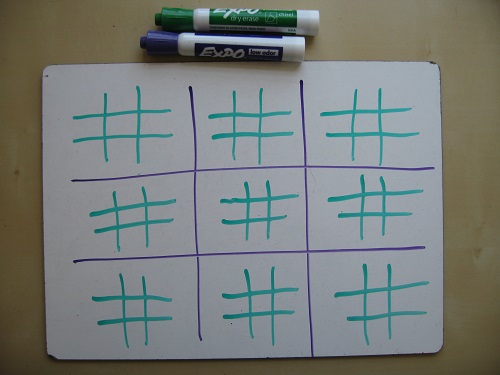
As I watched, the basic rules emerged quickly.
- Each turn, you mark one of the small squares.
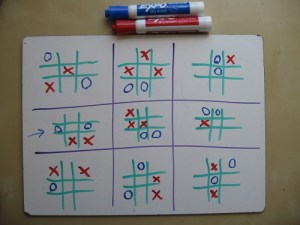
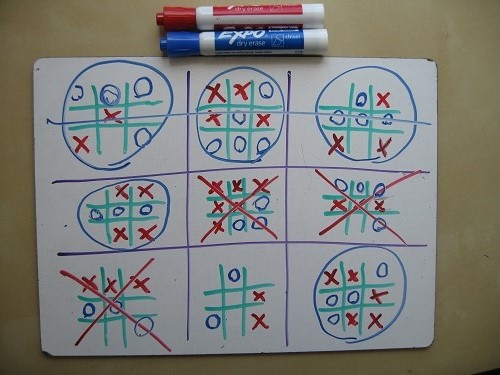
- When you get three in a row on a small board, you’ve won that board.
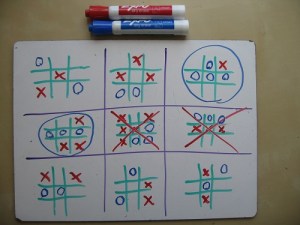 To win the game, you need to win three small boards in a row.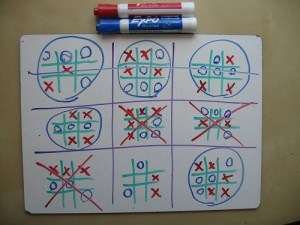
But it took a while for the most important rule in the game to dawn on me:
You don’t get to pick which of the nine boards to play on. That’s determined by your opponent’s previous move. Whichever square he picks, that’s the board you must play in next. (And whichever square you pick will determine which board he plays on next.) For example, if I go here…
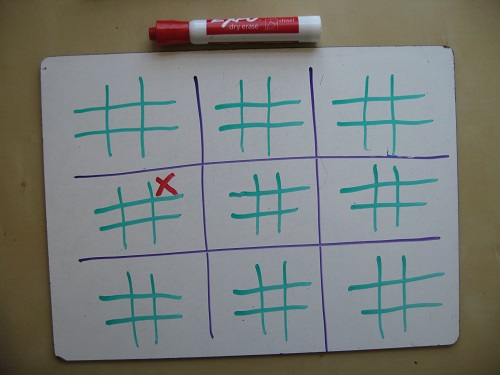
Then your next move must be here…
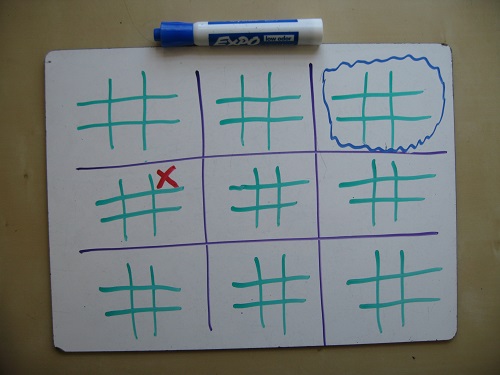
This lends the game a strategic element. You can’t just focus on the little board. You’ve got to consider where your move will send your opponent, and where his next move will send you, and so on.
The resulting scenarios look bizarre. Players seem to move randomly, missing easy two- and three-in-a-rows. But there’s a method to the madness – they’re thinking ahead to future moves, wary of setting up their opponent on prime real estate. It is, in short, vastly more interesting than regular tic-tac-toe.
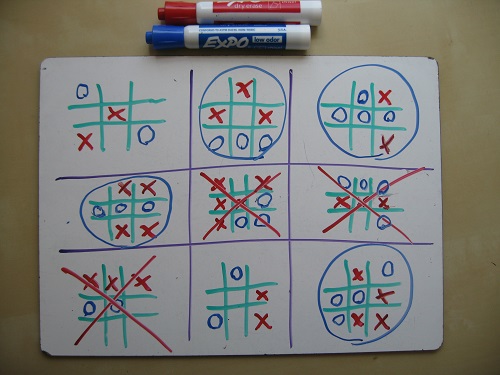
A few clarifying rules are necessary:
- What if my opponent sends me to a board that’s already been won? In that case, congratulations – you get to go anywhere you like, on any of the other boards. (This means you should avoid sending your opponent to an already-won board!)
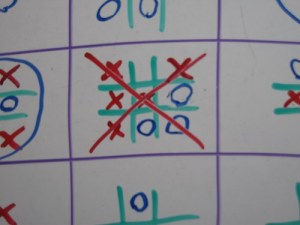
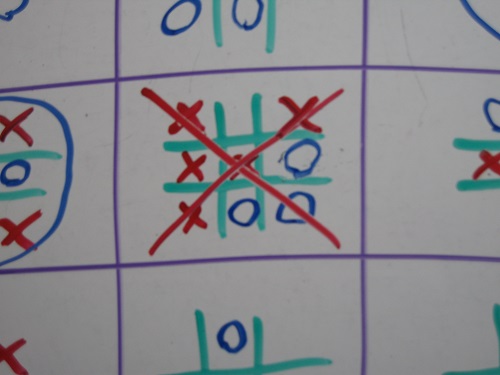
- What if one of the small boards results in a tie? I recommend that the board counts for neither X nor O. But, if you feel like a crazy variant, you could agree before the game to count a tied board for both X and O.
When I see my students playing tic-tac-toe, I resist the urge to roll my eyes, and I teach them this game instead. You could argue that it builds mathematical skills (deductive reasoning, conditional thinking, the geometric concept of similarity), but who cares? It’s a good game in any case.
Anyway, that’s Ultimate Tic-Tac-Toe. Go play! Let me know how it goes!
11/18/13: See the follow-up post!
A Partial List of Online Versions and Apps
(Check Comments Below for Others)
- Super Tic Tac Toe
- Tic Tac Toe Ten
- Ultimate Tic-Tac-Toe
- XO9
- Nikhil Baliga
- Niek Haarman
- Kongregate
- Inception Tic Tac Toe
- Khan Academy (open-source online version)
- Live-coding of an online version (French, with English subtitles)
- C code for a strong artificial intelligence
While you’re here, check out Math Experts Split the Check and the epic rhyming proof-poem A Fight with Euclid.
 Math with Bad Drawings
I would pay $2 for this on iOS and Android. GET ON IT.
INDEED!!!
I just tried to play until first local win. It is really hard and interesting. Just do not allow your opponent to win anywhere…
the problem: http://www.youtube.com/watch?v=H4zSRkBMPng
You would pay $2 for something you only need a paper and pen for?
You don’t need anyone to make the game for you ffs or are you unable to do anything anymore that isn’t on a phone/computer?
Think his plan was for it to be vs people on the internet and that makes it possible to play with friends who might be away or to meat people you’ve never met. Ofc if you are around your firends at the time a pen and paper would be preferable but if not then an app is a smart alternative. I would love to develop one. Don’t do iOS however but android though
I’ve actually made this on both iOS and Android … it’s called Tic Tac Toe Ten and is exactly what you described above.
It is already there, called Tic Tac Toe Ten. I am the developer and we made it in 2008.
Oops, didn’t see the creator posted first.
Hey we also created a version of Ultimate Tic Tac Toe for Android.
https://play.google.com/store/apps/details?id=com.shockblastapps.ultimatetictactoe
We disallowed the Orlin Gambit strategy though because it is kinda anti fun. We are currently creating an AI to play against and will release that + the IOS version together for free 🙂
I shall make a flash game out of this.
in another note, offcors free 😛
please don’t. flash is so rubbish and has ruined the internet experience!
apple jerk! if it wasnt for flash we wouldnt have youtube. and thats just one example
Here is the real reason to make it using built-in browser technologies… it will work across all the modern mobile devices.
give us a few reasons why flash is rubbish 🙂
Or are you just following the herd?
It’s not all bad. But it’s a resource hog, adds another surface of attack to the browser (which gets exploited more often than people realize), and for better or for worse, isn’t supported on many mobile platforms. When open standards exist (HTML5/Javascript) that can do virtually everything it does (often times faster, with the performance enhancements made to browsers’ JIT compilers), it makes sense to pick that option. Especially in such a heterogeneous world.
It’s playable on Silverlight at:
http://www.tictactoeten.com/play
http://bohdananderson.com/xo/
Just a basic version of it
Reblogged this on Rohith's blog and commented:
This is really good. Now Tic-Tac-Toe would be more interesting than it ever was
Truly a creativity! Now I regularly play this several times with my friends 😀
We’ve got to go deeper! What happens if you add a third layer?
what happens if you go for 4 x 4 boards rather than 3 x 3. In 3-D noughts and crosses (as we Brits call US tic-tac-toe), a 3 x 3 x 3 cube leaves the centre cube too powerful and if the first player goes in the centre cube, he/she can always wwin. With a 4 x 4 x 4 cube, there is no centre cube and the game is both less predictable and more demanding of skill from the players.
I like this variant and it would be interesting to see a 4 x 4 version.
Reblogged this on reflectionslav and commented:
Interesting blog ( & game) I came across today..play and njoi!!
too good:)
jusst a great creativity
Reblogged this on i-hilser and commented:
this is very clever..
What is actually the name of this game? 😀 Just “Ultimate Tic-Tac-Toe”?
Tic-Tic-Tac-Tac-Toe-Toe
Or Tic-Tac-Toe-Two?
Just Saiyan……
I would make one small adjustment so that the the “orlim gambit” don’t occur (because it’s fairly boring and way too used). Make it so that if the opponent sent you to a small board that you have already won, you can also go to any other small board, just like if the opponent had sent you to a full one.
This is very bad game. Nothing prevents starting player from using the strategy described here again and forcing 8 0’s in one of the corner boards. Next X grabs a victory of the opposing corner square with one move and at the same time forces 0 to play in the just won sub-board. X proceeds to grab 3 sub-boards in row with his next 2 moves while forcing 0 to play his 2 last moves on the board X won. W has won the game, 0 could do nothing to prevent this.
Since I am a go player, I substituted X with W (for White) in the post.
You’re right. Luckily, it’s an easy fix: If you’re sent to a board that’s already been won, you may go anywhere you like.
My friends and I used to play a version of tic-tac-toe using three boards, so less complicated than this. But the idea is, where you can put the X or O was determined by “gravity”. As in, it was actually a 3x3x3 (or 4x4x4) cube. We predetermined the order of the boards, that is to say, which was at the very bottom, which was above that, and which one was at the very top (and so on), and you could only occupy a box if it was the lowest one available. We hadn’t found any obvious ways of winning, but a lot of strategy and a certain amount of trickery needs to go into it. Of course, you could actually design a 3D game in which you didn’t have to remember the gravity rule by yourself, but since we were playing on paper in between collecting data in the lab, we had to keep track of the gravity problem (not that difficult for a couple of PhD students).
I like it! My mind is now running furiously around the problem of creating a self-learning system for it, the way one has to do for basic tic-tac-toe in computer science classes (well, we did back in the ’80s – not sure about now). I wonder if the same basic game theory applies… I have a feeling it does, but suddenly it’s all so recursive… mmm….
The way we implemented it in Tic Tac Toe Ten is such that your strategy depends on your end winning condition (1st to win 1 of 9 squares, 1st to win 2 of 9 squares, 1st to win 3 of 9 squares, or 1st to win 3 squares in a row). The way you play depends which mode you are in. There are some general strategies that translate across the modes and also some alternative winning conditions like winning a specific square out of the 9 (8 don’t matter). Visit https://www.facebook.com/tictactoeten and check out our community 🙂
just awesome
Another – possibly better – name for this game is: FRACTAL TIC-TAC-TOE.
Just for the math-heads out there…
I created this game with a friend when I was a Junior in high school (in 1986 or 1987) and called it Double Trouble Tic-Tac-Toe. I have been teaching it to my students since 1999 and started calling it Extreme Tic-Tac-Toe. Our rule was that your second move could NOT be in the same square as your first one.
Some more possible names:
TTT^2 – “Tic-Tac-Toe Squared”
TTT’ – “Tic-Tac-Toe Prime”, “Tic-Tac-Toe: First Derivative”
WATTT – “Wide-Area Tic-Tac-Toe”
### – “#ic #ac #oe”
and of course
“Tic-Tac-Toe-ception”
Tic-Tac-Toe-Two!!!
I’m just……SAIYAN!!!
4 T’s, its brilliant.
I’m ready to port this to Cocos2d-x for iPhone/Android peeps 🙂 But I’m sure it’s done already
yeah I did the work back in 2008 … http://www.tictactoeten.com … let me know what you think 🙂
It is called “Tic Tac Toe Squared” and a guy built an app for the thing in 2011 http://www.youtube.com/watch?v=WJolR8GmAaM
(skip to 3:05 to skip the uninteresting bla bla)
People! Is anybody writing a code/logic for this game? something that will play as the computer/default opponent in single player mode?? Anyone Interested?
It already exists on iOS, Android, and Windows Phone called Tic Tac Toe 10.
Computer:
http://www.tictactoeten.com/play
iOS:
https://itunes.apple.com/us/app/tic-tac-toe-ten/id317168510?mt=8
Android:
https://play.google.com/store/apps/details?id=com.livelovelearn.tictactoeten&hl=en
Windows Phone:
http://www.windowsphone.com/en-us/store/app/tictactoe10/d84eac98-7a6f-e011-81d2-78e7d1fa76f8
The Khan Academy version doesn’t implement a rule that is vital to this game. If a board is won, you can still force a player to move on the won board (according to the rules, an example of which is the gambit that you named after yourself). In the Khan Academy version in edit #2, if a board has a 3 in a row, you can’t force them to move there again.
Well, they do have a version that implements that rule, but it’s not very interesting, because the AI always wins. Turns out that my egotistically named gambit can be extended into a guaranteed winning strategy. See here: https://www.khanacademy.org/cs/in-tic-tac-toe-ception-perfect/1681243068
A rule mod to reduce first-mover advantage is to require the first play to be in a side box.
A creation of innovation!
Your tactics look fine at the end of the sequence but it is O to move. He simply selects the (eg) top left square in the Top Left board. He can then repeat your “steal the centre” moves by always selecting the top right in any board you send him to, forcing you to always play that top left board.
At the end you have 8 X in the top left to his 1 O and have won that board. In the remaining 7 boards there is an X in the centre and a O in the top left.
There is a symmetry here in that the complete boards are won in the “big game” by the opposite of the layout in the remaining boards.
Pursuing this stragey to its conslusion results in the same in evitable draw as a single game.
OXX | O |O
XXX | X | X
XXX | |
———————-
O |OOO|O
X |OXO | X
|OOO|
———————–
O |O |O
X | X | X
| |
OK – Formatting fails
To break this impasse you could introduce some extra rules:
eg:
The “same square – same board” combination could have restrictions applied. – eg can’t be first square selected in a board,
or
Can’t be first square played by either player for their first move in a board
or
can’t be slected by either player until all other squares have been filled.
or the forced move rule adapted
Once a board has has been won, the winning player can not be forced to play it or
neither player can be forced to play it,
or
the losing player can be forced to play it until he also completes 3 in a row or it becomes full.
or
A player can not be forced to play the same board 2 turns in a row.
brilliant idea (y)
Reblogged this on I am a gamer / or mugger (yeah right I wish) / Haikus are my life 😀 and commented:
Awesome!
I am not an English native speaker, so my grammar may be wrong.
In the first version(if you’re sent to an already-won board, you still have to go there), if O has already won in one small square, what will happen when X get three in a row in that small square?
Good question. The way I play: if O has already won the small square, then X can’t do anything to change that. Even if X also gets three in a row, it’s still O’s square.
You could play a different way, though. For example, if X also gets three in a row, you could count that board for both X and O. I’ve never tried playing like that.
Fine grammar, by the way! 🙂
You can play it online here – http://nikhilbaliga.com/tictactoe/tictactoe.html
I was thinking about this, and to avoid the strategy outlined (which basically means that the person who goes first wins, or at least forces a draw), give each player one “free choice” turn, after which it goes to the rules written. So, X plays anywhere, then O plays anywhere, then X has to play according to O’s play, and so on.
Android Holo app: https://play.google.com/store/apps/details?id=com.haarman.ultimatettt
Reblogged this on scybites and commented:
Will attempt to play at first opportunity.
Wrote this after seeing this post ..
It’s a nodejs webapp, where two players can open same URL and play online …
(Uses web sockets) ..
https://github.com/boopathi/tictactoe
The only way to lose or not to win (unless you’re stupid, of course) a tic-tac-toe game is if the first two moves are not NOT putting a tile (x or o) in the center and other one in a corner. Then you’re doomed.
Ok, I’m probably going to sound dumb for asking this, but I am confused about the system you use to send your opponent to a certain block. It was unclear to me how you know where you must go next. Can you please explain this in more depth? Thanks!
Hey, I made an open source version for Android (it’s also free).
(Two-players mode only, i.e., no AI, no internet.)
https://play.google.com/store/apps/details?id=org.droid_in_the_sky.ult_tic_tac_toe&feature=search_result#?t=W251bGwsMSwxLDEsIm9yZy5kcm9pZF9pbl90aGVfc2t5LnVsdF90aWNfdGFjX3RvZSJd
(it also runs on PC if you compile it from the sources)
Can’t you always tie as player 2 if you always play in the same small board as the previous move, aiming to tie on that small board?
https://play.google.com/store/apps/details?id=com.s0b3r.tictactoe is the only Android app that implements rule #1 correct. All the (free) others above has the “player 1 can always win”-version of the rule.
Are you sure?
I set the rule that you cannot go to a closed mini-board, but choose an open one:
http://play.google.com/store/apps/details?id=org.droid_in_the_sky.ult_tic_tac_toe
We also created a version of Ultimate Tic Tac Toe for Android.
https://play.google.com/store/apps/details?id=com.shockblastapps.ultimatetictactoe
This one doesn’t allow your Orlin Gambit strategy which isn’t fun to play against as you can not do anything against it. So the little boards that are already won can not be further played upon.
We are currently working on the AI so you can also play it alone and will update you guys when it is done 🙂
We’ve updated the app and now it has an AI to play against 🙂 So now you can play the game when you’re alone.
And here it is …
http://tictactoe.scriptle.net/
Multiplayer version of this game.