A mathematician named Stephen Pollock once pointed me towards a strange turn of phrase. In a New York Times Sunday Review piece on August 23, 2013, two authors penned this clause: “As the rate of acceleration of innovation increases…”
Listen to that again, and count the derivatives.
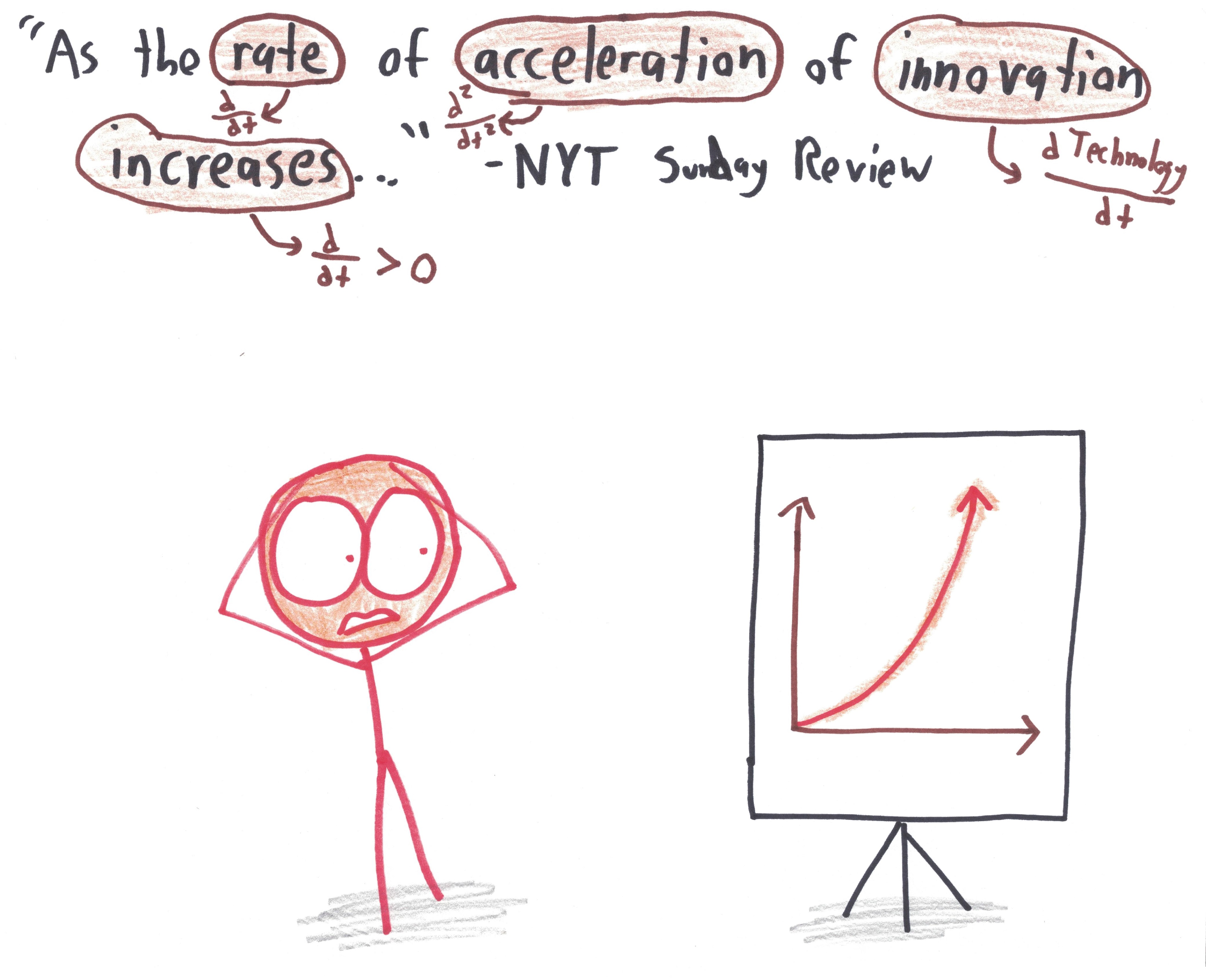
Stephen broke down the mathematics like this:
Level of technology in society = T
Innovation = change in technological level = T’
Acceleration of innovation = second derivative of innovation = T ’ ’ ’
Rate of acceleration of innovation = T ’ ’ ’ ’
Rate of acceleration of innovation is increasing means T ’ ’ ’ ’ ’ > 0.
In short: this is a claim about fifth derivative! Stephen wrote to the authors (two economists) and received the following gracious reply:
I am thrilled at the care you put into unpacking ‘the rate of acceleration of innovation increases’ – clearly, we used the terms as intensifiers in this context, and I am glad to have my attention returned to the implications of phrase in a technical context. Thank you.
Stephen’s interpretation is literally, technically correct, but (and I say this with full admiration) quite silly. It’s pretty clear they meant these derivatives neither literally, nor technically. Still I’m fascinated by the idea that the derivatives can be used in such a way.
Can a derivative really work as an intensifier?
I’m forced to conclude it can. Even ignoring their mathematical meanings, high acceleration feels somehow grander than high velocity (and the meek high position is scarcely worth mentioning).
I’m reminded of exponential. For mathematicians, it means “possessing infinite positive derivatives.” For laypeople, it means “really fast.”
Thus, the colloquial “exponential” is just a disguised version of the derivative as intensifier.
So, hold on: does this mean that integrals can work as mitigators? After all, in math, integrating does soften a function; it is an averaging process, and even a discontinuous function may have a continuous integral. Is the same true in English? To soften a claim (“eek, don’t drive so fast!”) do I simply take an antiderivative (“eek, don’t drive so far!”)?
No dice. If anything, an integral is sometimes an intensifier: not “X,” but “the sum total of all X.”
Further evidence that the languages of mathematics and English are not isomorphic: mathematical inverses become English synonyms.
 Math with Bad Drawings
What was the title of the article?
Here it is: https://archive.nytimes.com/opinionator.blogs.nytimes.com/2013/08/24/what-is-economics-good-for/
I think integrals or something like them can be mitigators. “On the whole, X”. “On average, X”.
(But, also, derivatives don’t always intensify. An “up-and-coming X” is probably not better than “our most accomplished X”.)
Mmm, both good points. To be fair, I’d rather be described as a “rising star” than a “risen star,” but only one of those is an actual idiom, so your second point stands.
I think there’s a few naughties going on to bump the count up to five.
Acceleration is a borrowed word. On its own it’s second derivative of displacement. So the word innovation in “acceleration of innovation” is there to indicate that we are metaphorically using “acceleration” to talk about changes in tech, not talking about speed/displacement. (And, surely, innovation is change, not a rate of change). So acceleration of innovation is second derivative, not third. And then “rate of” is really a language redundancy for emphasis. Saying essentially the same thing in an English language clause doesn’t necessarily mean they stack, its often for emphasis, clarity or effect.
So yeh – acceleration is often “misused” like exponential (the misuse of which was awful during the pandemic), but I think the case is overstated.
I agree with this. If instead of “innovation” it had said “speed”, then the phrase would become “the rate of acceleration of speed”. And that clearly, unambiguously, means exactly the same thing as “the acceleration”, which is the second derivative of position.
So in fact, literally, technically, the correct interpretation refers to the second derivative of technology level. That is what the authors meant, it is what they wrote, and it is what the words actually mean.
Notably, “the rate of” does not increase the number of derivatives, it merely indicates that what follows is itself a derivative. And “acceleration of [some type of speed]” only adds one derivative, thus changing a speed into an acceleration.
Even though I’ve seen calculus textbooks argue otherwise, I think you’re both right on “rate of,” which (as I hear it) doesn’t add a derivative when we talk about “rate of inflation” or “rate of hair growth” or whatever.
But I disagree on acceleration! “Acceleration of speed” is a phrase I wouldn’t expect from someone familiar with kinematics, but if they did use it, I’d assume they meant the second derivative of speed. Similarly, from a knowledgeable economist, “acceleration of inflation” would be different from “growth of inflation” which is itself different from “inflation” (which is itself a rate). Hence the old joke (I should track down the source) about Nixon making his re-election case on the basis of a third derivative.
Anyway, I think we all agree that the authors probably meant, “As the rate of innovation increases,” i.e., the second derivative of technology level is positive.
But I do think throwing the word “acceleration” in there, while easy to interpret as just a matter of emphasis, really does alter the technical meaning by adding two derivatives, just as a colloquial misuse of “exponential” would alter the persnickety technical meaning (while not really altering the intended or understood meaning).
Suppose there are two distinct types of acceleration taking place. For example, an ice skater might have both their rotational speed and their linear speed accelerating at the same time.
If we want to talk about just one of those accelerations, we can specify which by saying “the acceleration of rotational speed”. It may be more common to say “the rotational acceleration”, but that is simply a stylistic choice just like “a pile of rocks” versus “a rock pile”.
And if we actually want to consider the value of the acceleration, rather than its mere existence, then we may introduce that value as “the rate of acceleration”. Thus, for example, “The ice skater had a peak rate of acceleration of rotational speed equal to ___ rad/s².”
This is a slightly verbose stylistic choice, and the same idea could be conveyed more succinctly as, “The ice skater had a peak rotational acceleration of ___ rad/s².” But those two sentences carry the same meaning. After all, they only differ in whether the modifier (to specify which acceleration) appears before or after the noun it modifies, and whether “acceleration” carries double duty as both a type of thing and that thing’s quantitative value.
For the original example about innovation, nobody would ever put the modifier before the noun. The phrase “innovational acceleration” would never be considered as an option, so it was always going to be “acceleration of innovation”. And including “the rate of” makes it clear that the authors are discussing a concrete value, rather than an abstract concept.
The sentence as written is abundantly clear and precise in its meaning.
Hmmm…. I was not open to persuasion on this but you’re making a forceful case!
I still suspect that, if an economist did want to express that T”’ > 0 or T”” > 0, this would also be a reasonable way to express such a thought, so we are able to interpret this not because the phrasing is unambiguous, but because those meanings are just much less likely to come up in conversation than T” > 0.
That said, you’ve persuaded me that while this phrase is not unambiguous, it is perfectly idiomatic, not only in the colloquial setting, but in the technical one, too. So my charge that the phrase “literally, technically” means what Stephen says is, as you say, not right — better to say something like “it permits Stephen’s interpretation” or “we cannot strictly rule out Stephen’s interpretation.”
If I recall correctly, the classic example here is a 70s US president (Nixon?) stating that his administration resulted in a further decrease of the speed of growth of inflation or something along those lines…
Yes, that’s right! Wikipedia has the source: https://en.wikipedia.org/wiki/Third_derivative#cite_note-2
At the second derivative, I already see 3 quotes:
Acceleration of innovation = second derivative of innovation = T ’ ’ ’
Looks like the total is then 4 not 5?
Well, I think Stephen is right that innovation itself is already a derivative, T ‘.
The acceleration of innovation is the second derivative of this, so it adds two more derivatives: hence, T ‘ ‘ ‘.
But I think you’re probably right that the total is 4, since squeezing an extra derivative out of the phrase “the rate of” is cheeky at best.