Lecture #1:
There lives the dearest freshness deep down things
Welcome, everyone, to Math 190 / Literature 210: Mathematical Proof as Literature.
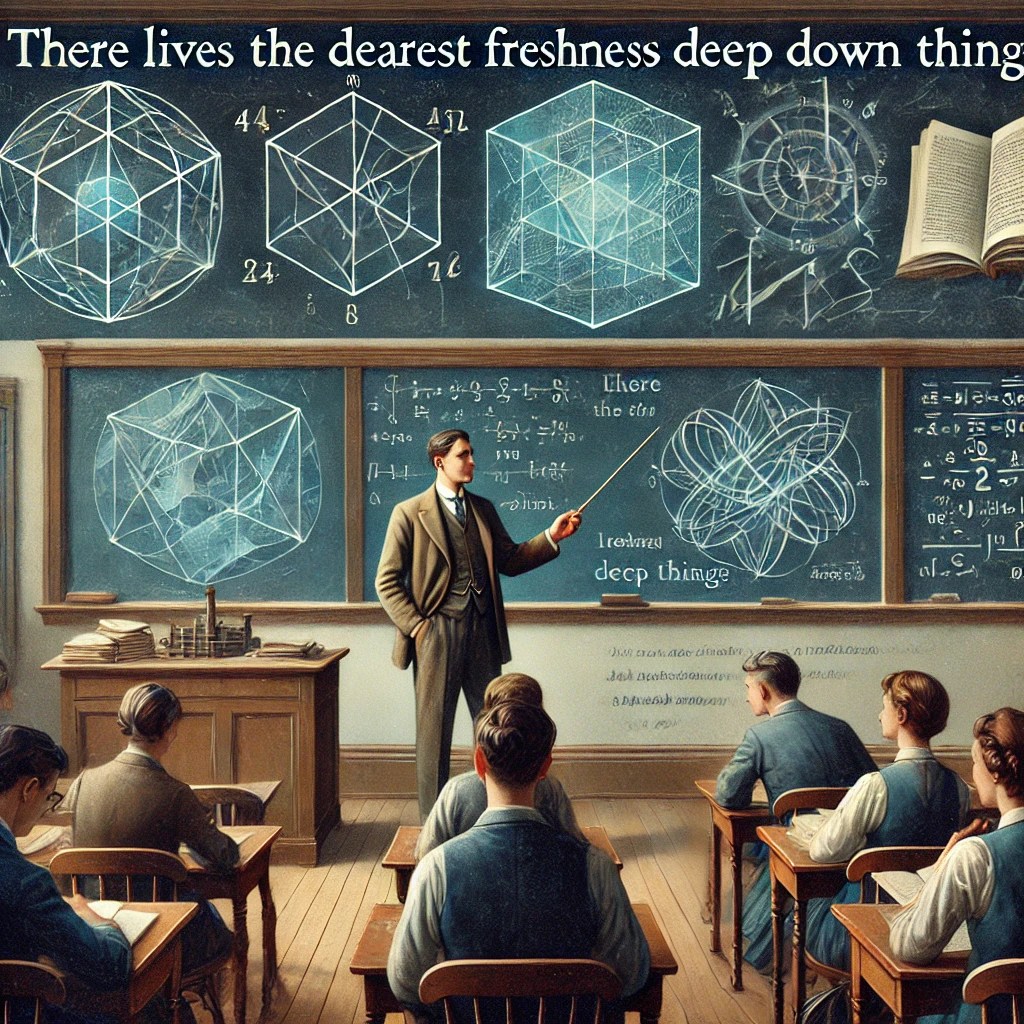
I realize that half of you are here only to fulfill the writing requirement, and the other half, the math requirement. Either way, I hope to cause you a great deal of intellectual discomfort.
As you know, I am a scholar of literature, with no more than a high school background in math. Yet together we shall reach up and touch the thinnest, most delicate branches in the canopy of modern mathematics. Most likely, we will snap them by mistake.
Anyway, we begin as moderns must: by venerating the ancients in a covertly self-serving manner.
In A Mathematician’s Apology, after a long preamble about mathematics as an Edenic garden of harmless beauty, G.H. Hardy finally turns to some actual math:
I will state and prove two of the famous theorems of Greek mathematics… They are ‘simple’ theorems, simple both in idea and in execution, but there is no doubt at all about their being theorems of the highest class. Each is as fresh and significant as when it was discovered—two thousand years have not written a wrinkle on either of them.
No surprise that Hardy calls the proofs “significant.” But why “fresh”?
Why advertise this proof, like a synthetic fabric, as “wrinkle-free”?
Perhaps he means that each proof still “sounds like new”? But if so, this is fatuous. Hardy’s presentation is new; he is not using Euclid’s precise logic, and certainly not his precise Greek. If he is praising the style of the proofs as “fresh,” then he is merely applauding his own wit and verve, his own ability to bring these dusty texts back to life.
Or, alternatively, is Hardy making a claim about the nature of mathematical thoughts–that, somehow, to think them is to refresh them? That seems a lovely idea: that a proof blooms anew in each mind that ponders it.
But what does it say about the tenuous ontology of mathematical objects, if they are freshened in the mere thinking?
If a proof unfurls in a forest, with no mind to perceive it, is it still logically sound?
Anyway, enough of this game, these deliberate misconstruals. I know (or think I know), what Hardy means. He is not talking about a fresh style, or the fresh ears of a new listener. He is talking about the proof itself, which boasts some intrinsic freshness.
But this, too, is troubling.
What sorts of things do we call “fresh”? Only those with the potential to wilt, fade, decay. Vegetables and breezes may be fresh. Stones and stars may not.
Does this not contradict the traditional image (which Hardy has painted mere pages earlier) of proofs as timeless works? We do not call the pyramid in Giza “fresh.” We do not call Stonehenge “timely.” How, then, can mathematics be both fresh and eternal?
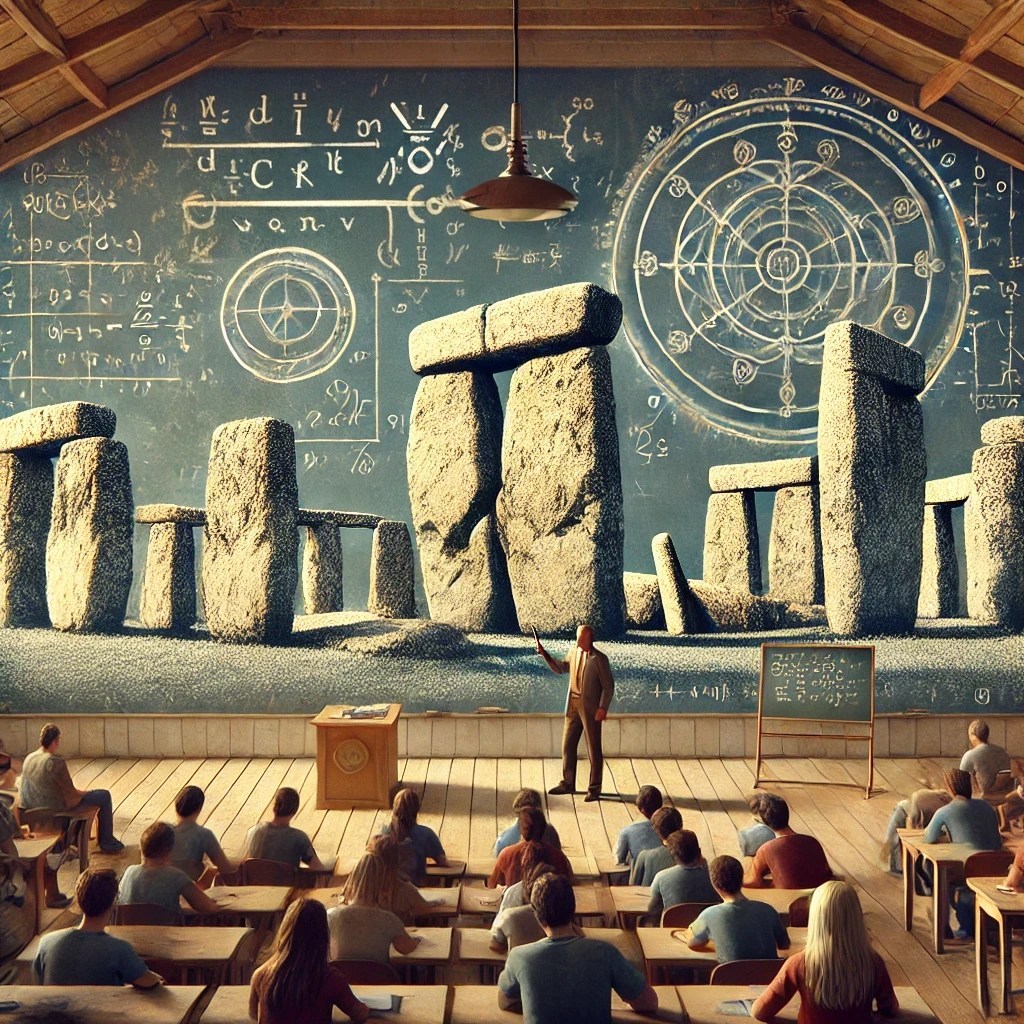
Or, perhaps–and here, after all this meandering, I began to circle towards my own view of the matter–is freshness the very essence of math’s immortality? Does the permanence of mathematics lie not in some kind of artistic or practical relevance, but in its potential for perpetual surprise?
I leave this question to your discussion sections: What, exactly, is fresh in an ancient proof?
Lecture #2:
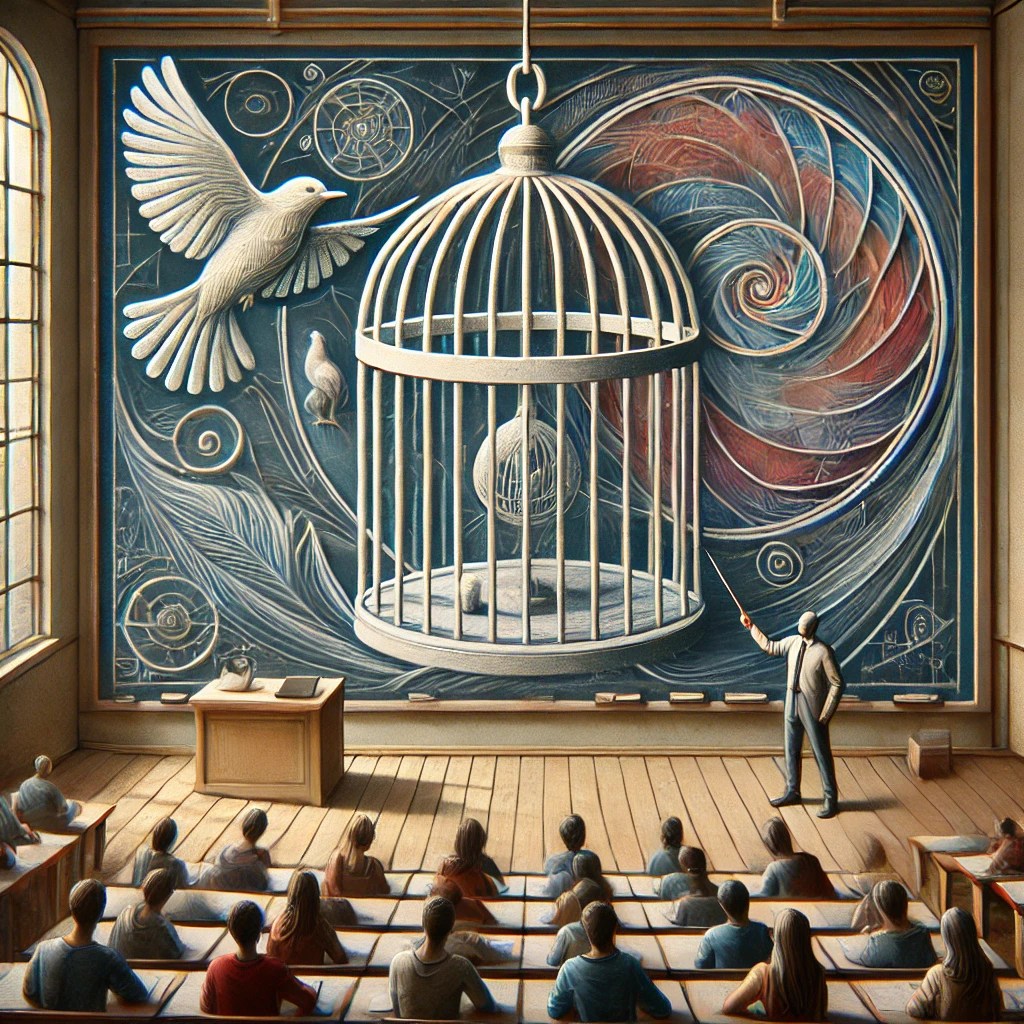
The self is a cage in search of a bird
Welcome back. I must confess that my first lecture was, in the strictest sense, a mathematical failure. I talked about a proof; I proved nothing.
Let us remedy that today, and consider the first of Hardy’s two specimens of freshness: the proof that there exist infinitely many prime numbers.
He opens with a definition:
The prime numbers or primes are the numbers
(A) 2, 3, 5, 7,11,13,17,19, 23, 29,…
which cannot be resolved into smaller factors. Thus 37 and 317 are prime. The primes are the material out of which all numbers are built up by multiplication: thus 666 = 2 ⋅ 3⋅ 3 ⋅ 37. Every number which is not prime itself is divisible by at least one prime (usually, of course, by several).
Next comes the proof:
We have to prove that there are infinitely many primes, i.e. that the series (A) never comes to an end.
Let us suppose that it does, and that
2, 3, 5,… , P
is the complete series (so that P is the largest prime); and let us, on this hypothesis, consider the number Q defined by the formula
Q = (2 ⋅3⋅5⋅ … ⋅ P) +1.
It is plain that Q is not divisible by any of 2, 3, 5,…, P ; for it leaves the remainder 1 when divided by any one of these numbers. But, if not itself prime, it is divisible by some prime, and therefore there is a prime (which may be Q itself) greater than any of them. This contradicts our hypothesis, that there is no prime greater than P; and therefore this hypothesis is false.
My question: Who is the protagonist of this proof?
(“Wait,” you say, “must a proof have a protagonist?” Well, that impertinent question is yours, and this lecture is mine, so let us proceed from my preferred assumption: that proof, like most forms of narrative, has a hero. Or at least an actor who’s first on the call sheet.)
In naming the protagonist, one might point to P, the ostensible largest prime. But read again. The true focal character is not P, but its antagonist Q, who appears only in the final act, and whose self-destructive nature is the narrative engine of the whole proof.
This proof does not have a hero. It has an antihero.
Q is an embodied contradiction. It is prime and not. Prime, because it is divisible by no prime; and not, because it is larger than any prime (under the assumptions of the proof) can be.
Hardy presents Q’s dilemma in layered and convoluted language, with a fog of ambivalence. All is couched in conditionals (“if not itself prime”) yet the conditionals reverse themselves (“therefore there is a prime… which may be Q itself…”). Like Gregor Samsa, Q awakes to find itself grotesque, transformed, negated. Q is a poor creature, conjured by unfeeling gods, for the sole purpose of refuting itself.
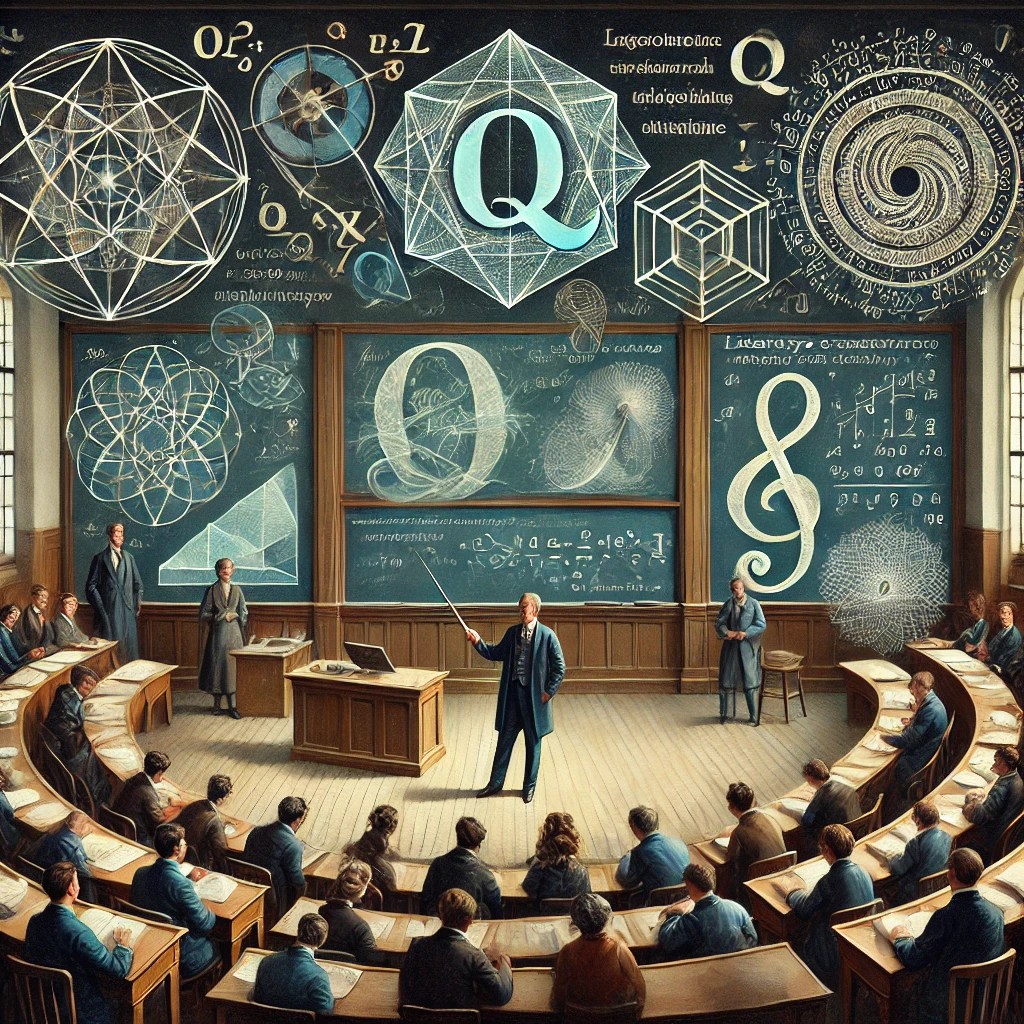
Hardy, of course, would disapprove of this reading. Why psychoanalyze the character Q? In Hardy’s mind, there is no Q, no character. That’s the whole point.
But in Hardy’s proof, there is such a character: a chimerical non-prime prime, as real as any figure in myth or character in fiction. Q is realer, or at least more enduring, than Hardy himself, or Euclid, or any of us slowly decaying organisms in this lecture hall whose brief lives by sheer historical happenstance catch the glimmer of the present moment.
Lecture 3:
You can have anything in life if you sacrifice everything else for it.
Last lecture, we explored Hardy’s proof (Euclid’s, really, but Hardy is exercising squatter’s rights over it) of the infinitude of the primes.
However, I omitted the passage’s most famous paragraph, a concluding comment from Hardy:
The proof is by reductio ad absurdum, and reductio ad absurdum, which Euclid loved so much, is one of a mathematician’s finest weapons. It is a far finer gambit than any chess gambit: a chess player may offer the sacrifice of a pawn or even a piece, but a mathematician offers the game.
The bravado is magnetic. But in what way, exactly, does a mathematician offer the game?
Hardy is referring to the pivotal moment — which he actually breezes past, with baffling nonchalance — when we posit the opposite of what we are trying to prove.
We have to prove that there are infinitely many primes, i.e. that the series (A) never comes to an end.
Let us suppose that it does, and…
Hear that? Not even a period, not even a full stop. For this existential risk, Hardy offers only a comma of punctuation, half a breath’s pause, before moving on.
But this moment deserves more. Let us linger here.
Hardy proposes to sacrifice precisely what he wishes to prove. The primes do not end; so let us suppose that they do.
Wise politicians know never to repeat an attack against them, not even to refute or negate it. To say something at all is to entertain it, to enliven it. Gossip does not spread because it is true; it spreads because it is spoken.
Hardy then, must be playing a different game than a gossip or a politician. He knows that, in his arena of logical proof, a false claim cannot long stand. It will trip over its own falsehood, get tangled in its own mendacious shoelaces.
What, then, does he risk? What does he sacrifice?
Nothing, really. In the literature of mathematics, all statements already exist, like distant stars. To author a proof is to guide our gaze along a constellation of these pre-existing statements, to reveal a meaningful shape in the otherwise meaningless scatter.
There is, of course, no risk of sacrificing the game.
Rather, what the mathematician sacrifices is herself. The mathematician surrenders everything: not to a human opponent, but to the game itself, to the fixed and merciless rules of logic. She throws her oars out of the boat, and lets the rapids carry her where they may, no matter what horrors await.
And make no mistake. Horrors await.
Endless primes. Rationals lost like grains of sand tossed in an irrational sea. Curves jagged at every point. Shapes we cannot measure. Logic even turns against itself, and proves its own limitations. To travel this landscape we must sacrifice, to varying degrees, everything human about us: intuition, vision, experience, personality, and in the end, even the very virtue that led us to begin the journey, the thirst for certain truth.
It is only a slight indulgence to say that to be a mathematician is to sacrifice oneself to math.


What’s with the AI-generated images? Isn’t that just the antithesis of what you’re about (and also a bit of a kick in the teeth to the illustrators whose work is ripped off to create them)?
Fair complaint! I can’t really defend the ethics of these models; using them gives me the same sense of complicity as when I eat meat (which is a slightly worse feeling of complicity I get than when I say, fly on an airplane).
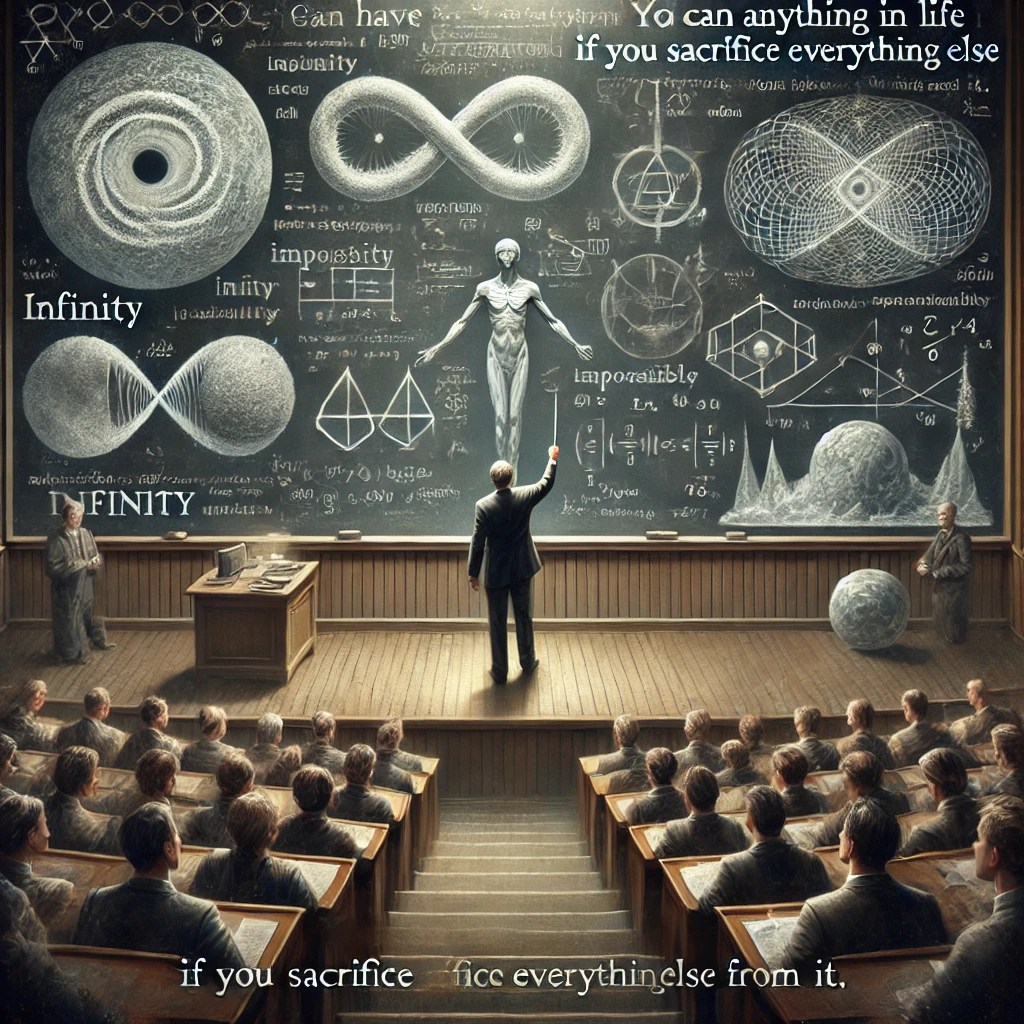
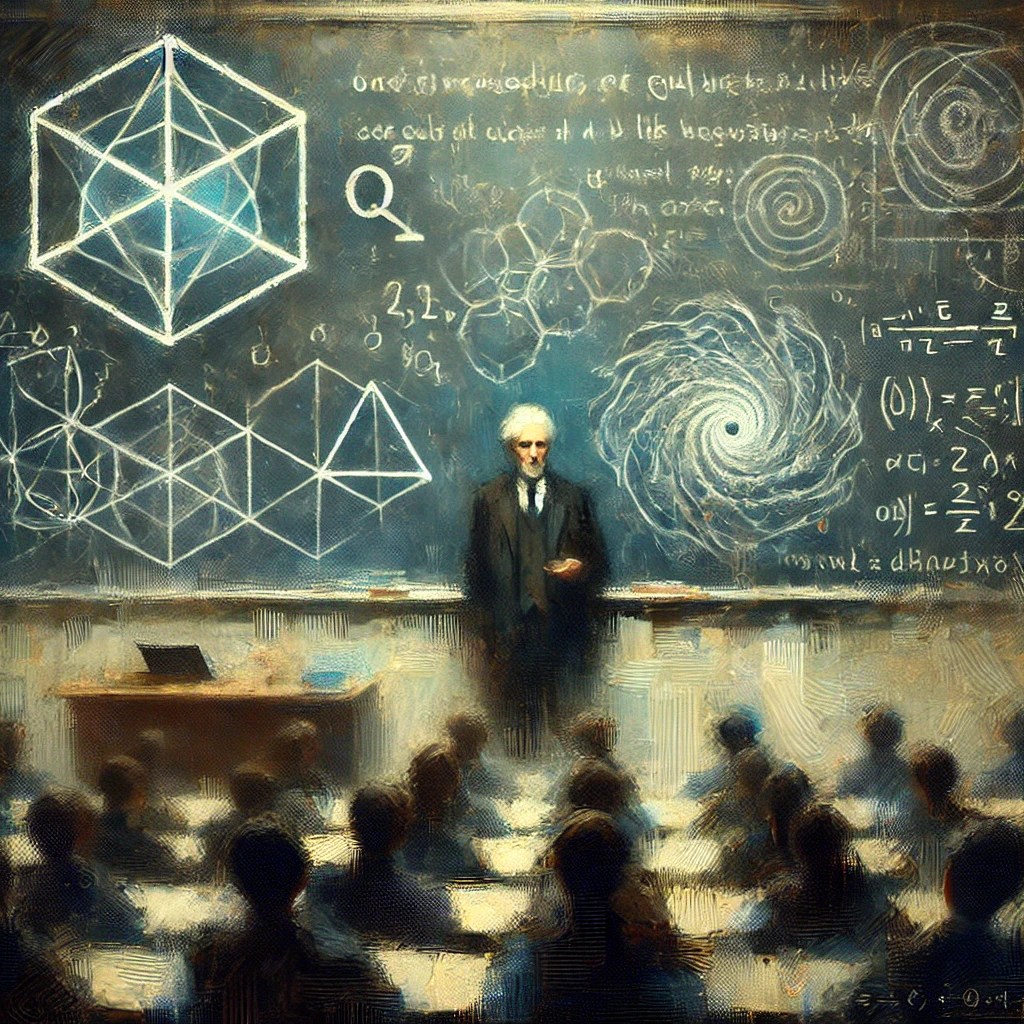
This is the second post where I’ve used these kinds of images. In both cases I liked the thematic fit: each post is a weird literary pastiche about the intersections of math and art; each is aiming for a kind of eerie, uncanny tone; and maybe most relevant, each is itself a kind of AI-style hallucination (this one of a class that doesn’t exist, by a lecturer who isn’t me; the other one is about four books that don’t exist, ostensibly by people who actually do). Not sure that redeems my complicity (I’m sure it doesn’t, in fact!) but anyway that’s what led me here.
it’s somewhat reassuring to hear you write a bit more calmly and rationally about these creative choices, I was worried you were having some sort of breakdown.
Everything is more memorable with a protagonist and a story. Poor ol’ Q. But he turns out to be prime in the end, right?
Depends! Could be composite, but its prime factors weren’t in the original (supposedly complete) list. E.g., if your list is 2, 3, 5, 7, 11, 13, then for Q you get 30,031, which is divisible by 59 and 509.
I see where my using the AI slop would look like a guy having a breakdown, but if I’m honest, my usual stick figures already look like a guy having a breakdown.
That’s the MWBD guarantee: “you will get the distinct impression that the guy making these posts is not okay.”
I love the illustrations – you’ve gotten much better! 🙂 They reinforce the mood of the piece perfectly. I really enjoyed hearing Hardy’s voice and reading your reflection. Something good to think about as this week begins…
I loved this. I have thought for a long time that formulas are poetic. But reading your lectures on how proofs are in fact literature and contemplating on who is the hero has made me even more enthusiastic about mathematics. Thank you! Best reading all week.
In your sections, use Google (please, not ChatGPT; you must learn how to do things for yourselves!) to discover the “one romantic incident“ in Hardy’s life. Having done so, decide whether you think Hardy “sacrificed himself” for math. Having then reached your own conclusion about this (which had better agree with with mine), ask yourself: What would you say to Hardy if he were around to hear you? Or would you simply give him a pitying hug? If the latter: for how long? If the hug is a quick one, is it quick because you barely know him, or because you are afraid of catching the mathematical contagion?
(As always, Ben, a really nice piece of writing! Fresh, even. Thanks for writing it.)
Oi, I see the AI “art” there. Not happy mate. I’d have thought as a fellow creative and mathematician you would abhor and condemn it. I mean, look at the messed-up writing in those images – QED.
I don’t really see “abhor and condemn” as a necessary conclusion. It’s just another tool in the box, and he felt it was appropriate to use it for this particular article. Yes, it looks weird and has surreal, muddled text, but based on his own comment above, that enhances the intended effect rather than taking away from it.
The AI slop is ugly. Worse, it disempowers real artists (and the AI training sets are an enormous theft). Why are you rewarding this?
And you a professor of literature…. They’re coming for your field next!
Hello! We don’t seem to be acquainted: I’m Ben, a math teacher, who wrote this blog post in a fictional voice, as a kind of satirical comment on a topic that interests me–namely, the importing of aesthetic methods into a mathematical realm where they don’t quite belong. I chose to illustrate it with the converse: images that import a mathematical sensibility into an aesthetic realm where they don’t quite belong. (The fact that the images are creepy, uncanny, and off-putting was of course a bonus.)
Anyway, I share many of your concerns about the dubious ethics of how these models are trained (and this is why I use them only on rare occasions–notice that the blog is mostly illustrated with my titular “bad drawings”!). But I don’t think there’s much to be gained by scolding individual users of these technologies; consider, by way of analogy, that vegetarians and vegans have generally found that scolding individual meat-eaters is not an effective form of persuasion.
“But I don’t think there’s much to be gained by scolding individual users of these technologies”
I disagree: scolding individual users is the best way we have to fight back against these technologies. Right now, there is a stigma against AI art, a stigma that prevents many people from using it who otherwise would have, because they know they’ll be seen in a negative light if they do. And we need to keep it that way. If we start giving individual users passes because “they’re not the ones causing all this”, then the stigma will fade, and more people will use it. This is exactly what the corporations creating these models want: they’re pushing them as something normal and everyday to use (those of us who are Windows users have no doubt seen Microsoft trying to normalize Copilot on the screens you get when you boot up your computer), and the stigma around them right now is the best weapon we have to fight back against this. Trying to scold the corporations isn’t going to do anything – they don’t care. But making AI art be seen as a bad thing to use, as something that people won’t want to use because of the stigma – that’s been working so far.
Going back to your comparison between this and eating meat, a single meat-eater might not be doing much harm (assuming eating meat does count as “harm”, which the vegetarian/vegan argument is assuming it does), but they’re contributing a little bit of money to the companies towards the businesses that do rely on consumption of meat, plus they’re contributing a bit towards keeping meat-eating as something that’s seen as respectable to do. Public opinion is a powerful thing – in modern-day society, where getting your way by force isn’t a valid option (…unless you’re a government with a military force, but that’s beside the point), public opinion is the best weapon we have to stop bad things from proliferating.
Yes, a single person’s use of these tools isn’t a big deal on its own. But it’s one more drop in the river, and a big enough river can cause a flood. Given how powerful the corporations are, we can’t just dry up the source of the water, so all we can do is make the terrain harder for the river to flow through.
Oh yes, I hear all those arguments — but I think you missed the import of the vegetarian example! My point was that it would be perfectly natural for vegetarians to scold meat eaters, for all the reasons you outline — but that the folks actively campaigning against factory farming specifically and consciously refrain from this kind of scolding, because they find that it alienates more people than it persuades. Instead, they focus on (1) disseminating information about factory farming, with the moral outrage focused on those perpetrating harm rather than those passively abetting it; (2) trying to make vegetarianism/veganism more appealing and desirable; (3) legislative efforts to curtail the abuses of factory farms, etc.
My hunch (unsullied by empirics, I must admit) is that scolding is most effective (1) within existing relationships where there is some measure of trust and respect to draw on, and (2) when enforcing lines that are already a matter of consensus. When dealing with strangers and/or with ethical questions that are not a matter of consensus, one simply doesn’t have the same leverage over the other person, and it seems to me there is no choice but to fall back on more patient and conventional attempts at persuasion.