

I’ve got a proof stuck in my head.
It comes from a man as brilliant as he is grumpy. Last week in the staff room, one of my all-time favorite colleagues busted out a dozen-line proof of a world-famous theorem. Though I doubt it’s original to him, I shall dub it Deeley’s Ditty in his honor:


This argument is sneaky like a thief. I admire but don’t wholly trust it, because it solves a differential equation by separation of variables, a technique I still regard as black magic.
What I can’t deny is that it’s about 17 million times shorter than the proof I usually show to students, which works via Taylor series:


You might call this one Taylor’s Opus. It builds like a symphony, with distinct movements, powerful motifs, and a grand finale. It takes familiar objects (trig and exponential functions) and leaves them transformed. It’s rich, challenging, and complete.
It’s also as slow as an aircraft carrier making a three-point turn.


Here we have two proofs. The first is a nifty shortcut, persuasive but not explanatory. Watching it unfold, I’m unsure whether I’m witnessing a scientific demo or a magic trick.
The second is an elaborate work of architecture. It explains but perhaps overwhelms. If an argument is a connector between one idea and another, then for some students, this will feel like building the George Washington Bridge to span a creek.
The question it prompts, to me, is: What do we want from a proof?


Here’s another example. Week #1 of teaching here in England, I posed a classic challenge to my 14-year-olds: Prove that √2 is irrational. To my delight, it took only 90 seconds before one of them produced this clever argument, which I’ll call Dan’s Ditty:


I loved it, finding it slicker and more satisfying than the standard proof I’d seen a dozen times:
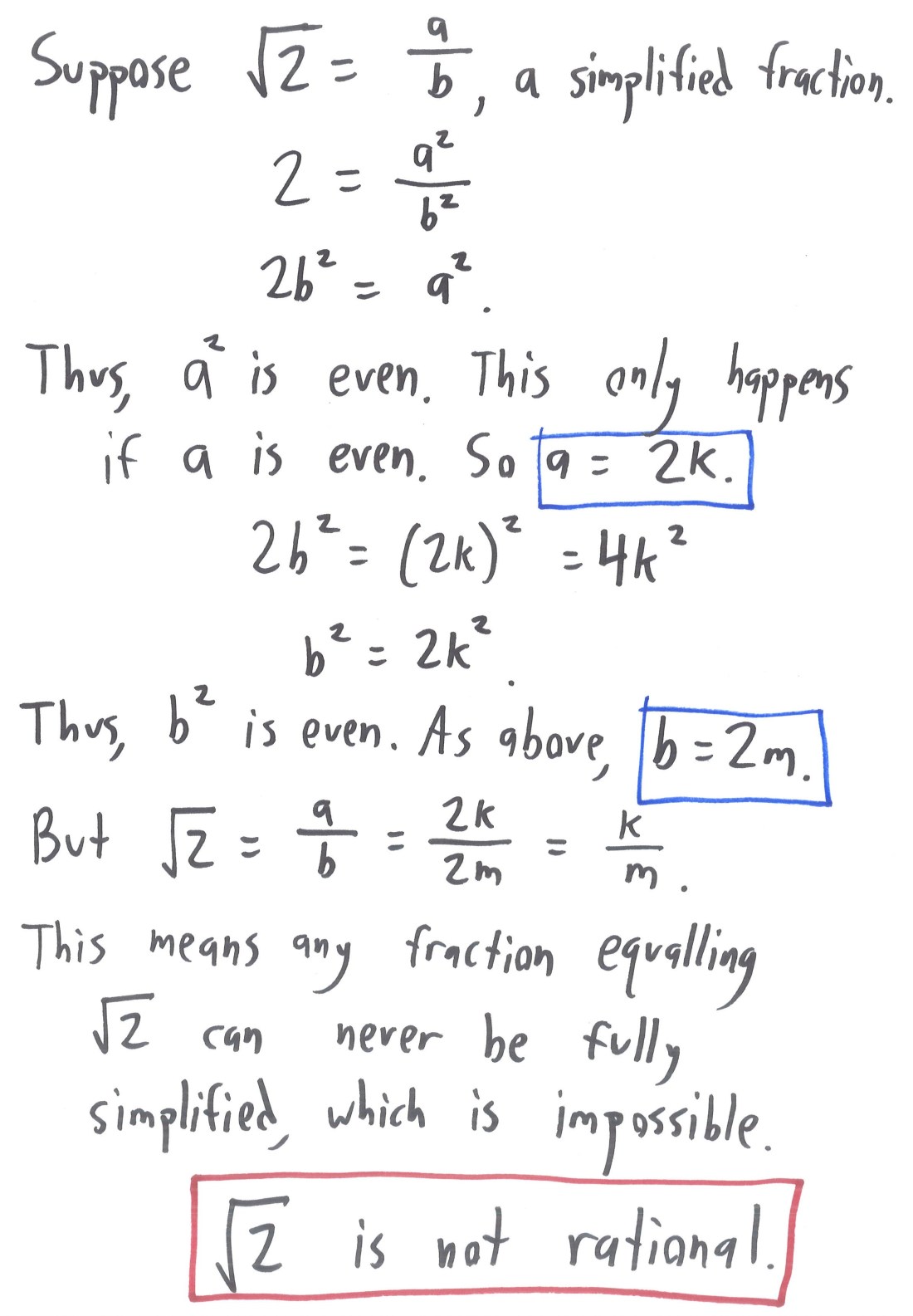

Of course, I could also see the ditty’s downfall. It relies on the Fundamental Theorem of Arithmetic: the idea that each number has a unique prime factorization. That’s a nontrivial result, one I didn’t encounter until group theory in college. No such machinery is needed for the standard proof, which Hardy and Erdös (among others) hailed as one of the loveliest and most perfect in all of mathematics.
Holding the two ditties side by side, some themes emerge:


What do we want from a proof? I say it depends on the spirit in the room.
In the somber mood of scholarship, clad in academic gowns and posing for our portraits, we prize rigor and depth. The “standard proofs” are standard for good reason. They convey unambiguous truths through careful logic. They’ve stood the test of time better than just about any other work of the human mind.
But in playful moods, holding coffee in one hand and chalk in the other, there’s a lot to be said for the ditties. They’re fun. They provoke. They refresh. They’re like trying a new path on the commute home; coming at the street from the other side, you see a slightly different world.
Here’s a last and favorite example, which I heard from my boss Neil, who heard it from whoever he heard it from: A proof that all higher-order roots of 2 are irrational.


I find it hard not to smile at that one.
It’s as if Andrew Wiles has arrived at the top of Everest, only to notice that I’ve been riding piggyback the whole way. “Hey, what are you doing here?!” cries Sir Wiles, and by way of response, I grab a chunk of fresh Himalayan snow and drop it into my drink. “Needed ice,” I explain.