Last year, I conducted alumni interviews for Yale applicants. It’s an easy gig. You take a smart, ambitious 17-year-old out for hot chocolate, ask them about their life, and then report back to the university, “Yup, this is another great kid.”
I recently got an email asking me to re-enlist. Was I ready for another admissions season?
I checked “No,” mostly because “Aw, hell no” wasn’t an option.
Why my reluctance? No grudge, no beef, no axe to grind. It’s just that the whole admissions process is so spectacularly crazy that participating in it— even in the peripheral role of “alumni interviewer”—feels like having spiders crawling out of my eyeballs.
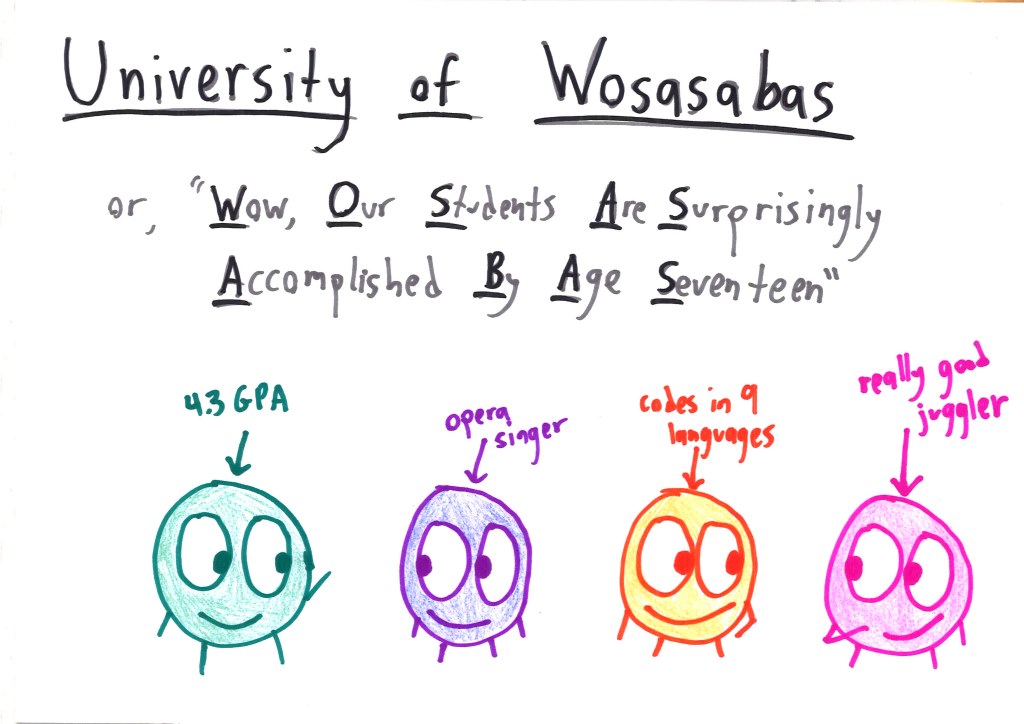
In the last 15 to 20 years, Yale’s applicant pool has gone from “hypercompetitive” to “a Darwinian dystopia so cutthroat you’d feel guilty even simulating it on a computer, just in case the simulations had emotions.”
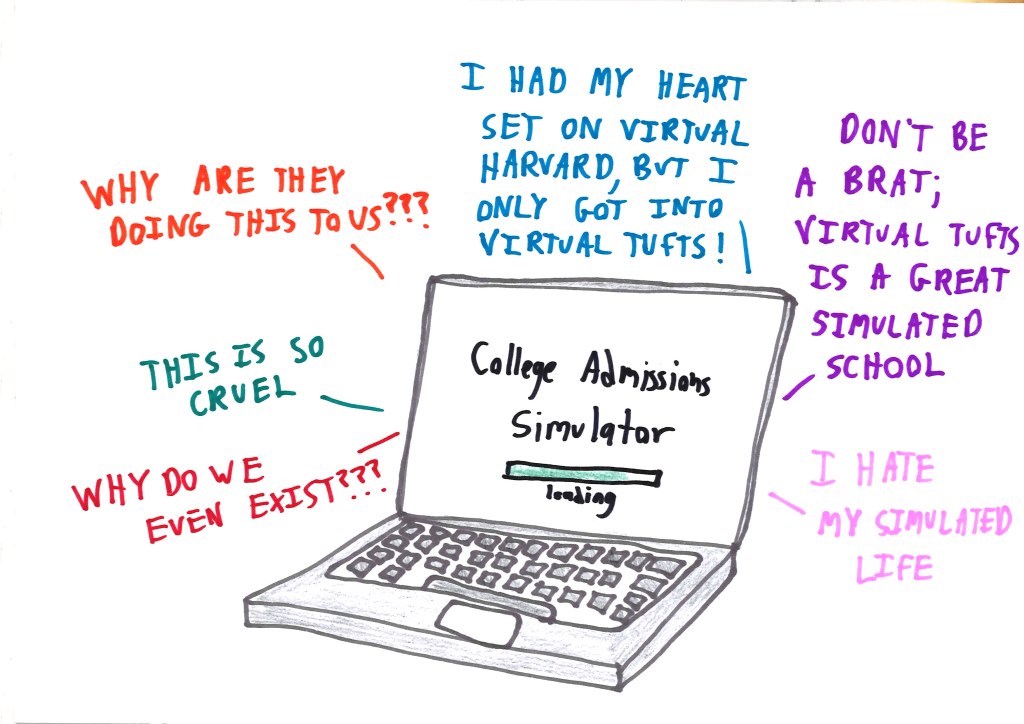
I don’t fault the admissions office. For every bed in the freshman dorms, twenty kids are lining up, at least five of whom are flawless high-school rock stars. From that murderer’s row, they face the impossible task of picking just one to admit. There’s no right answer.
But two things freak me out about this process.
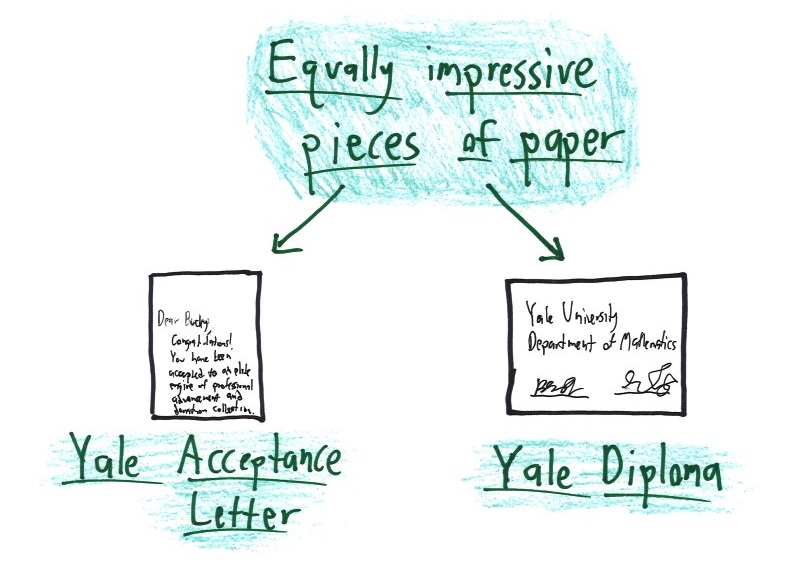
You may have heard this chestnut: “The hardest thing about getting a Yale degree is getting accepted in the first place.” For me, it rings true. Thousands upon thousands of the rejects from Yale would have thrived there, if they’d just gotten the thick “yes” envelope instead of the thin “no” one. (That includes the five totally amazing kids I interviewed last year, none of whom got accepted.)
Dozens of people have asked me, “Wow, how did you get into Yale?”
Not a single one has ever asked, “Wow, how did you manage Yale coursework?”
With so many uber-qualified students lining up, top colleges don’t—as you might expect—look for the “very best.” They don’t even operate on a single, well-defined notion of what “best” means. Instead, they pick and choose. They go for balance. They’re just trying to fill their campus with a dynamic, diverse cohort of freshmen. Consistency and “fairness”—whatever that would mean—have nothing to do with it.
It’s like making a trail mix. I don’t care whether this particular peanut is more “deserving” than that particular chocolate chip. I’m just choosing high-quality ingredients to strike a nice balance of flavors. Nothing more.
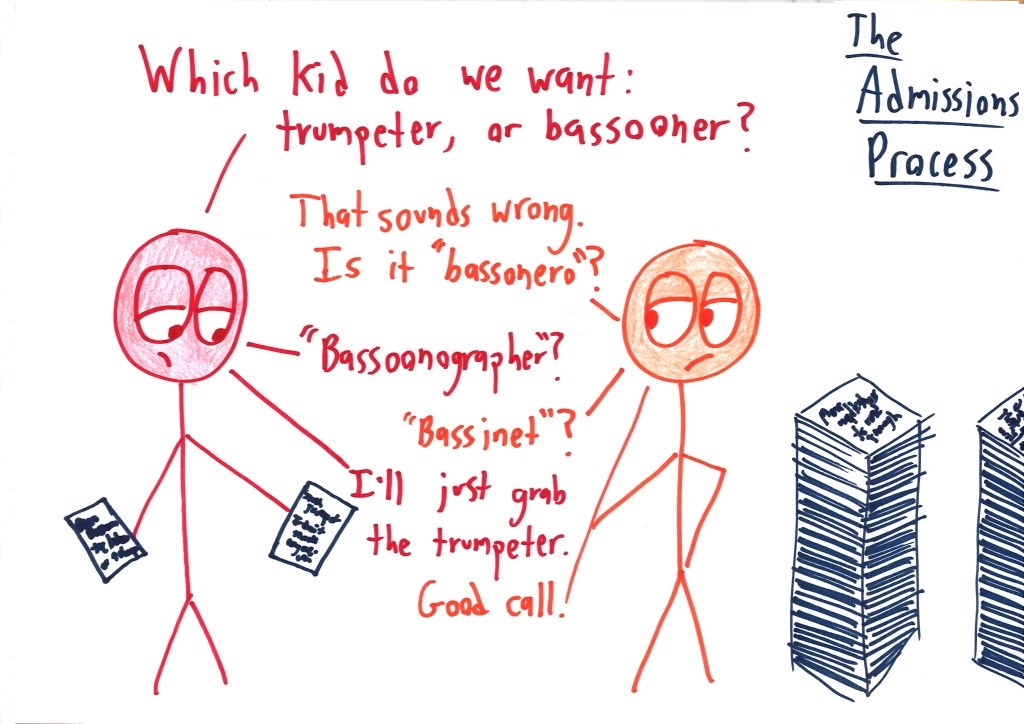
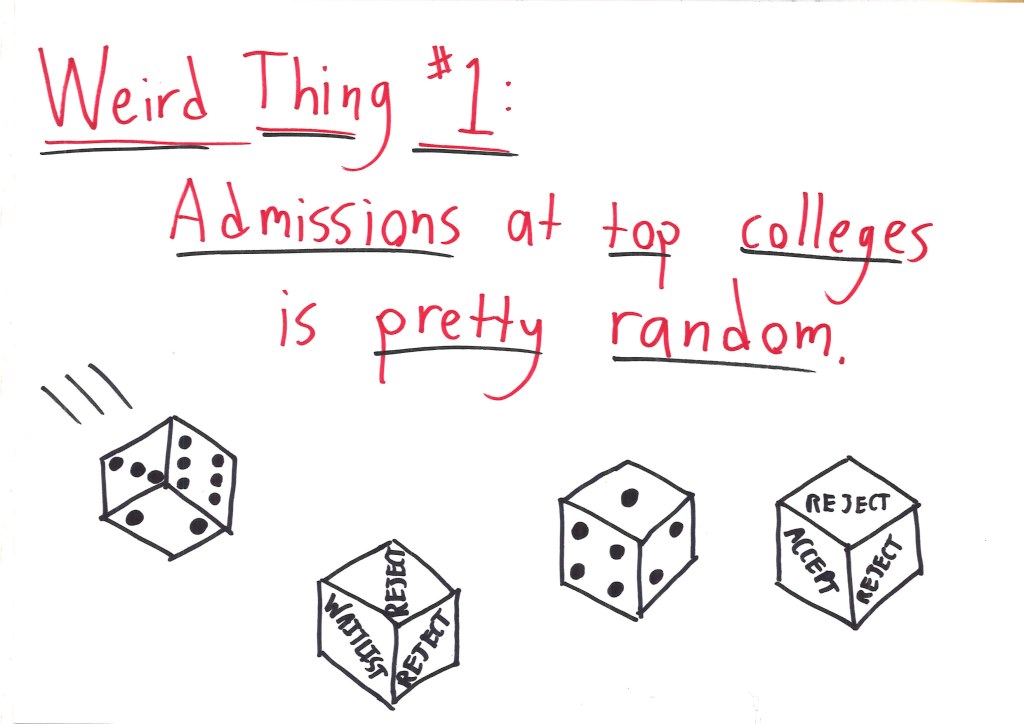
It might not be “random” from the university’s perspective. But it is from the students’. One year favors trumpeters, the next favors bassoonists, and kids have no way of knowing whether their particular skills will be in demand this time around.
All this wouldn’t be particularly troubling, except when coupled with this fact:
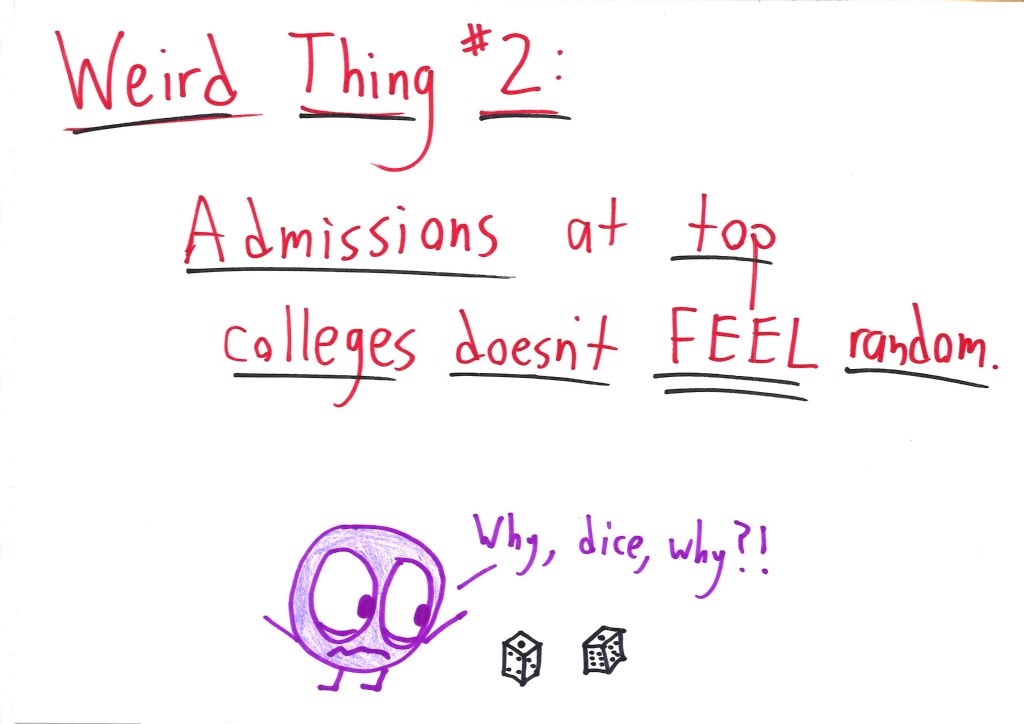
Just look at the demands of the Common App. “Write me a confessional essay. Document your leisure activities in meticulous detail. Muse on a philosophical question. Tell me what you love about my school. Give me testimonials from your teachers.”
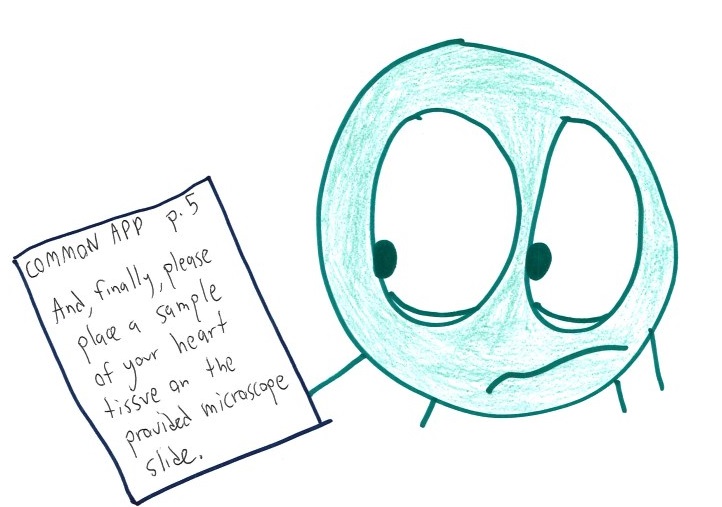
The application becomes an autobiography, an audit of your whole self: ambitions, achievements, convictions. The process feels customized, personalized, complete. Before they make a decision, Yale insists on peering into your very soul. (Either that, or they’re gathering the data to build your robot doppelgänger.)
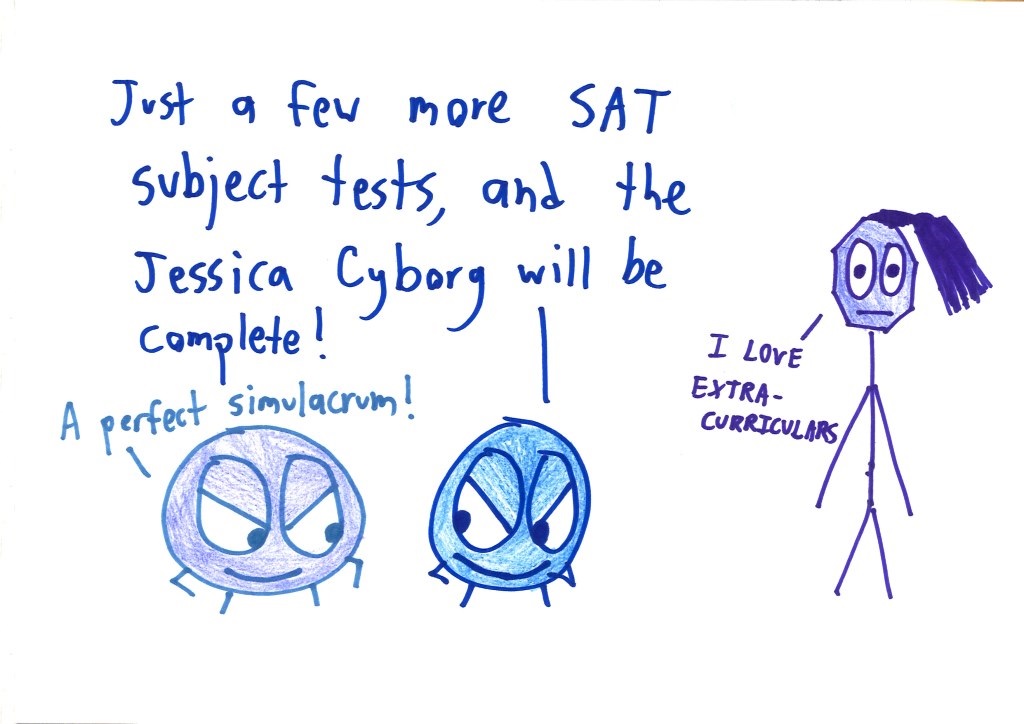
I get why they want all that information. But all this data puts a mask of intimacy on what is fundamentally a factory process. No matter how sincere their intentions, the Yale admissions team is beholden to grim statistical reality: 94% of students are getting rejection letters, period.
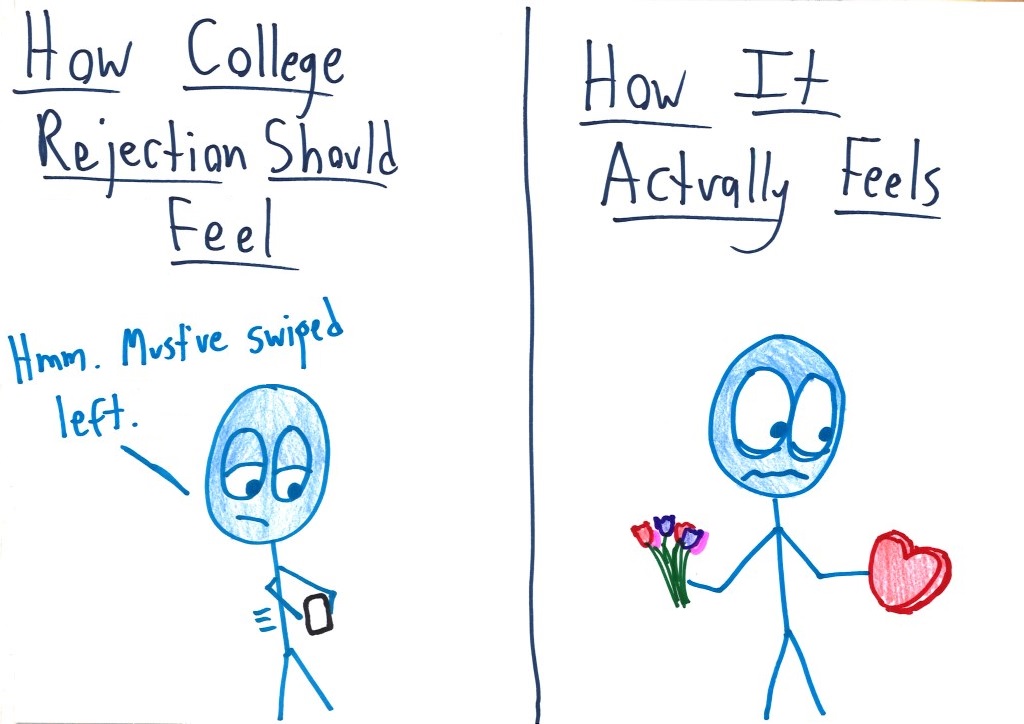
Being rejected by a university ought to feel like getting swiped left on Tinder. There’s nothing terribly personal about it. They don’t really know you. The university is just looking out for its own interests, and you don’t happen to fit into the picture.
But between everything—campus tours, information sessions, supplemental essays, test scores, transcripts, letters of recommendation, and alumni interviews—the application process becomes a lengthy and weirdly romantic courtship.
Rejection feels less like turning down a first date than getting left at the altar.
Long story short, that’s why I’m not doing Yale alumni interviews anymore. As much as I loved my college education, it drives me crazy to be the face of a process that’s unpredictable, opaque, and (at least 94% of the time) disappointing.
I find myself compelled by the so-crazy-it’s-gotta-be-right proposal of the psychologist Barry Schwartz: run admissions by lottery. Says Schwartz: “Every selective school should establish criteria [for admission]…. Then, the names of all applicants who meet these criteria would be put into a hat and the winners would be drawn at random.”
Before you write Schwartz’s proposal off, remember this. Currently, we’ve got a random process, disguised as a deliberative one.
Why not take off the mask?
 Math with Bad Drawings
Cool article.. I think many things in life feel like this… We live in a very impersonal, information heavy world.. Where regulation of the information you put out there about you can shape a perception of you that isn’t real.. And unfortunately much of the opportunities you are rendered in life are based off this persona that’s becomes a symbol of you… Weird society we live in when the fake is valued more than the real..
wow this article is really cool! if any of u would like to follow me thats awesome thxs!!!
That’s such a great post! How do you do the pics? And I have never thought that it would be like that 😮
As someone from Britain, it is strange how close to the assumption about the interviewing system for Yale was. I’m not saying I am the all might smarty pants, because clearly, there are amazingly talented people (who are also getting rejection). Our system was to apply to five universities maximum with your grades or upcoming target grades and a personal statement. All my university choices gave me offers, including Cardiff and Exeter, Russell group universities (an equivalent to Ivy league). I had picked Exeter as my first choice with the hope I got AAA and University of Plymouth with at least 300 UCAS points to get. Both in my eyes were equal, but Exeter had the edge in terms of the course and I had to pick a higher offering as my first choice in insure I got into University nonetheless. I got A*BB in the end. I am not disappointed with that because I knew I worked my hardest, I got into Plymouth and I am completely happy. Sometimes I feel people get caught up in the idea that going to the best Uni will mean a better life, not necessarily. We need to remember that sometimes it might be better not going to a high demanding establishment, not because you’re not good enough, but because you know you will be better and happier to be a part of somewhere that doesn’t want to make you, you know, drop out and be completely confused about who you are (not that dropping out is a problem, I’m trying to make a point abut making the right decisions0 regardless of the name and its connotations in our society.
#beatiful
Beautiful written words. I enjoyed reading this and how it works behind the whole application process.
Incredible to read, thanks for sharing!
That was a really insightful. And extremely well written. Answered a lot of questions on my mind – now I can sleep in peace for my rejections.
Reblogged this on ibrahima657.
enjoyed reading..
I love your blog – so well written! The process is so harsh
So good!!
http://glitterboxblog.wordpress.com
I stole Kim Kardashians outfit! Check it out
http://Www.laluafashion.com
Uau.
wilnaraaraujo.wordpress.com
🙂
Brilliant
Very entertaining…and sadly, true!
Very interesting article about university admission. When I was preparing the application for postgraduate study last year, I was totally lost my mind: how to write an impressive personal statement, how to make me stand out from thousands of applicants all over the world? I was really confident at one time due to my work experience and good text scores. However, when I received the rejection decision from Boston University, I was desperate. Why? Why should the admission process could be more transparent? How could I know if something unfair happened?
This is extremely interesting. I have personal ambitions to go to a ‘top’ University, maybe Oxford or Cambridge. But every time I express this intent others always tell me how hard it is, waving statistics in my face. I know it’s hard. I’m still unsure whether I can do it or not. Do you have any advice for very early preparation for University application – perhaps 1/2 years before? Thanks
The British system is actually very different than the American system! I don’t know Oxbridge well enough to give any specific advice, unfortunately.
https://badgersclub.wordpress.com/2015/10/14/decayed-leaf/
Great post. For an outsider like me, it provides great insight into the American Education System.
In India we have similar prestigious (government) institutions for technical under graduation courses, the IITs. I am in one of them. We have to go through two levels of nation-wide exams (only the top 1% get through).
I always thought it can’t get any more competitive. Guess not.
I feel lucky right now.
There are reasons “I’d rather be lucky than good” gets handed down from generation to generation. College admission is one such reason.
This really opened my eyes.
Check out my blog:
Youmeandmyveggie.wordpress.com
Reblogged this on Thoughts from a Christian Cowgirl and commented:
Does not make me look forward to submitting applications to college!!
https://lookingcalm.wordpress.com
Reblogged this on Lost Dudeist Astrology.
Amazing how it was to the point And how you linked it with dating. Really liked it.
This is a great blog , it’s interesting how they make their decisions.
Enjoyed the visuals as much as the information. I’m glad I never applied. Went to Oberlin instead.
Hey, can you help me get into Yale or Harvard so I can go to space?
I love this! It’s very transparent and the stick figures were a nice touch.
The outcome of your imagined college admissions simulator was so brutal, it drove imagined simulations of denied applicants into despair so deep they vowed to create a simulation of “fair Yale admissions” …
I could read this again and again. It’s simply wonderful.
My daughter is a college freshman, and this rang so true. I think I agree with the lottery proposal. It would certainly de-personalize the rejection. I used to teach high school Seniors, and I dreaded “rejection season”. The tears, the despair, the drama…. It is wonderful to go to a top tier school, but not getting in does NOT mean your life is over. Their lives are just beginning. I blame parental and peer pressure as well as the admissions process. Bravo to you for taking a stand.
http://www.kathydasgupta.com
Great article, very well written
I felt incredibly accomplished, when I received one of those chunky envelopes from the university I applied to (in Finland) years ago. Application process was simple enough, heavy on what you accomplished in high school and how high you tested on your entrance examination. Impersonal. Did my studies in a swift manner, all that’s lacking is my thesis for my master’s and… not sure if I will finish writing it. I feel incredibly let down at this point in my life. Learned a whole bunch of theory from very intelligent people, but I just fail to see the connection to applying all of that to life. Perhaps universities are not my cup of tea after all. Or perhaps I chose the wrong program. Your article was a cool read, despite bringing up some memories 😉
This is so great to hear. Being a college student myself, I appreciate all your honesty. Thank you.
Reblogged this on Kracd.
Reblogged this on Lazy Batman.
My son plans on applying to Yale this year. I can’t wait to see his response to your blog after I show it to him. Thank-you for the insight.
Great article with great illustrations. If I ever decide to apply for Yale, I’ll think better of it and wait for them to remove the ‘applicant dartboard’ instead.
You draw good I never went to college everyone there is so smart and are all good writers I always wanted to go and wonder what it was like but only see it on tv it looks fun but I never went maybe if I write a good letter I can go but probably not
The doppleganger part was pretty hilarious. I don’t know much about how colleges in the US work but recently I got a rejected letter from one of a top university in Japan. Well, it might be random as well, to be optimistic, lol.
Do you think sports have a more significant impact on an application?
I feel like I have read some top secret document on the way of life, you’re a fantastic writer!
This article is fantastic, despite being 13 I really enjoyed it, its great to know how it works behind the scenes ! p.s. loved the doppelganger, funny as!
The whole process is in absolute variance with our idea about the pupil. Pupil should be one who can receive an idea without wholly accepting it, questions rising thousands in his mind and seeking of the answers ensues. His mind should be basically clean and open to suggestions. Wonder if it can happen with an over worked mind of an youngster who has been through so much terrifying experience upfront.