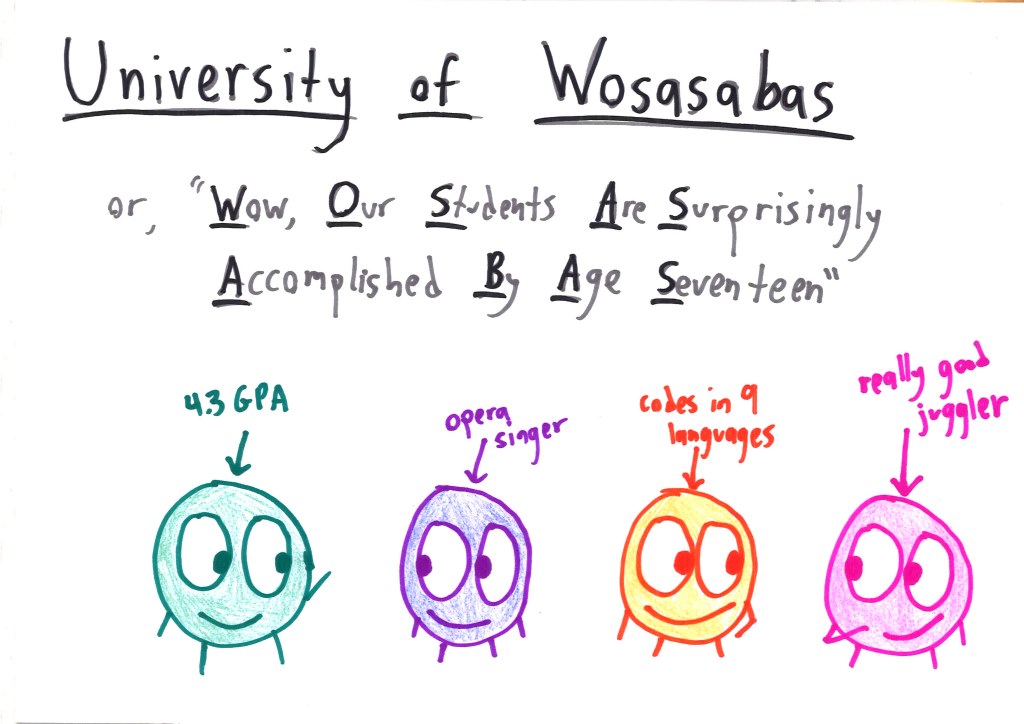
Last year, I conducted alumni interviews for Yale applicants. It’s an easy gig. You take a smart, ambitious 17-year-old out for hot chocolate, ask them about their life, and then report back to the university, “Yup, this is another great kid.”
I recently got an email asking me to re-enlist. Was I ready for another admissions season?
I checked “No,” mostly because “Aw, hell no” wasn’t an option.
Why my reluctance? No grudge, no beef, no axe to grind. It’s just that the whole admissions process is so spectacularly crazy that participating in it— even in the peripheral role of “alumni interviewer”—feels like having spiders crawling out of my eyeballs.
In the last 15 to 20 years, Yale’s applicant pool has gone from “hypercompetitive” to “a Darwinian dystopia so cutthroat you’d feel guilty even simulating it on a computer, just in case the simulations had emotions.”
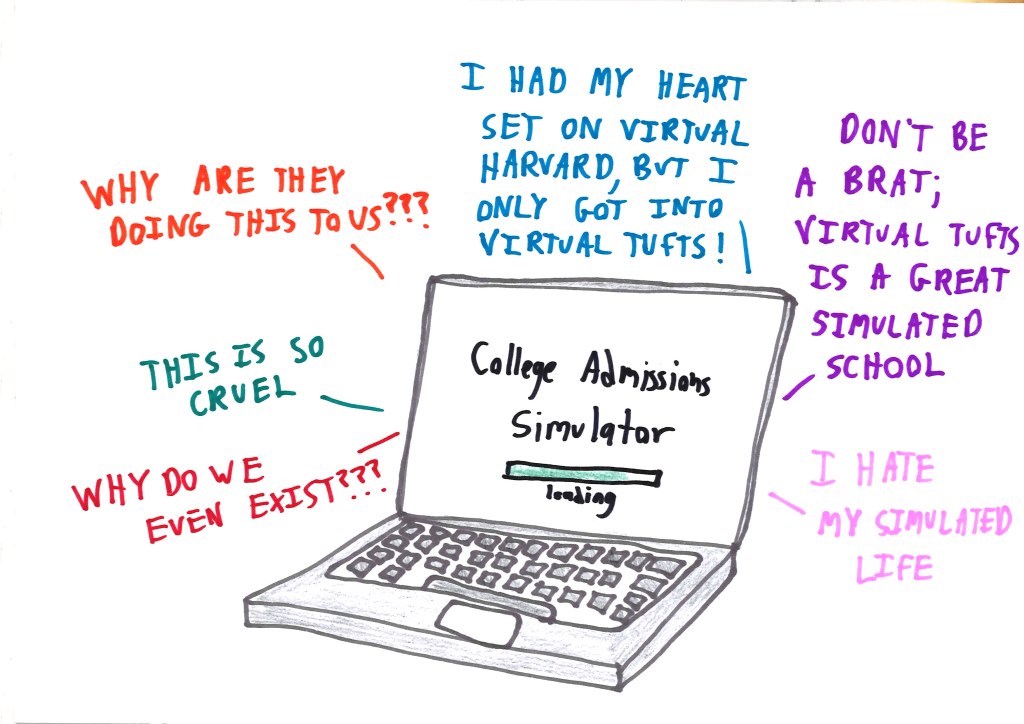
I don’t fault the admissions office. For every bed in the freshman dorms, twenty kids are lining up, at least five of whom are flawless high-school rock stars. From that murderer’s row, they face the impossible task of picking just one to admit. There’s no right answer.
But two things freak me out about this process.
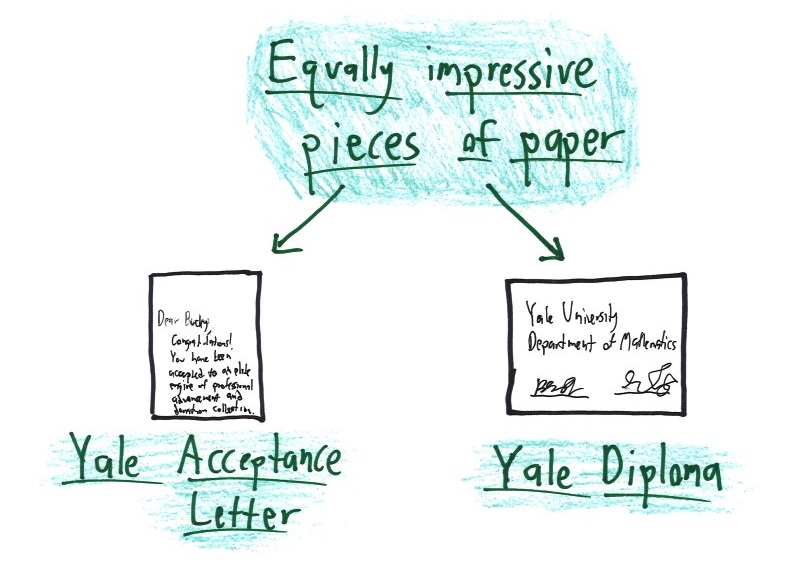
You may have heard this chestnut: “The hardest thing about getting a Yale degree is getting accepted in the first place.” For me, it rings true. Thousands upon thousands of the rejects from Yale would have thrived there, if they’d just gotten the thick “yes” envelope instead of the thin “no” one. (That includes the five totally amazing kids I interviewed last year, none of whom got accepted.)
Dozens of people have asked me, “Wow, how did you get into Yale?”
Not a single one has ever asked, “Wow, how did you manage Yale coursework?”
With so many uber-qualified students lining up, top colleges don’t—as you might expect—look for the “very best.” They don’t even operate on a single, well-defined notion of what “best” means. Instead, they pick and choose. They go for balance. They’re just trying to fill their campus with a dynamic, diverse cohort of freshmen. Consistency and “fairness”—whatever that would mean—have nothing to do with it.
It’s like making a trail mix. I don’t care whether this particular peanut is more “deserving” than that particular chocolate chip. I’m just choosing high-quality ingredients to strike a nice balance of flavors. Nothing more.
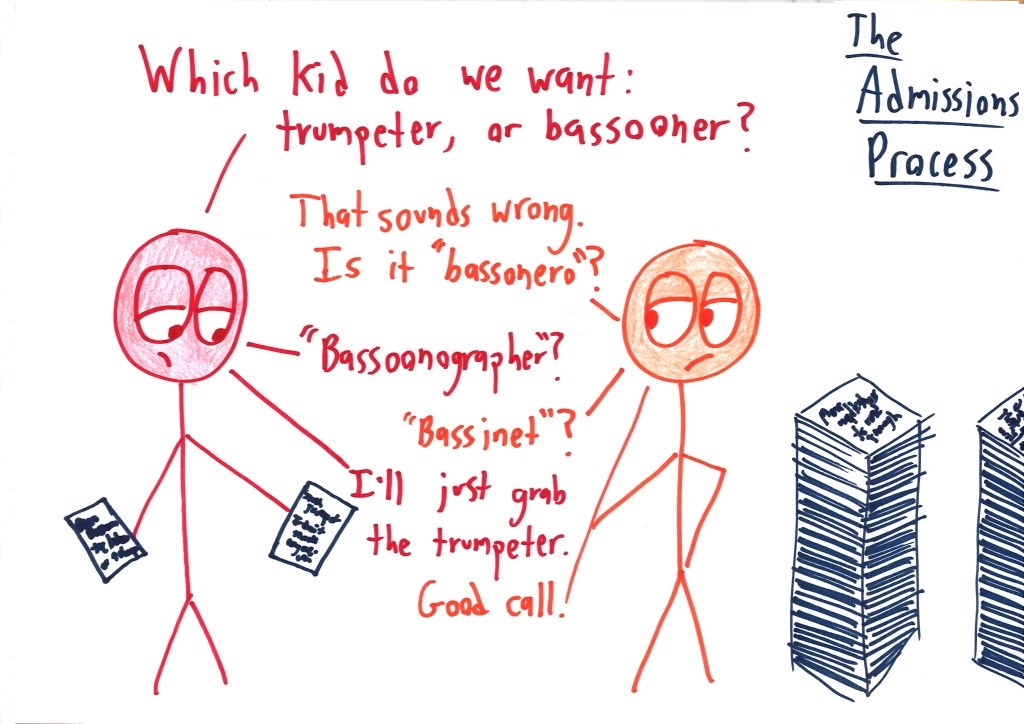
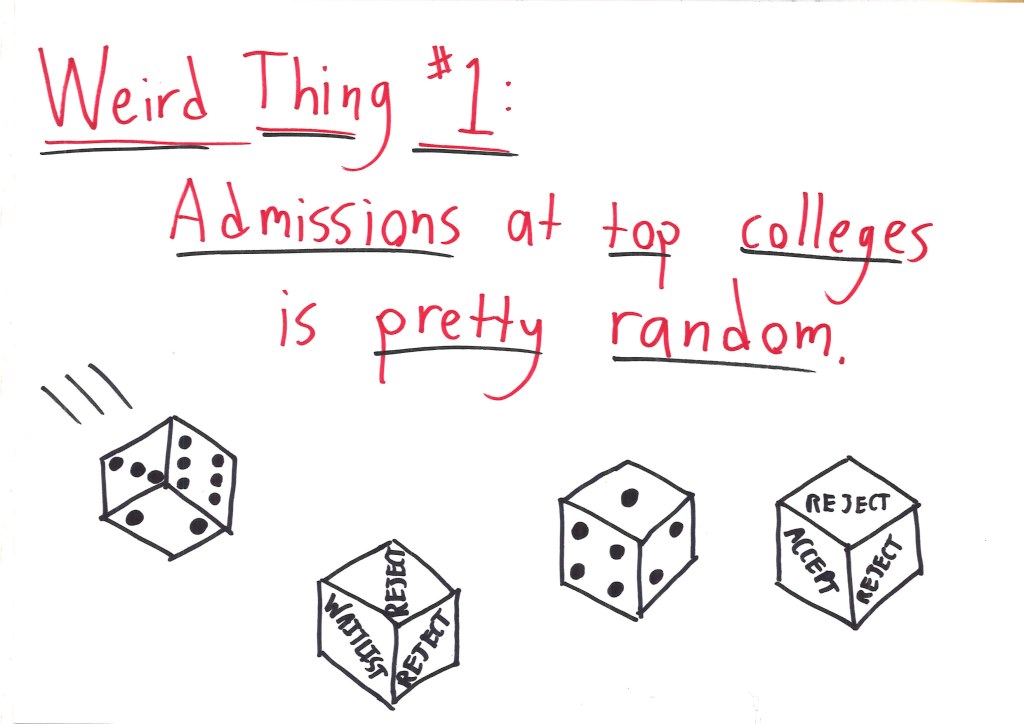
It might not be “random” from the university’s perspective. But it is from the students’. One year favors trumpeters, the next favors bassoonists, and kids have no way of knowing whether their particular skills will be in demand this time around.
All this wouldn’t be particularly troubling, except when coupled with this fact:
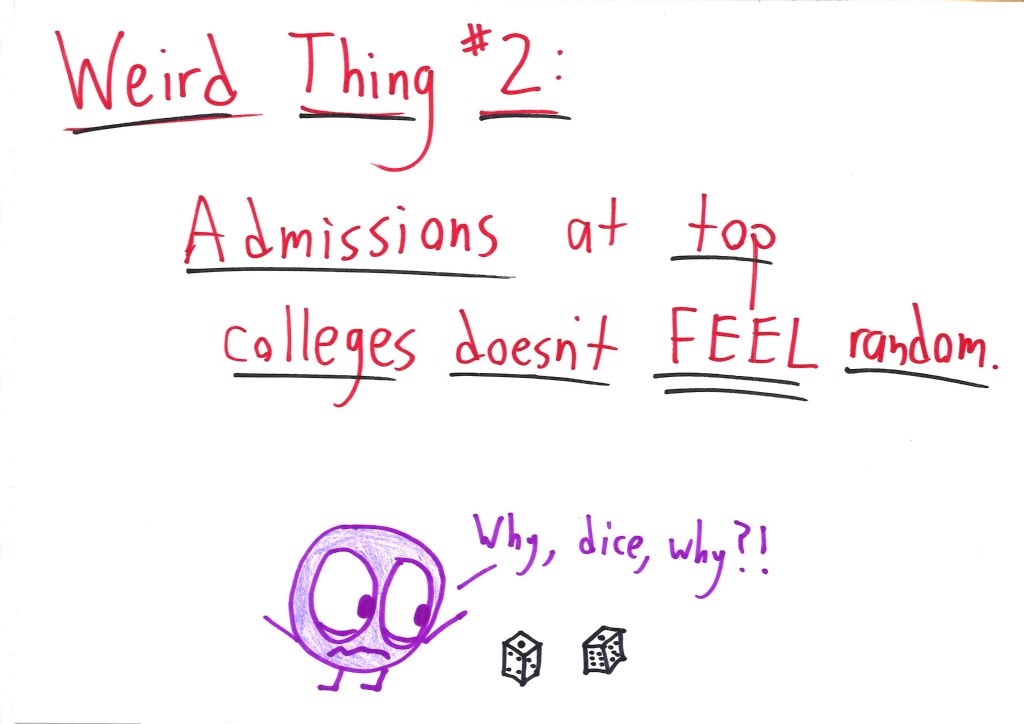
Just look at the demands of the Common App. “Write me a confessional essay. Document your leisure activities in meticulous detail. Muse on a philosophical question. Tell me what you love about my school. Give me testimonials from your teachers.”
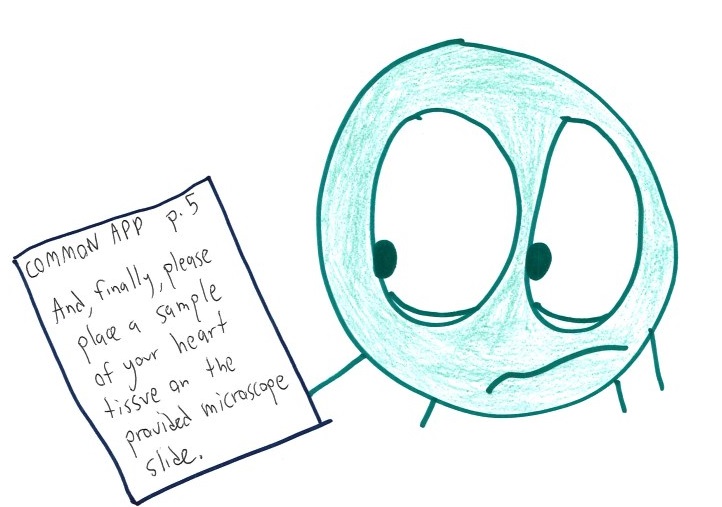
The application becomes an autobiography, an audit of your whole self: ambitions, achievements, convictions. The process feels customized, personalized, complete. Before they make a decision, Yale insists on peering into your very soul. (Either that, or they’re gathering the data to build your robot doppelgänger.)
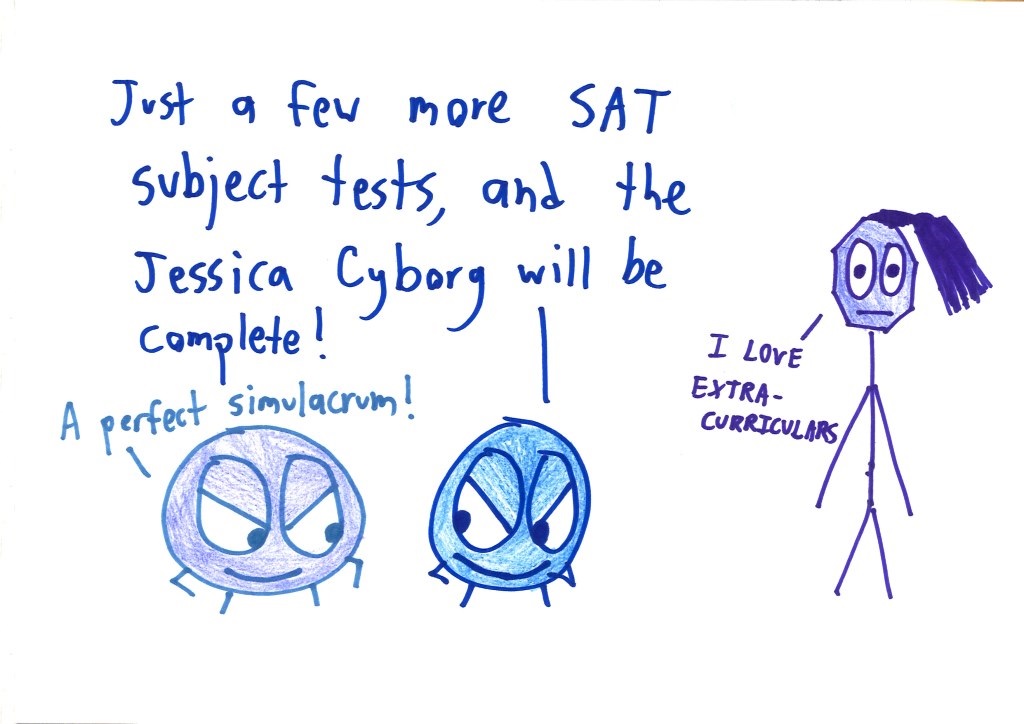
I get why they want all that information. But all this data puts a mask of intimacy on what is fundamentally a factory process. No matter how sincere their intentions, the Yale admissions team is beholden to grim statistical reality: 94% of students are getting rejection letters, period.
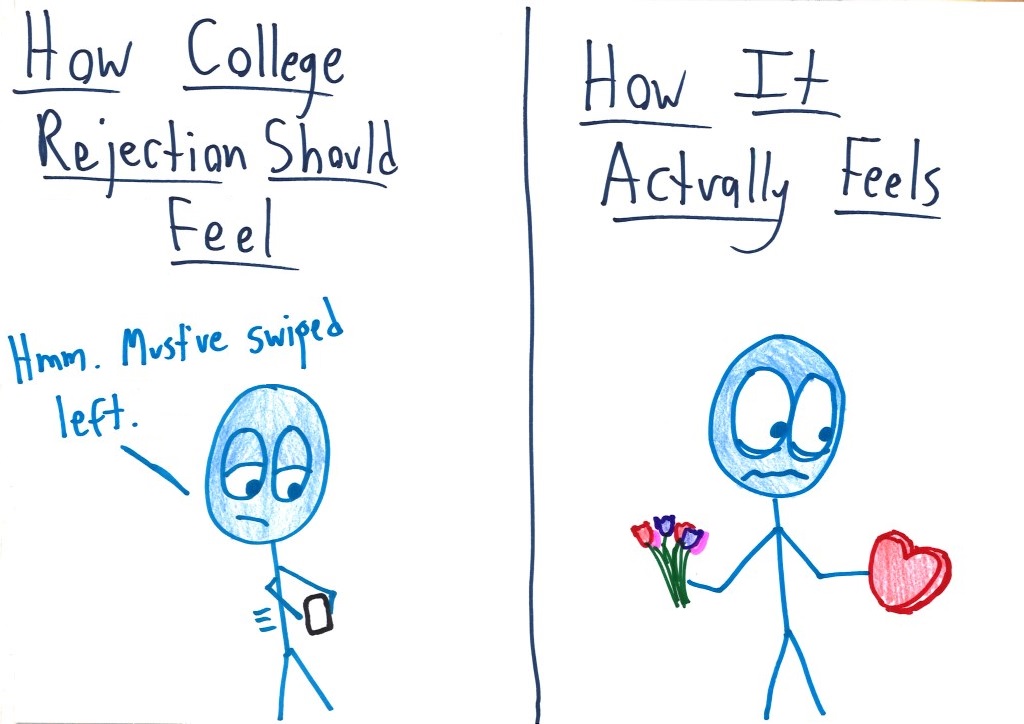
Being rejected by a university ought to feel like getting swiped left on Tinder. There’s nothing terribly personal about it. They don’t really know you. The university is just looking out for its own interests, and you don’t happen to fit into the picture.
But between everything—campus tours, information sessions, supplemental essays, test scores, transcripts, letters of recommendation, and alumni interviews—the application process becomes a lengthy and weirdly romantic courtship.
Rejection feels less like turning down a first date than getting left at the altar.
Long story short, that’s why I’m not doing Yale alumni interviews anymore. As much as I loved my college education, it drives me crazy to be the face of a process that’s unpredictable, opaque, and (at least 94% of the time) disappointing.
I find myself compelled by the so-crazy-it’s-gotta-be-right proposal of the psychologist Barry Schwartz: run admissions by lottery. Says Schwartz: “Every selective school should establish criteria [for admission]…. Then, the names of all applicants who meet these criteria would be put into a hat and the winners would be drawn at random.”
Before you write Schwartz’s proposal off, remember this. Currently, we’ve got a random process, disguised as a deliberative one.
Why not take off the mask?
 Math with Bad Drawings
Excellent post. What really amused me are the hand drawn pictures. Lovely.
I totally agree. I hope you start your own college and use the Schwartz method of admission decisions. I will tell all the kids I know to apply, common app or no.
Can’t even imagine our family being anywhere near qualified for one of these. That said, I am so glad U of M rejected me and I had the very positive experience of being in the honors college at Michigan state. And my own kids got their undergraduate degrees at small private schools, and thrived there. Sometimes, that is, often, rejection turns out to be a good thing.
An official draw would be it. Great idea, cost-effective and leaving those rejected with the right mind-set.
Good for yuo, I say!
I stopped reading motivational letters for admission to my Toulouse University rural college in France when I realized they were superficial and thus of very little help in determining applicant suitability.
I think I would have made the same choice you did. Accept I would have created my own box stating “aw hell no” with a check next to it. Good man.
An already fascinating subject of selection process in Yale written with perfection and then added a color of cute drawings to give whole thing a comical touch has really elevated the level of this informative blog.
Your drawing is better than mine
What a great read. Brilliantly written👏
Reminds me of my interview!
REJECTION HURTS! BUT WHY SO MUCH? | thepinkpages92
https://thepinkpages92.wordpress.com/2015/10/09/rejection-hurts-but-why-2/
Check out my blog💗
Brakes my heart the driven-Yale kid. Upon rejection he should celebrate and start to give a hand.. ‘Cause who wants to sell his heart and tie his mind when all the world is shining?
Read this in the LA times yesterday. Thought it was great. Although it’s rather sad that it has to be that way. I can see why you don’t want to go back, that has to be as stressful for you as the students waiting to hear whether or not they get in. Thanks for the great read and info! Love your illustrations by the way 😉
…And these are the kids with then guidance to know how to navigate the application system! I work with largely first-gen students at a rural two year, and this process is so far beyond their ken, it’s not funny. Yet brilliant young people enter and emerge here… and they may point their kids toward the Ives… Your’ re so right–reform is needed, but from where I am situated, I think the US system still allows for real transformation. Thanks for a thoughtful, thought-provoking post!
Apologies for the typos above! I hit ‘send’ before I meant to!
Ok, why is this post attracting so much comment spam?
What a brilliant post. Well Written! Loved the little images. One hell of a well presented piece of work.
Check out my blog: https://www.facebook.com/fatemahhayyatphotography
It’s all about my photography and how each image has a funny backstory. I want to inspire people with my images. Check it out, and if you think I am worthy of a follow or a like or even a share. Go ahead. No one is stopping you 😉
I pasted the wrong link….OOOOOOPS! My Blogs URL is: https://fatemahhayyatphotography.wordpress.com
nice
Cute post. I wish they were building robot doppelgängers. I’d buy one and send it to work for me.
After reading this I’m more scared of applying to college next month and I most probable won’t be applying to competitive schools
Follow me and see all of aur phrases
Much of an eye opener to so many and great read
Reblogged this on .
Ben, this is a fabulous read.
Did you do those doodles as well? Because they are really well done and funny
Also, I never knew that such processes are random. I thought that the council really goes through each student individually to pick the best student.
Guess I shouldn’t be surprised because the scholars in my nursing course are really not that fantastic? They are only there to fill the quota of foreign students.
This article has given me lots to think about
Thanks
Cheers!
Nurfatma
Well written…I liked your artistic way of telling the fact with images…its simply superb..
My blog URL https://cininatarajan.wordpress.com/
Love this raw type of writing. Lol
In France we have an equally a full admission system for the “grandes écoles” : it comes first with an opaque selection with your high school marks to get into à two years no life prep school and then it goes with a nation wide contest… The lottery looks fine to me!
https://natetheprovost.wordpress.com/2015/10/12/the-giver-and-the-taker-all-summed-up-in-one/
Read it through and through…..check it out and leave a comment pliz
follow me? 🙂
I love this. Great drawings. Being from Connecticut, I’ve got a soft spot for this stuff. So many of my own classmates tried to get in in the 90s with zero luck. Snarkily good drawings, too! actyankeegoeswest.wordpress.com
I didn’t apply to Yale, or any ivy league school for that matter. This is why.
Great post, and good for you for standing up for what you believe.
Hey, I heard from my dad’s friend, who used to do harvard interviews during the 2000’s, and they say it’s completely random. ‘Let’s say the passing score is 90 out of 100, a hell lot of people get passed, now what, you can’t do another interview? No choice but random.’ Coming from his words, and I want to ask you your thoughts on this.
Félicitations pour ce post 🙂
Try http://www.yobboo.wordpress.com
I would never hope to get into Harvard or Yale because I see those students jumping to the top of their respective fields without ever experiencing the hard work that it takes as you try to work your way up the food chain instead of having someone giving it to you without the experience. Those who start at the top and DO NOT understand what it is like to work their way up, or get stuck in a stagnant job because of the snob mentality at the top, create rules that they learned in a book, or a the top of a corporate ladder, and more often than not, hold back the company if they don’t cause complete failure. Those who don’t move up through the knowledge of the company can get complacent more easily because they are held back for reasons such as ‘we can leave them in their position because they are good at it, and we need someone in that position who knows what they are doing’. Yes, they DO know what they are doing, and without those people, the company would, and often does fail as they no longer see reasonable pay increases, declining benefits, and zero upward mobility, and eventually, getting laid off before they can achieve a reasonable retirement after putting heart and soul into the company for many years. The top of the corporate chain looks at everyone but themselves as expendable until one corporation buys other companies and corporations, and kicks out all of the top level with less than they feel that they were worth (even though they may not have had any value toward the company in the first place).
Follow me
This is great.
Super interesting to get a behind-the-scenes look at getting acceptance into an Ivy League education. In Australia, you literally apply online and if you get the grades you get accepted. I don’t agree with either method entirely but the American method seems far more intimidating and (dare I say it)…a little unfair? Although in Australia, you don’t get your acceptance based on extra-curricular involvement, sporting attributes or even anything else…only academics!
Yes yes yes! Thank you! This is fantastic!
That’s totally accurate even for French Grandes Ecoles. Here the students write contest exams. If they are judged billiant enough, they go through orals and there, everything depends on the examiner’s mood when the kid is interviewed. No process at this point, just luck. We also a a sociology study that shows that kids who already have a feeling of belonging in the place have a higher success probability than the kids who don’t.
Yes the unfairness of it makes me sick. But you can’t really do without it so… You might as well accept it! You never know what the future holds, you might get accepted somewhere else and end up happier than you would ever be in this particular school. 🙂
Very nicely written, and your illustrations were bang on the money. You have written something that’s dark and discouraging for most people but your way of writing, coupled with those illustrations, just made it all a breeze to go through. Kudos!
Better nothing than the wrong people and situations around you fulling your life with toxic thoughts and energy
I say, as a former dean (counselor) at Scarsdale HS for many years, you are absolutely right. Your creativity in explaining the process, if you wrote your college essays this way, no doubt helped keeping admission committee members awake as well as earning you a place at Yale. The competition and pressure can hardly be overstated–extremely talented and smart high school seniors competing for relatively few spots.
Your roll of the dice is a good analogy. Omitted, however, is the influence of legacies and other connections. They don’t replace being a rock star, but they can tip the balance–all else being equal.
I put a sign on my door every April: “Don’t let your self-image be affected by your college acceptances/rejections.” If I were still counseling, I’d put your post on my door next spring.
This is really interesting–I am currently a 17 year old applying to some top colleges, and I’ve always wondered about the admission process. It always seemed very random to me, and it’s nice to have this hunch validated by someone working in the field.
I love all your drawings and especially the one that says: how college rejection should feel, and how it does feel. There is so much truth to your comparison of tinder and how it really does feel. Good read.
What an insight!!!!
Fantastic
Reblogged this on #shyamis and commented:
all are not cutes
Applications to most top colleges in the world happen on a random basis. It is exactly like choosing the ingredients of a trail mix!