Last year, I conducted alumni interviews for Yale applicants. It’s an easy gig. You take a smart, ambitious 17-year-old out for hot chocolate, ask them about their life, and then report back to the university, “Yup, this is another great kid.”
I recently got an email asking me to re-enlist. Was I ready for another admissions season?
I checked “No,” mostly because “Aw, hell no” wasn’t an option.
Why my reluctance? No grudge, no beef, no axe to grind. It’s just that the whole admissions process is so spectacularly crazy that participating in it— even in the peripheral role of “alumni interviewer”—feels like having spiders crawling out of my eyeballs.
In the last 15 to 20 years, Yale’s applicant pool has gone from “hypercompetitive” to “a Darwinian dystopia so cutthroat you’d feel guilty even simulating it on a computer, just in case the simulations had emotions.”
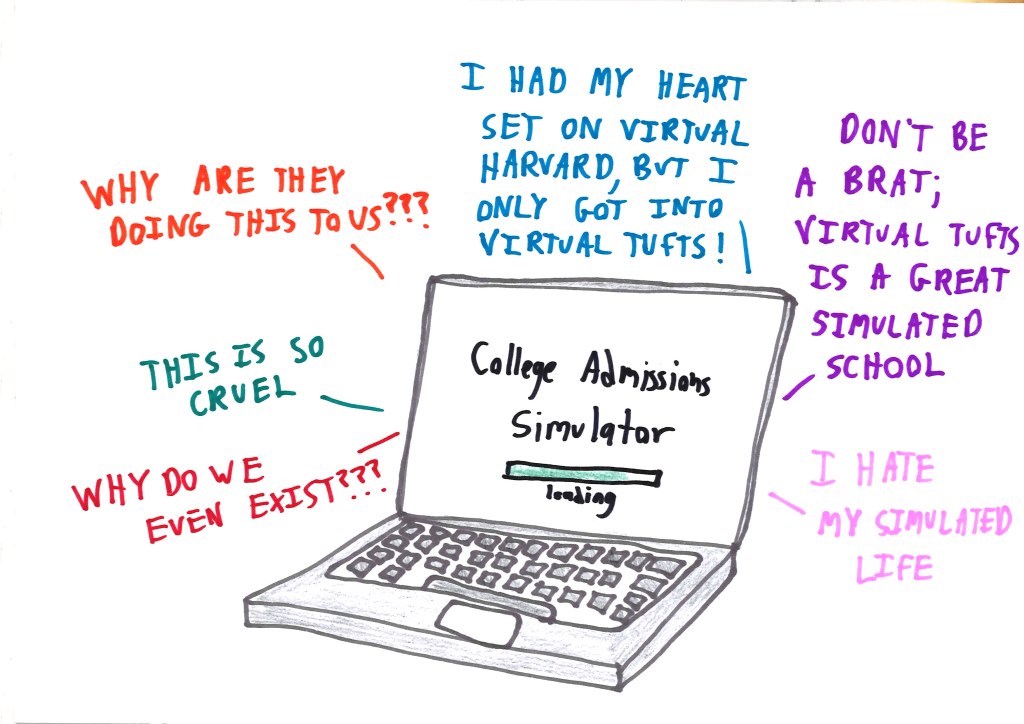
I don’t fault the admissions office. For every bed in the freshman dorms, twenty kids are lining up, at least five of whom are flawless high-school rock stars. From that murderer’s row, they face the impossible task of picking just one to admit. There’s no right answer.
But two things freak me out about this process.
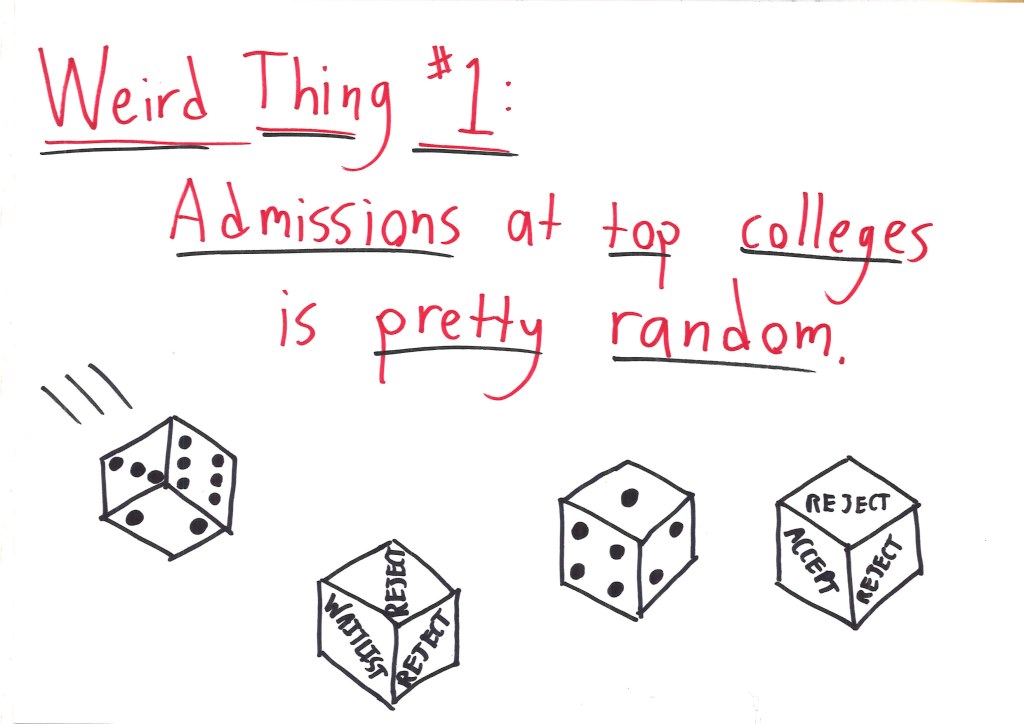
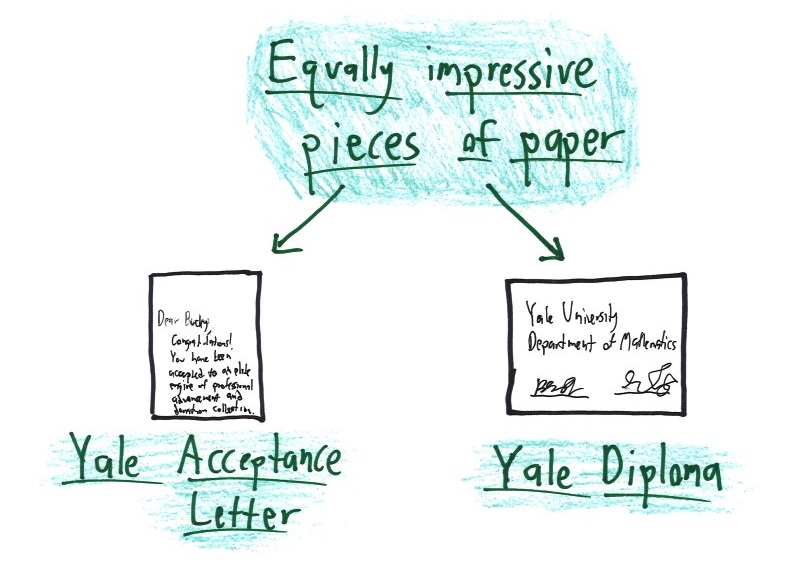
You may have heard this chestnut: “The hardest thing about getting a Yale degree is getting accepted in the first place.” For me, it rings true. Thousands upon thousands of the rejects from Yale would have thrived there, if they’d just gotten the thick “yes” envelope instead of the thin “no” one. (That includes the five totally amazing kids I interviewed last year, none of whom got accepted.)
Dozens of people have asked me, “Wow, how did you get into Yale?”
Not a single one has ever asked, “Wow, how did you manage Yale coursework?”
With so many uber-qualified students lining up, top colleges don’t—as you might expect—look for the “very best.” They don’t even operate on a single, well-defined notion of what “best” means. Instead, they pick and choose. They go for balance. They’re just trying to fill their campus with a dynamic, diverse cohort of freshmen. Consistency and “fairness”—whatever that would mean—have nothing to do with it.
It’s like making a trail mix. I don’t care whether this particular peanut is more “deserving” than that particular chocolate chip. I’m just choosing high-quality ingredients to strike a nice balance of flavors. Nothing more.
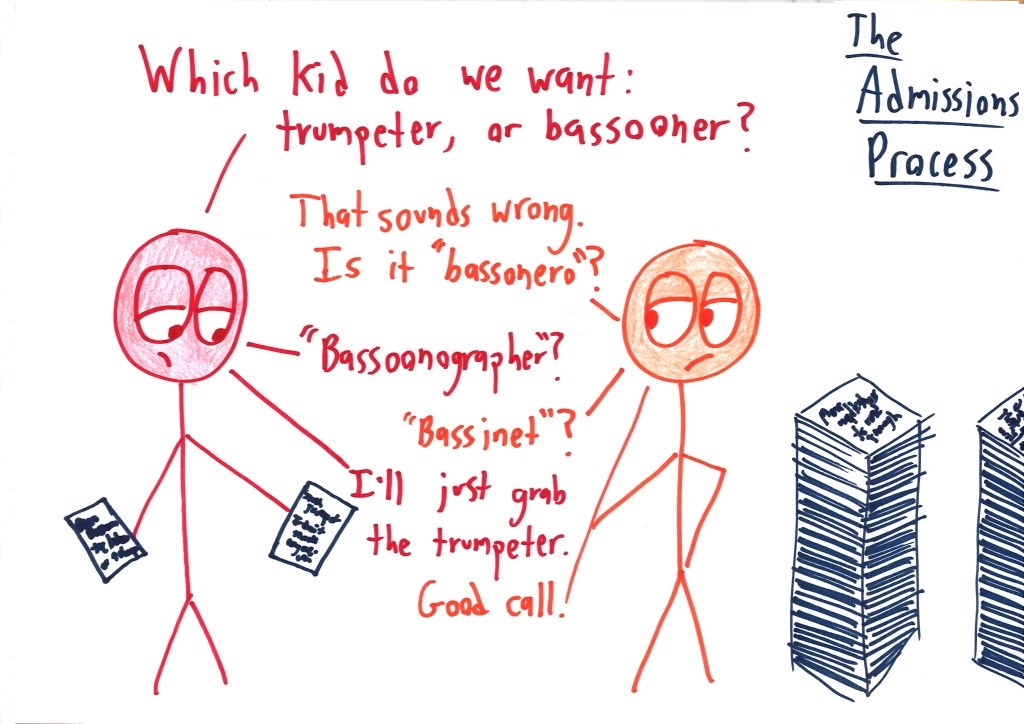
It might not be “random” from the university’s perspective. But it is from the students’. One year favors trumpeters, the next favors bassoonists, and kids have no way of knowing whether their particular skills will be in demand this time around.
All this wouldn’t be particularly troubling, except when coupled with this fact:
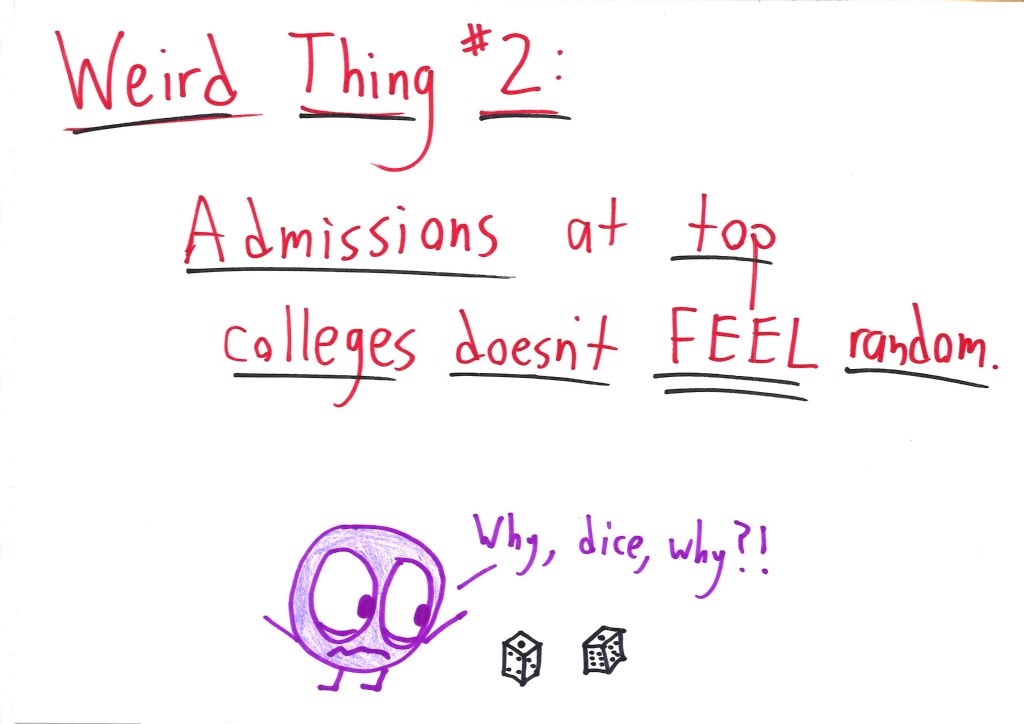
Just look at the demands of the Common App. “Write me a confessional essay. Document your leisure activities in meticulous detail. Muse on a philosophical question. Tell me what you love about my school. Give me testimonials from your teachers.”
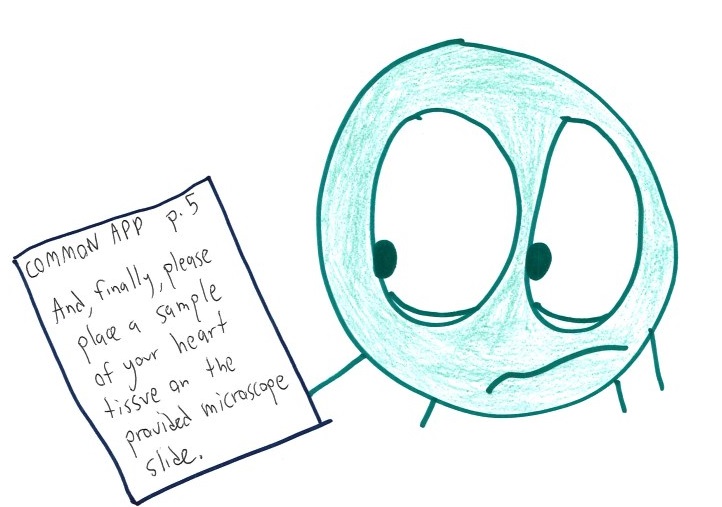
The application becomes an autobiography, an audit of your whole self: ambitions, achievements, convictions. The process feels customized, personalized, complete. Before they make a decision, Yale insists on peering into your very soul. (Either that, or they’re gathering the data to build your robot doppelgänger.)
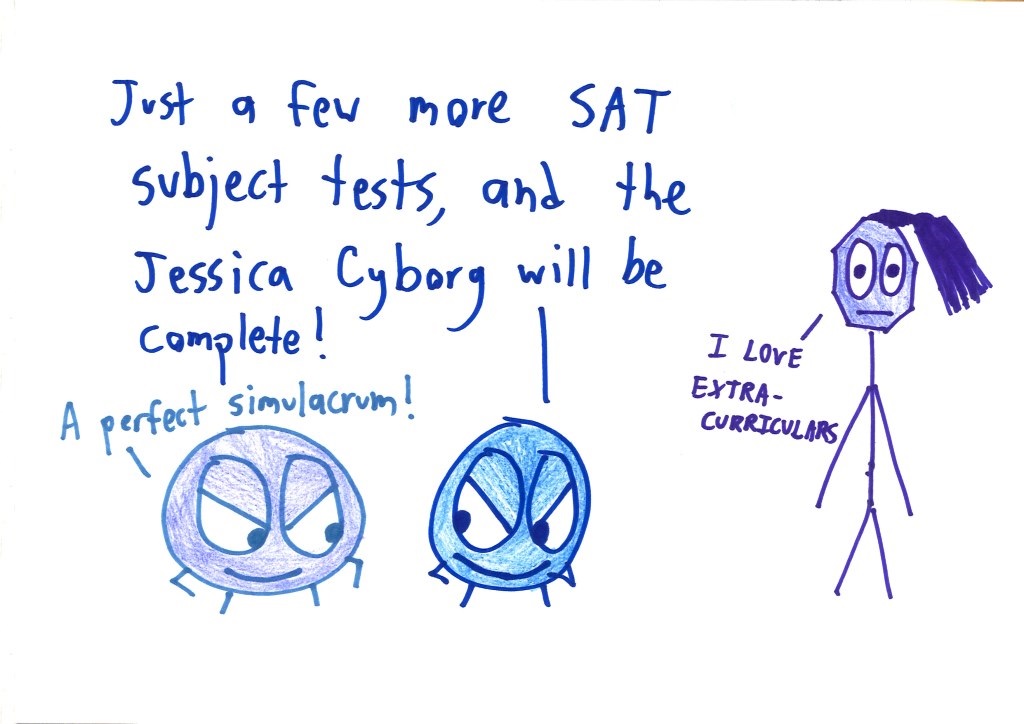
I get why they want all that information. But all this data puts a mask of intimacy on what is fundamentally a factory process. No matter how sincere their intentions, the Yale admissions team is beholden to grim statistical reality: 94% of students are getting rejection letters, period.
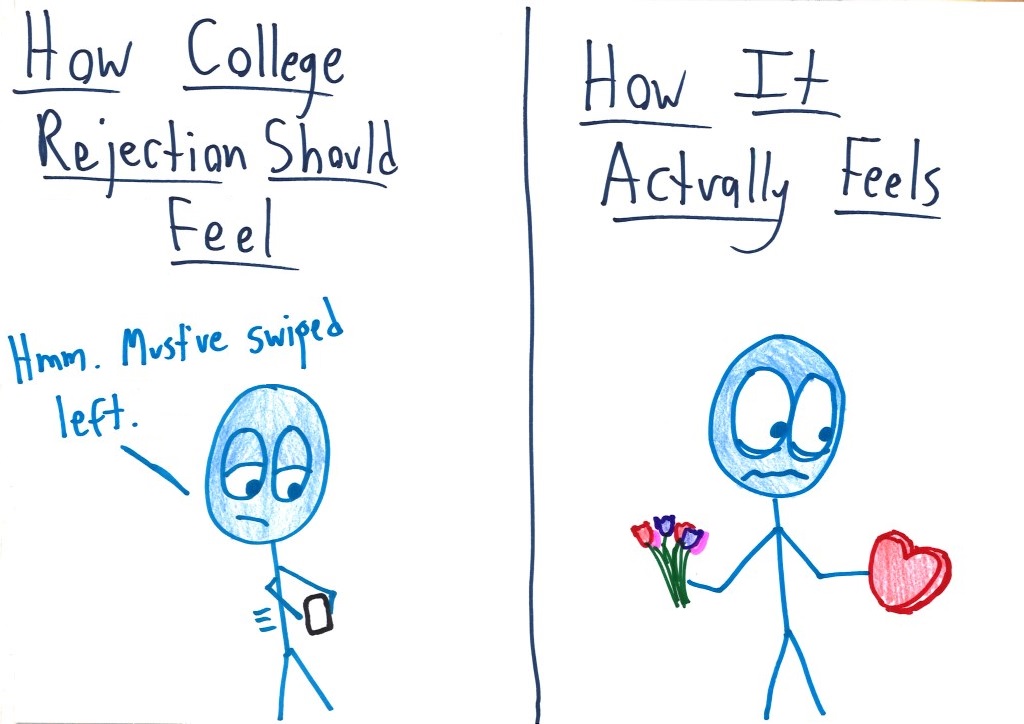
Being rejected by a university ought to feel like getting swiped left on Tinder. There’s nothing terribly personal about it. They don’t really know you. The university is just looking out for its own interests, and you don’t happen to fit into the picture.
But between everything—campus tours, information sessions, supplemental essays, test scores, transcripts, letters of recommendation, and alumni interviews—the application process becomes a lengthy and weirdly romantic courtship.
Rejection feels less like turning down a first date than getting left at the altar.
Long story short, that’s why I’m not doing Yale alumni interviews anymore. As much as I loved my college education, it drives me crazy to be the face of a process that’s unpredictable, opaque, and (at least 94% of the time) disappointing.
I find myself compelled by the so-crazy-it’s-gotta-be-right proposal of the psychologist Barry Schwartz: run admissions by lottery. Says Schwartz: “Every selective school should establish criteria [for admission]…. Then, the names of all applicants who meet these criteria would be put into a hat and the winners would be drawn at random.”
Before you write Schwartz’s proposal off, remember this. Currently, we’ve got a random process, disguised as a deliberative one.
Why not take off the mask?
 Math with Bad Drawings
This is fabulous.
I concur! It’s perfectly illustrated & written. Pls email me when you publish your 1st book. I am already hooked. Oohhh and add illustrations to books (so I can be sure my tweens and teens will read them).
Vibrant.kisa@yahoo.com
I hope they read that.
This suggestion reminds me of an interview about airport security that I saw once; the point the security expert made was that one should truly pick people at random for extra screening, since any other method will necessarily be game-able and simply introduce biases.
In other words, I like this idea.
As is so often the case, you’ve written a post that gets right to the heart of the matter in a fun and understandable way. Both of my sons have gone through this wacky and odd admissions process and lived to tell the tale, but it wasn’t fun for any of us. I was involved only as a proofreader of Statements of Purpose, Letters of Intent, and Statements of I’m Sort of Smart but Have No Money So Please, Please Accept Me and Also Fund Me, but graduate school admissions seem just as surreal and random.
Oh, my goodness!!!!! The only thing that grabbed me on this page is the “Bassooner” part. 😛 I just started learning bassoon this fall as an attempt to have it look nice on college apps…so that was just the awesome part of my day. Thank you for that! 🙂
And of course, the blogpost was realyl helpful and informative as well.
Thanks!
sqq100 | rockandminerals4him.wordpress.com
You’re focused on the good ones who get rejected (by bad luck, whimsy, etc.) – however, what about those who the process might actually help screen OUT? Say 5 of the 20 are great, and maybe 6-10 could be good too…. OK, but is there merit to help distinguish from #11 vs. #5? Or similar?
Having said that – yes, it is all fairly challenging, likely not well-controlled or guided enough to really achieve what could be a useful qualitative signal. (that’s why I wrote at length for years about the madness of college admissions – from BOTH angles)
Yeah, I gather that the process consists of a nonrandom phase (narrowing it down to the top 15-20% of the applicant pool) followed by a random phase (choosing 1 in 3 students from that already-narrowed pool).
What I like about Schwartz’s proposal is that it doesn’t really change the first phase, other than insisting on greater transparency. It’s the second phase only that would become a lottery.
We have been using a national Schwartz system for NL MedSchool admissions for nearly 50 years. Positive side effect: gross pp profits form attending MedSchool have been estimated without serious bias. Experiments with ‘decentral’ selection haven’t shown room for improvement yet.
As a student who has gotten into (and gotten rejected from) selective schools, I love this idea. Nothing emphasizes the reality of the lottery system more than getting into a highly-ranked university shortly after getting rejected from one much, much lower on the list. (Sorry about how this sounds – I’m trying to be anonymous, not snobby.)
The only thing I would add would be to limit the number of schools students can get into–if it’s a lottery system anyway, and a student gets picked in the lottery for his/her first choice, then don’t let them get picked for their second choice. We resolve this with the waitlist system, but we could eliminate that step (and, therefore, eliminate students feeling they’re “second best” once they get in off the waitlist).
I often like mathwithbaddrawings, but this one seems particularly on point. Even at moderately selective schools, having a clear “qualified” line, followed by random drawing would be a big improvement over the current “biases of the anonymous admin officers” approach.
Hi, Ben.
“Currently, we’ve got a random process, disguised as a deliberative one.
Why not take off the mask?”
I think those two lines sum it up in a nutshell. Beautifully said.
Furthermore, I think the same can be said for the hiring process (when students leave school and start sending out resumes.) But that’s another topic for another time.
I was going to comment nearly the same thing, though in particular with the academic hiring process. Since being on the hiring committee a couple of times my advice to anyone on the academic job market – for their self esteem’s sake – has been to recognize how much randomness is involved. Narrowing down the candidates by merit typically leaves a completely unorderable set. Then it’s down to the personal preferences of the faculty who happen to be on the committee that year. And “merit” itself may or may not be an objective notion in the first place…
I love this post and the cartoons! Especially nice how you compare it to dating.
Lottery sounds good. Who are they kidding? One student was accepted because he played cello and the orchestra needed a new cellist. (We were told this on one of our college tours at another university.)
This was such a refreshing article to read. I applaud you, and admire you for taking your stance. I have often said that parents need to push back on this whole process. It is so crazy and deflating, because as you pointed out these kids have to pour their hearts out and then it does make it feel like a personal rejection rather than a best fit for both sides.
Truthfully, I have decided it has become a money making process, especially when we read an article that schools have even stooped to recruiting kids so they can get reject more and get their college rankings up. Yale, MIT and Harvard even sent my son letters that they were interested in him and none accepted him. So many qualified kids apply there why did they bother doing that.
I think if a school is looking for an bassoonist , and other specific talents that should be stated with a comment that others need not apply that year. I also feel Early Admissions and Early Decision should be abolished as they too feel like a marketing ploys. Furthermore, they push senioritis earlier. My daughter found that the majority of classmates who knew where they were going just slacked off!
Really enjoyed the levity of your drawing style and cartoons!
Bassoonist? Cellist? Are they a music school? Competitive entrance exams in selected subjects would be infinitely better.
You don’t typically commit to a subject until the end of your 2nd year. Schools do also look at some subject-specific standardized tests (APs, SAT II’s). But at the most selective places, these aren’t enough of a basis for distinction, because there are still too many students with top scores.
Hmmm. Maybe, then there could be a 2-year “orientation” basics for everyone who wants it. Those two years could be used as preparation, a taste of something, then there could be exams, and university entrance afterwards. Why doesn’t it happen in high school, if it is full of electives and homeworks and whatnot?
This is pretty much the model in the UK, where I teach now, and it has some advantages. The process is less overblown. It doesn’t suck up children’s souls in quite the same way. It’s more predictable, and less opaque.
On the other hand, I think the broad American B.A. is a better degree for most purposes than the specialized European B.A. If you’re staying in academia, specialization is great. If you’re not, it doesn’t do you much good, and foreclosing your options so early is a shame.
Personally, I wouldn’t want to require American students to specialize, the way that A-Levels force British students to do so. I like the breadth and variety of American education. But it does make these admissions problems harder, because you’re admitting not just for a single academic department, but for an entire university.
Why is Yale or any other top tier school so desirable? Is it the prestige? Is it the education? Is it the alumni? Is it the network/tribe? Is it a tangible piece of paper diploma? Is it your first job? Salary? Or is it a feeling and the idea of what that the feels like to others? What if you could create a similar feeling in the community college ecosystem with greater numbers and effective job placement? #SuccessGenome
Never gonna happen. Getting into Yale, or even just being wait listed by Yale, is a signal that says you were smart enough or talented enough to get into Yale. Getting into community college says you have a pulse. In our CC system, many of the “students” read and write at elementary school levels.
I mean, I think community colleges are one of the coolest things about American democracy. Everyone with a pulse SHOULD be able to get an education.
A major function of undergraduate education right now is sorting/labelling students for the ease of employers. Obviously, employers like having the workforce sorted, with tags (like “Harvard graduate”) that are strong indicators of quality. We’re never going to eliminate that need for sorting. We can only hope to make the process more honest, accurate, and flexible, and less costly in terms of time, energy, and psychological toll.
In New Zealand basically anyone can get into university. We are a *lot* smaller though, which probably has a lot to do with making the system feasible. I’m not sure what it is with the new high school grading framework (NCEA) but when we had Bursary you basically just needed a C pass to qualify for University Entrance. Obviously some demanding programs you then needed to get much higher marks, but you could get into basically any *university* with Cs.
I quit doing alumni interviews for Yale years ago. Thanks for putting into words (and pictures!) what is so discouraging about the process.
Love it. I interviewed two outstanding people last year, one who I still think about all the time – I really think, with or without Yale, she is going to change the world. Of course, neither got in. I tried to tell them while interviewing that the fact that they got to the interview stage already meant they were qualified – and they were going to be highly successful wherever they went. Still – it is quite a painful process to be a part of. I often wonder if going in as an honest interviewer – and warning them that it can be a bit random at that point – is better than not taking part at all. I’m still deciding.
That’s definitely fair.
For what it’s worth, I don’t think my decision whether to participate has any impact whatsoever. I’m stopping simply because the fun of meeting clever, energetic young people is outweighed by the unpleasantness of engaging in a crazy process.
Reblogged this on wonderwall.
Hear, hear!
Reblogged this on Shawn M Weisser.
Brilliant. It really is a lottery, not only at Yale but at all of the top 50 or so colleges and universities. And you didn’t even mention the “early decision” circus.
Perhaps, instead, Yale should confine the pool of applicants it will consider to those 17-year-olds who reside in zip codes between 06450 and 06549?
That is, it is not at all clear to me why random selection among qualified applicants should not apply to other levels of the education system. Say, kindergartens, or high schools. That a qualified applicant may be forbidden by law to even apply for admission to his or her preferred institution because of “zip code” and “attendance zone / bus route boundaries” and ” ‘reasons’ ” seems inherently unfair. Even more unfair if there is some sort of discontinuous step-change in the overall education process that only kicks in at age 17.
This is the system utilized in higher education in Sweden, and I think most of Europe as well. I get the impression that it leads to less focus on extracurriculars and stuff like that. Unless you want to force young kids to turn their hobbies and personalities into a competition for college admission, I think that’s a good thing. I think it’s rather bizzarre that anything other than academic aptitude should be taken into consideration.
I met someone around 2002 who was a Yale grad from the early 90s who had worked in admissions as a work-study student. He (yes, as a student) read applications and put them into 3 piles: Definitely Yes, Definitely No, and Maybe. He then took the Maybe pile and randomly put them into “yes, no, waitlist, yes, no, waitlist, yes, no, waitlist.” So as much as a matter of fact that you can take from a random person leaving a post on a website who is a degree separated from the actual person who experienced this randomness, the admissions process at Yale IS random.
@NC: I think it would be more reasonable to conclude from what you wrote that there is a random element in the admissions process for some students, if we accept that the judgments that went into placing students in “Definitely Yes” and “Definitely No” were not random.
Further, you are making an assumption here that I would not: that only one person at Yale in 2002 made decisions on admissions for a given applicant. That seems highly doubtful.
I graduated with you from Yale, and I continue to do alumni interviews. I worked in undergraduate admissions at another competitive university, and the reason why I continue interviewing against these odds is because the alumni interview is now more of a recruiting tool than a make-or-break application component. The AO doesn’t have the capacity to reach an applicant in all corners of the world, so the interview is actually a way for the AO to have a conversation with the applicant about Yale through the interviewer and make sure that the applicant has a friendly face to associate with the University. In that respect, I do think the interview is still a worthwhile exercise.
Love your blog, which I discovered when this post was posted on my Yale Class Facebook page. I also did Yale alumni interview for only one year, and interviewed several impressive young people who did not get in. This was over 25 years ago, when admissions rates were actually in the double digits, but I still felt that my contribution to the admissions process was minuscule and that admissions decisions were made according to some elaborate, unknowable algorithm. I am now a parent of a high school student so I see the process from that point of view, and I totally agree with the lottery plan. You mostly focused on the angst of senior year, but I think the worst part of the current system is the way it affects the previous three years of high school – the constant stress of wondering whether every missed test question, or hour spent on sleep rather than yet another extracurricular activity, is going to be what keeps them out of their dream college. A lottery system would mean that kids would know that if they achieve certain benchmarks, then they can spend the rest of their time on whatever they wish, since the rest is a crap shoot anyway.
Yale is a good unviersity…
Your proposal of random admission (of those who are qualified) is slightly different than your description of what happens now (an attempt to construct a diverse, well balanced class.) Neither is fair or within the control of applicants, but they are different. Although perhaps extracurriculars shouldn’t impact admissions as much as they do, some consideration of non-academic factors do impact the quality of life on campus. So perhaps the current system is one step better than random. Your argument that the system should be transparent is still valid.
THANK YOU, THANK YOU, THANK YOU. I am all for the Schwartz plan. What we have now is sick. I think the lottery plan would also help bring home the point that there are plenty of interesting, bright, motivated, etc. students at NON-ivy league schools, thus beginning to break down the mindset where every ambitious high school student thinks she needs to attend an ivy to not feel like a loser. Admission to college should be the finding of the best fit for student (at that moment in his life) and school, rather than a prize and bragging rights for the whole family. As an alum myself, I took my son to an information night, and he had the wisdom to remark: “It’s not for me, mom. Yale is looking for kids who don’t actually need to go to college. They want people who know everything and can do everything already.” 🙂
Wonderfully uplifting refreshing thoughts! Unfortunately, this selection process is not quite random nor just applicable to Yale but to most colleges/universities in the USA. Throughout the USA these essentially socio-engineered microcosms continue to reinforce stale social, political and economic ideas and perceptions in attempts to “balance out their student body.” A truly random process, after criteria has been met, would be enlightening for all. Thank you for sharing these fabulous thoughts!
Scott:
The problem is not just Yale’s which is why this member of the Class of 1982 wilI continue to interview for Yale ASC.
The issue is the Common Application and the low barrier to entry to submitting 15-20 applications with a click of a button and Mom’s credit card. The colleges love it because it drives up revenue from applications and it makes the college appear to be more difficult to get into since the % of admittees goes down (look at the University of Chicago’s numbers from the past few years as they started accepting the Common App). Buried in footnotes is that the yield of admittees who actually accept the offer of admission is out of whack as of result of this higher education game of roulette. By Colleges accepting the common application, applicants are in response exhibiting two behaviors that I don’t like. One is when I ask what they thought of the Yale campus they say they have never been (even though they insist it is their first choice – btw I am not interviewing economically disadvantaged kids here but kids from the best high schools and prep schools in the Boston area who arrive in a nicer car than I did at Starbucks) and second is the number of students that apply to all 8 Ivys, Williams, Amherst, Middlebury, Tufts and Trinity etc. without batting an eye as to the fact that even though they have no intention of going to Williams unless it is the only place they get in they may be possibly preventing someone who has Williams as their first choice from getting in. Darwinian indeed and completely unnecessary and inefficient.
The solution is to go back to when we were in high school and the application process was long, arduous and difficult – completing the application for Harvard, Yale or Princeton was a test in itself – and perhaps that would cut down on the number of “me -too” or “while I am at” applications. Short of that limit the number of colleges you can apply to to five. Not perfect but better than it is today. Because in the end right now – you are right it looks and feels like a lottery – no ryhme or reason and an inefficient one at that and I am sure it will start to show up in alumni development numbers – maybe not at Yale because we have David Swensen as a backstop but at a number of high quality schools who may not be Ivy but are fantastic places to go to school and who are missing out on future dedicated alums because the admissions office is sorting through 15,000 applications from people who have applied just in case and therefore are missing out on the kid whose scores and grades may not scream admission but whose dream in life always has always been to bleed blue, red, green, purple etc.
The common app feeds this problem but so do the schools and their relentless marketing, including Yale. My child had a very high PSAT score and was then literally swamped with letters, emails, brochures praising her great accomplishments, telling her what a great candidate she is, and imploring her to apply. These things seem really personal and meaningful but they are sent to thousands and thousands of students, far more than could fill a freshman class.
I have done Yale ASC interviews on and off for 25 plus years and feel similarly fed up. The other thing that makes it seem like a courtship is that these schools, Yale and others, literally inundate high school kids with emails, brochures, etc. essentially begging them to apply. It’s like a person hounding you to go on a date and then when you finally break down and say yes, they say ‘oh well, I also asked out thousands of other people and I’ve decided to go out with them instead. But thanks for saying yes (and giving me $70).” Not to mention the schools get higher rankings and notoriety as “hardest to get into” by pumping up the number of people they lure into applying so they can report an absurdly low acceptance rate.
Same thing happened with my youngest son. When I saw it my thought was “Why do Yale, MIT… recruit? They get so many qualified applicants already? I would imagine all those kids they reached out to got thrown applicant pool which all leads to the conclusion for me that today’s process has become a huge money making process for the schools.
Error above: meant to say “thrown into the same applicant pool”
” has become a huge money making process for the schools.”
Seriously? Yale’s financial aid awards were well over $100 million last year. They application fees they collected totaled less than 1% of that amount. I’ll let you do the math to figure out whether they are making money.
You have some valid points, and I enjoy your strip very much. But giving up interviewing after one round hardly qualifies you as an expert in the process. I’ve been interviewing for Yale for 20 years. I’ve seen the acceptance rate drop from 20% to 5% in that time. Some of that is a demographic bulge without a proportional increase in freshman slots. There was also a large jump in applications when the Common App became available. But even when the acceptance rate was 20%, many qualified applicants did not get in. Most of the applicants I interview are quite aware of the seeming randomness. Interviewing them gives you an opportunity, though, to reinforce the fact that their future success doesn’t depend on the school they get into.
Change ‘Yale’ to ‘Northwestern,’ and I could have written most of this.
Spot on with identifying the problem.
Unfortunately, these perceptions that rejected = not good enough, even when false, are good for the University, good for the people who do get in, and probably help boost Alumni giving. So it’s not likely to change.
The recruiting isn’t about app money; it’s about rankings. Rankings are based on percent admitted. Larger the app pool, the better the stats look.
I cannot tell you how glad I am that my kid has no intention of applying to any of these schools. Not because the admissions process is ridiculous, but because no BA on earth is worth that kind of money. Not even the net-price money.
Frankly, I think there should be a screen-out on the $60K COA schools before you’re allowed into the main app:
1. Is your family rich? Y/N
2. Like, really rich? Like the lawyer comes to see your father, and instead of saying how much money your parents have, they talk about worth, and you find it irritating when your friends don’t show up on the same continent you’re spending a couple of months on? Y/N
3. Are you brilliant and willing to explore a life of Xanax and alienation from your astronomically wealthy “friends”? Y/N
If you have not answered Y to 2 or 3, here is a list of schools that would be perfectly happy to have you.
I agree that the admissions decision process is a ridiculously inefficient and dumb operation for the universities. For students and their parents, the college decision process is a good one. That’s not to say it’s easy, fair or a good use of time. That process, starting in 9th grade and continuing on through until the student selects his/her lucky college/university, provides for maturing the student to a state where they’ll be ready for college and it provides them and their parents with a real-world example of how you work through a difficult and important decision. The student and parent have a lot of elective decisions along the way…how many schools to apply to, which ones to apply to, what tests to take, what schools to visit, on and on. Far too many parents and students are not strategic and efficient about this process. They bring a lot of the most stressful pressure on themselves. Parents of college-bound students, look at this as a great opportunity to work with your kid to make the best decision possible given the options and constraints.
Super interesting insight, thanks for sharing. Great job with those drawings too!
Sxs
You have foumd out and you have actually seen what all of this is about. That is one of my principles all of them break all the time.
Funny yet quite insightful
1. Your drawings are fabulous.
2. I attended college and med school/graduate school at state universities. I’m now completing residency in the Ivy league (Hah-vahd). My colleagues at all of these institutions are/were of comparable caliber; a (much) greater percentage of those I work with currently do get their hair and nails done more often, live in amazing condos, and drive sick cars (thanks to mummy and daddy), though…
3. Due to 1 and 2 as above, and because your writing style is of that lovely glib variety, I find this piece fascinating. Well done you.
Love the illustrations!
Love the blog. ahkllc.com