The second in a series of seven fables/lessons/meditations on probability.
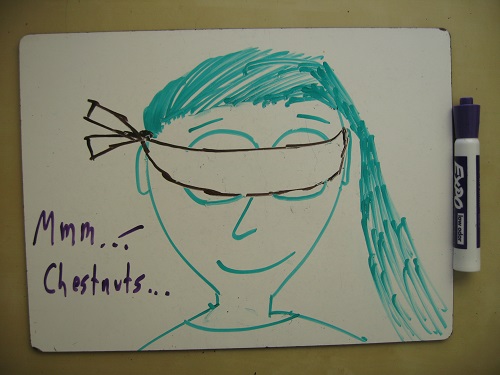
When the chestnuts finished roasting, a sweet aroma filled the kitchen. The student was about to dig in when, out of nowhere, a blindfold appeared in front of her eyes.
“No peeking,” the teacher warned.

The student heard the chestnuts being poured. “Now,” the teacher said, “I have divided your chestnuts among three bowls.
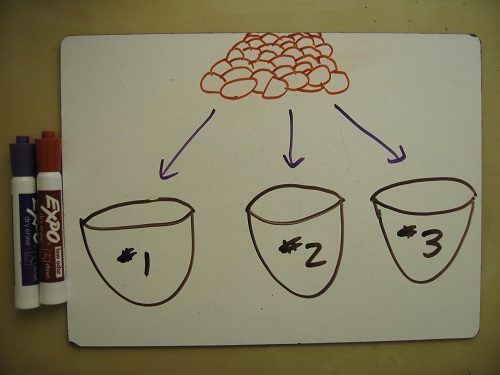
“I’ve also taken ten pieces of wasabi root, and carved them into the shape of chestnuts.” The teacher laughed. “These will not be to your liking. Bite into one, and your eyes will cry rivers, while your nose burns like a dragon’s.
“Now,” the teacher continued, “I am dividing my ten wasabi chestnuts among your delicious roasted ones. Six wasabi into the first bowl.” The student heard six plinking sounds. “Three into the second bowl.” More plinking sounds. “And one into the third.” Plink.
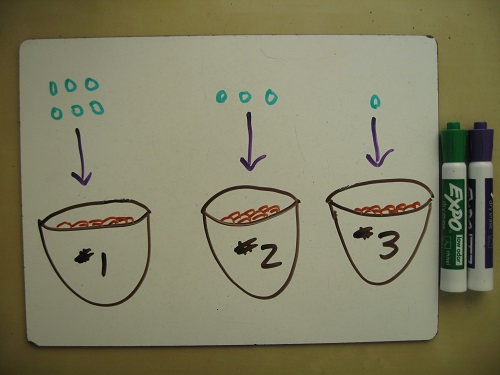
“You may reach into one bowl,” the teacher said, “and draw a chestnut at random. Which bowl do you choose?”
“The third, obviously,” the student said. “It only has one of your devil chestnuts.”
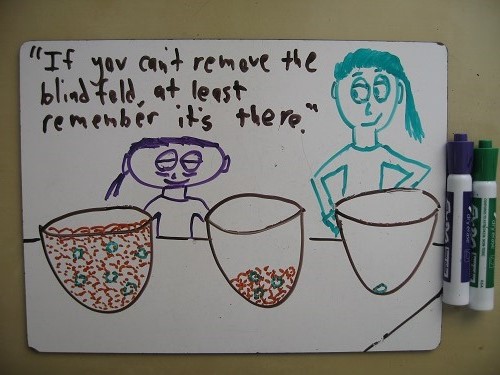
The student’s hand groped around the third bowl, but found only a single chestnut. Throwing off her blindfold, she saw that its color was a pale wasabi green. Peering into the bowls, this is what the student saw:
|
Bowl |
Regular Chestnuts |
Wasabi “Chestnuts” |
|
First |
100 |
6 |
|
Second |
20 |
3 |
|
Third |
0 |
1 |
“That’s not fair!” the student said. “You tricked me.”
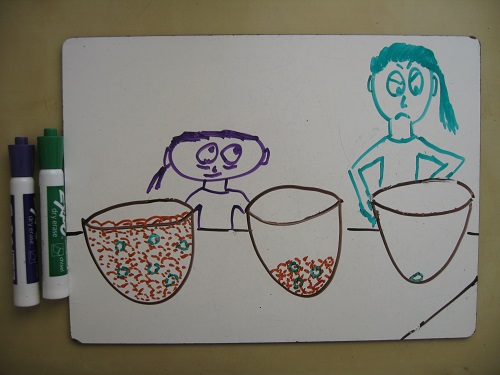
“You tricked yourself,” the teacher said. “Why did you believe that the third bowl would be the best?”
“I figured the bowls would all have the same number of roasted chestnuts.”
“Why? Did anyone tell you this?”
“No,” the student said. “Once you said ‘three bowls,’ I just assumed you’d split the good chestnuts equally.”
“So what have you learned?”
“Well,” she said, “a probability is all about context. It doesn’t really matter how many wasabi nuts there are. It matters how many wasabi nuts there are compared with the other nuts. Even though the first bowl had the most wasabi, my probability of getting one was lowest, because there were so many other nuts, too.”
The teacher nodded. “What else?”
“You’ve got to know what information you’re missing, and what assumptions you’re making.”
“What else?”
“Never make a decision blindfolded.”
The teacher laughed. “An impossible wish. We’re all wearing blindfolds, every moment of our lives, and they come off far less easily than this cheap piece of cloth.”
“Then what should we do, when we can’t take the blindfold off?”
“Do the best you can,” the teacher said, “and never forget that you’re wearing it.”
Further Thoughts
First takeaway: A probability is a ratio. It’s the number of outcomes you’re interested in, divided by the total number of outcomes. A probabilist must remember that the numerator (in this case, the number of wasabi “devil chestnuts”) isn’t all that matters. You’ve also got to pay attention to the denominator (in this case, the total number of chestnuts).
Second takeaway: We often make hidden assumptions (in probability as in life). You can’t avoid making assumptions altogether—for example, without any assumptions, the student could never have chosen a bowl—but it’s important to know when you’re making them. The assumptions that torment us most are the ones we’re unaware of.
Get the pdf, or check out other stories in the series!
I’d like to thank my father, James Orlin, for providing some foundational ideas for these stories, as well as helpful feedback and conversations. Also for being one sly dog.
 Math with Bad Drawings
http://xkcd.com/169/ . Nuff said.
Ah, old-school XKCD!
Generally, I agree. If information is given in a deliberately misleading way (in the comic’s case, exploiting linguistic ambiguity), you can’t blame someone for being misled.
But in this case, the information isn’t so much misleading as incomplete. We should be able to recognize gaping holes in our own knowledge of a situation, whether or not they’re pointed out to us.
If the student had asked, “How many GOOD chestnuts are in each bowl?” and the teacher had lied or dodged the question, then the student would have cause to complain. But as it is, that was an obvious question to ask, and she didn’t ask it.
The information was misleading! You claimed, “I have divided your chestnuts among three bowls”, but you only divided the chestnuts between two. Therefore, your claim was as spurious as if you’d said any number of bowls. Still, it’s a good lesson, especially because recognizing and communicating assumptions can be quite difficult and is rarely done effectively.
why can’t one of the amounts i split the chestnuts into be 0?
I have to confess, I now agree that it’s probably a little misleading (though not on the level of the deception in the XKCD example).
Fair point! I guess you could fix that misleading-ness by putting precisely one chestnut in the third bowl.
The update of belief, I guess. As the student assumed that it is easy to find chestnut the third bowl when She was blindfolded. And when she opened her eyes and found out that there was no real chestnuts, it updated her belief.
Hmmmm…another story in the light and in the dark.
Your stories are reminding me a little of the book “The Number Devil.” It is one of my very favorite kids math boks.
My wife’s too! I haven’t read it, but I think it’s sitting on her shelf–I’ll have to go steal it.
You DEFINITELY need to steal that book soon. It’s fantastic.
It’s now on my desk!
This brings up an interesting point: Ben, since I enjoy your approach to math, I’d be interested in what books you would recommend on the subject. Perhaps other readers would also be interested in this and in sharing their own suggestions. Thanks to UrbanMythCafe, I’m going to look up “The Number Devil”, and I would recommend “Why Do Buses Come In Threes?”, a little bit of light reading on the mathematics of everyday life.
Cool; I’ll add “Why Do Buses Come in Threes?” to my list.
As for math writing I like: Ian Stewart, Steven Strogatz, John Allen Paulos, and David Berlinski all offer interesting (and different) takes on mathematical topics. Simon Singh’s book “Fermat’s Enigma” and Paul Hoffman’s “The Man Who Only Loved Numbers” are both great. (I also taught “Freakonomics” in my Statistics class.)
I enjoyed the story, Ben. One minor comment is that probability is a ratio if each object is equally likely to be selected (perhaps another assumption we naturally believe, and probably true for your story when choosing chestnuts randomly). A loaded die may not have a 1/6 chance of rolling a 6, even though there is 1 outcome out of 6. I like your drawings, you are becoming quite the artist. Thanks!
Thanks for reading (and for your benevolence towards my “art”).
That’s a really good point. In the story, I’m assuming that all possible outcomes are equally likely. That’ll probably be true only if (1) The chestnuts are well-mixed; (2) The fake chestnuts are the same size/shape as the real ones; and (3) The student picks the very first chestnut her fingers touch.
I hope you and Erin are enjoying San Diego!
Reblogged this on Just another complex system and commented:
This is good story-telling and good math..:-P